
Customer Complaint and Resolution Tracking
Recording a complaint does not mean someone has taken responsibility for it. I build a screen that connects each complaint to an owner, a response target and the next action. The team can distinguish unanswered complaints, records awaiting customer information and cases that have genuinely reached closure.
This service focuses on the customer response and resolution process rather than replacing a technical service work order. A complaint can link to an order or service record while keeping its own communication history and status.
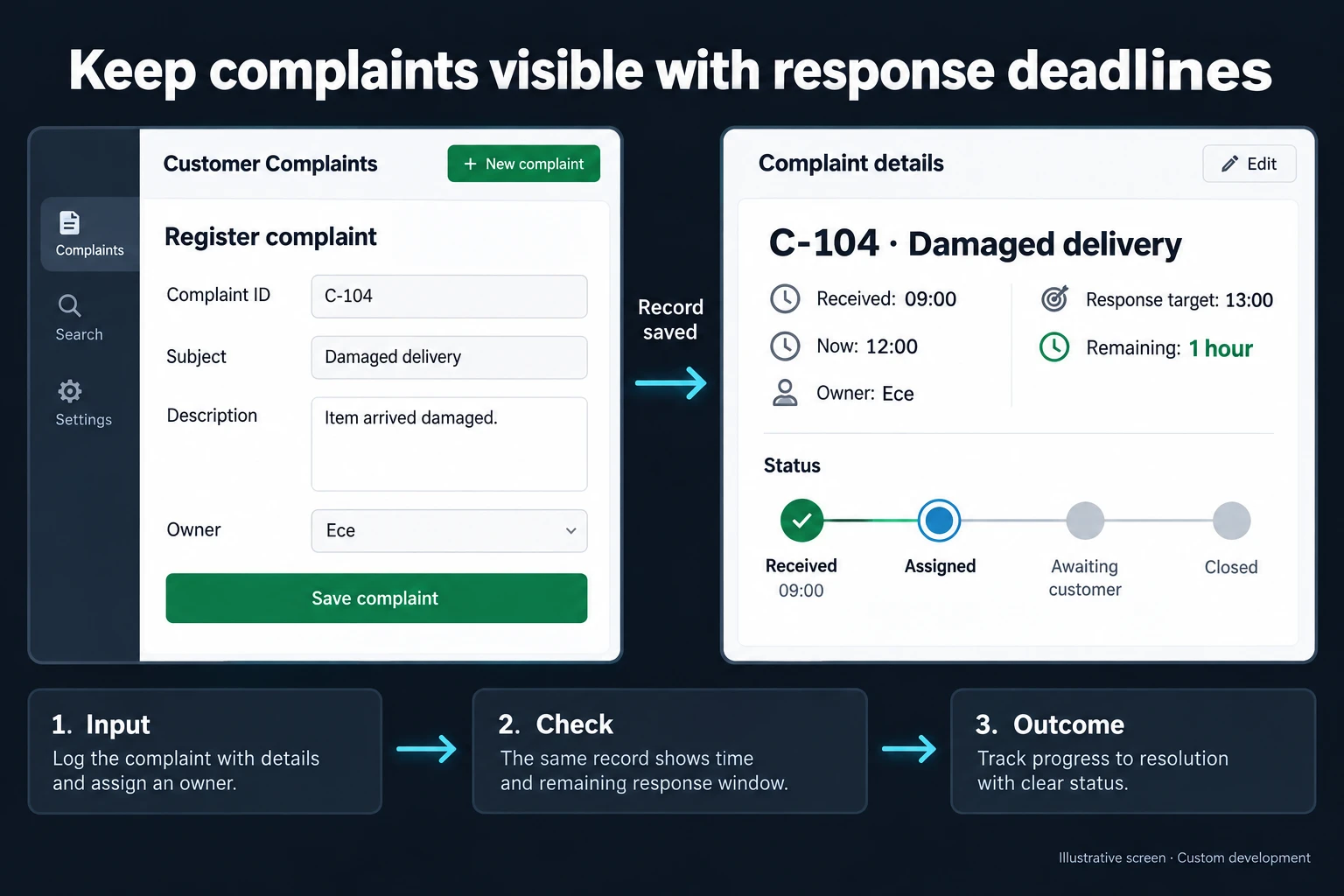
Example: One hour remains for C-104
The illustration is fictional. Complaint C-104 concerns a damaged delivery received at 09:00. Ece owns it, and the initial response target is 13:00. At the displayed time of 12:00, one hour remains. This is an example business target, not a universal legal deadline or a guarantee of resolution.
If Ece requests a photograph, the complaint may move to awaiting customer information. That does not mean the issue is resolved. The first response time is recorded, while any resolution target remains separate. A replacement or another remedy proceeds through the appropriate authorised decision.
Make the clock’s rules understandable
Elapsed calendar time and working time are different measurements. I establish whether weekends, after-hours messages and holidays affect the target. We also decide whether any timer pauses while information is awaited. Changing a status must not become an arbitrary way to improve the reported response performance.
If the customer writes again about the same incident, the new communication can join C-104. Similar wording alone is not sufficient to merge separate incidents automatically. Reopening a closed complaint preserves the earlier closure reason and starts a visible new sequence of actions.
Keep a suitable existing support tool
If your support or CRM system already handles the owners, targets and states you need, keeping it may be sensible. A basic spreadsheet can also work at a small scale. Custom development becomes useful when complaint handling must follow your own order, branch and decision rules. Customer-visible updates are defined separately from internal team notes.
Making the scope testable
I start with a de-identified example of your current file or screen and the roles of the people using it. The written scope defines where each field comes from, who can change it and where the result goes. I test after-hours arrivals, waiting for customer information and reopening C-104. The first response timer and resolution timer must remain distinct throughout those transitions.
The scope also covers exports, the backup approach and who handles failures. We review the first version against one real workflow before planning further connections.
Frequently Asked Questions
Does sending a reply automatically close the complaint?
No. First response and resolution are separate stages. I define closure conditions around your process, including the responsible person and the reason for closing the record.
Who receives an overdue complaint?
Its owner remains visible. A defined delay can trigger a manager notification or reassignment. Repeated notifications for the same open incident are controlled separately rather than flooding the team.
Can customers view their own cases?
That can be included. Customer-facing statuses and explanations are separated from internal notes, and access must be limited to the relevant customer’s records.
Discuss your workflow
For a related workflow, see Field Inspection Forms with Photo Evidence. Explore custom web applications for your team or contact me with an example of the process you want to improve.
How do I work?
Work-hour packages
Tell me about your business and what you need on WhatsApp or by phone; we agree on a work block of somewhere between 5 and 40 hours and I start doing what is needed. What you get is not a calendar window — it is net working hours spent directly on your business. I can use 40 hours working three days straight, or deliberately spread it out and finish it over a year — whatever the work calls for. I do not spend my time estimating how long something will take, I spend it doing the work; every hour I spend leaves a lasting result in your business. We keep going for as long as you find it useful.
Why not monthly?
Is 40 hours a week?
On a fixed monthly fee both sides are watching the wrong thing: you watch a fixed cost, the other side watches how many more contracts like this they can line up. Working by the hour puts us both in front of the same thing — the real value of the work that got done. I know not having an upfront answer to "how much will this cost in total?" is the natural cost of this model. But instead of paying a fixed fee for months to a setup that is not producing results, you only pay for the qualified time spent on your work — and you see exactly where that time went, start to finish. That is why my clients keep coming back.