
WhatsApp Multi-Agent Inbox and Assignment Panel
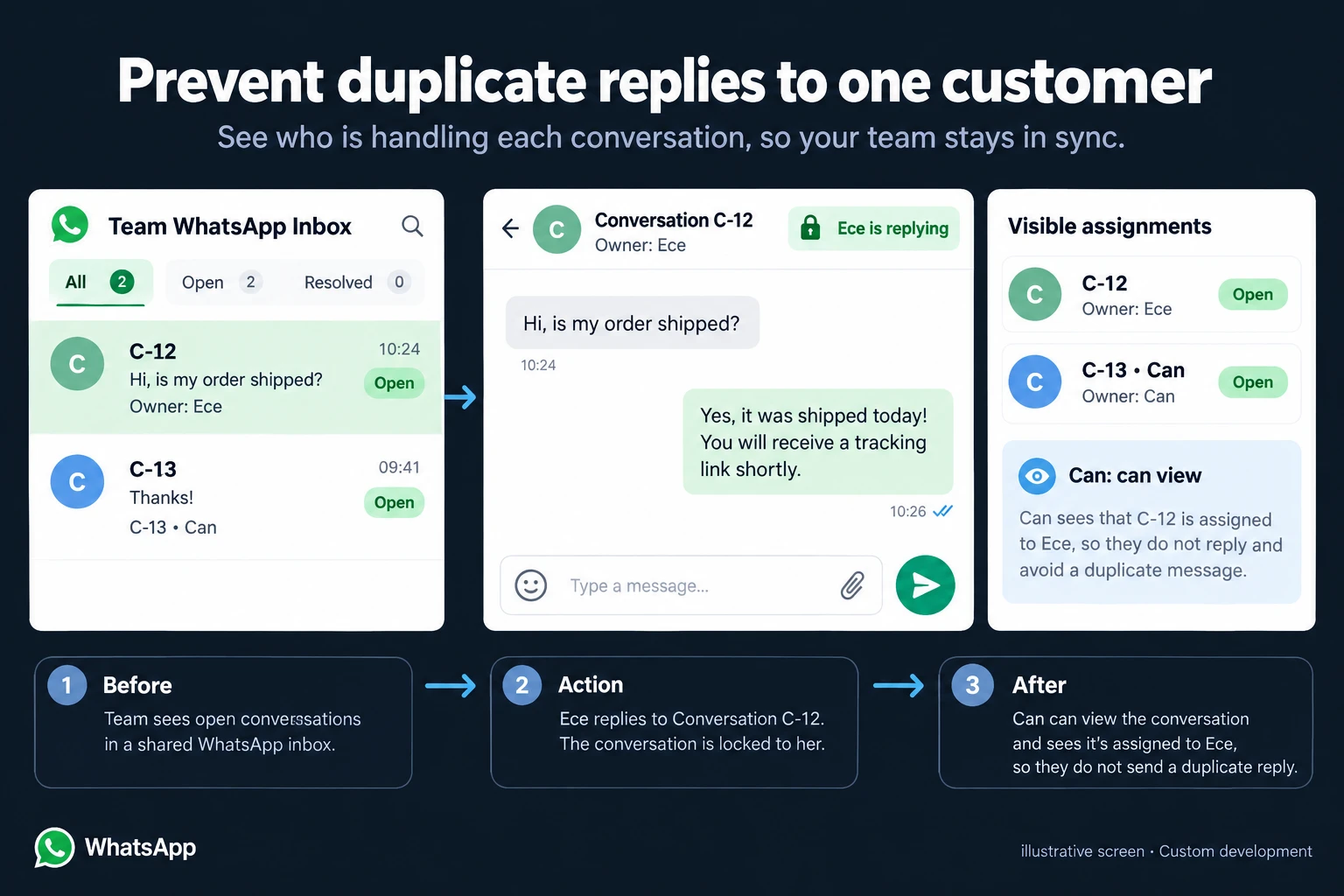
Two people can answer the same customer without knowing what the other person promised. One may offer a delivery date while the other is still checking stock. I build WhatsApp team screens that show the conversation owner, the person preparing a reply and the associated business record.
The handover follows your working process. Moving a conversation from sales to operations should preserve the outstanding question and previous commitments, rather than merely changing an assignee’s name.
Example: Ece is replying to C-12
In the illustrative inbox, C-12 belongs to Ece and C-13 belongs to Can. When Ece starts responding to C-12, the screen shows “Ece is replying”. Can can read the conversation but sees that another person currently owns the response.
A visible indicator alone cannot prevent a collision. Ownership and permission are checked again when a reply is submitted. If Ece loses her connection, the conversation must not remain locked indefinitely. An agreed expiry or an authorised takeover can release it.
When an existing shared inbox is enough
For basic assignment, labels and shared replies, an established inbox product may already fit. I review that option first. A larger team does not automatically need custom software.
A custom panel becomes more useful when the responsible team changes with the order stage, staff must see only their branch’s conversations, or a handover requires specific information. These rules can connect to role-based sales and operations screens.
Handling handovers and conflicting replies
The person transferring a conversation selects the next owner and records the pending action. The previous assignment remains in the history.
If a new customer message arrives while a reply is being drafted, the reviewer sees the updated context before sending. A manager takeover is a distinct action with its own reason and record.
Closing a conversation must not automatically complete its associated order or task. Those states have different meanings. When another team needs to make a decision, the conversation can produce an assigned task without losing the original message.
Connection and implementation
I use the official WhatsApp Business Platform or a supported provider connection. Account and number eligibility are checked before implementation. The scope defines conversation visibility, assignment rules, reply ownership and takeover permissions.
The messaging policy still applies. Permission and opt-out preferences must be respected, and approved templates are required outside the 24-hour service window. Assigning a conversation to another colleague does not restart that window.
I test simultaneous sends, handovers with an open draft and interrupted connections. The handover documentation explains how staff access is removed and how another team is added. Provider changes and new workflow rules are considered within the maintenance scope.
Frequently Asked Questions
Does everyone have to see every conversation?
No. Visibility can follow team, branch or record ownership. Access is enforced when data is requested, rather than simply hiding rows in the interface.
What happens when the owner is away?
An authorised colleague can take over, or an agreed delegation rule can assign cover. The history preserves who handled the conversation before and after the transfer.
Discuss your workflow
Describe how your team currently hands over a customer conversation. I can assess whether an existing inbox is sufficient and identify the rules that need a custom screen.
How do I work?
Work-hour packages
Tell me about your business and what you need on WhatsApp or by phone; we agree on a work block of somewhere between 5 and 40 hours and I start doing what is needed. What you get is not a calendar window — it is net working hours spent directly on your business. I can use 40 hours working three days straight, or deliberately spread it out and finish it over a year — whatever the work calls for. I do not spend my time estimating how long something will take, I spend it doing the work; every hour I spend leaves a lasting result in your business. We keep going for as long as you find it useful.
Why not monthly?
Is 40 hours a week?
On a fixed monthly fee both sides are watching the wrong thing: you watch a fixed cost, the other side watches how many more contracts like this they can line up. Working by the hour puts us both in front of the same thing — the real value of the work that got done. I know not having an upfront answer to "how much will this cost in total?" is the natural cost of this model. But instead of paying a fixed fee for months to a setup that is not producing results, you only pay for the qualified time spent on your work — and you see exactly where that time went, start to finish. That is why my clients keep coming back.