
Agentic AI Guide: AI Agents and Their Types
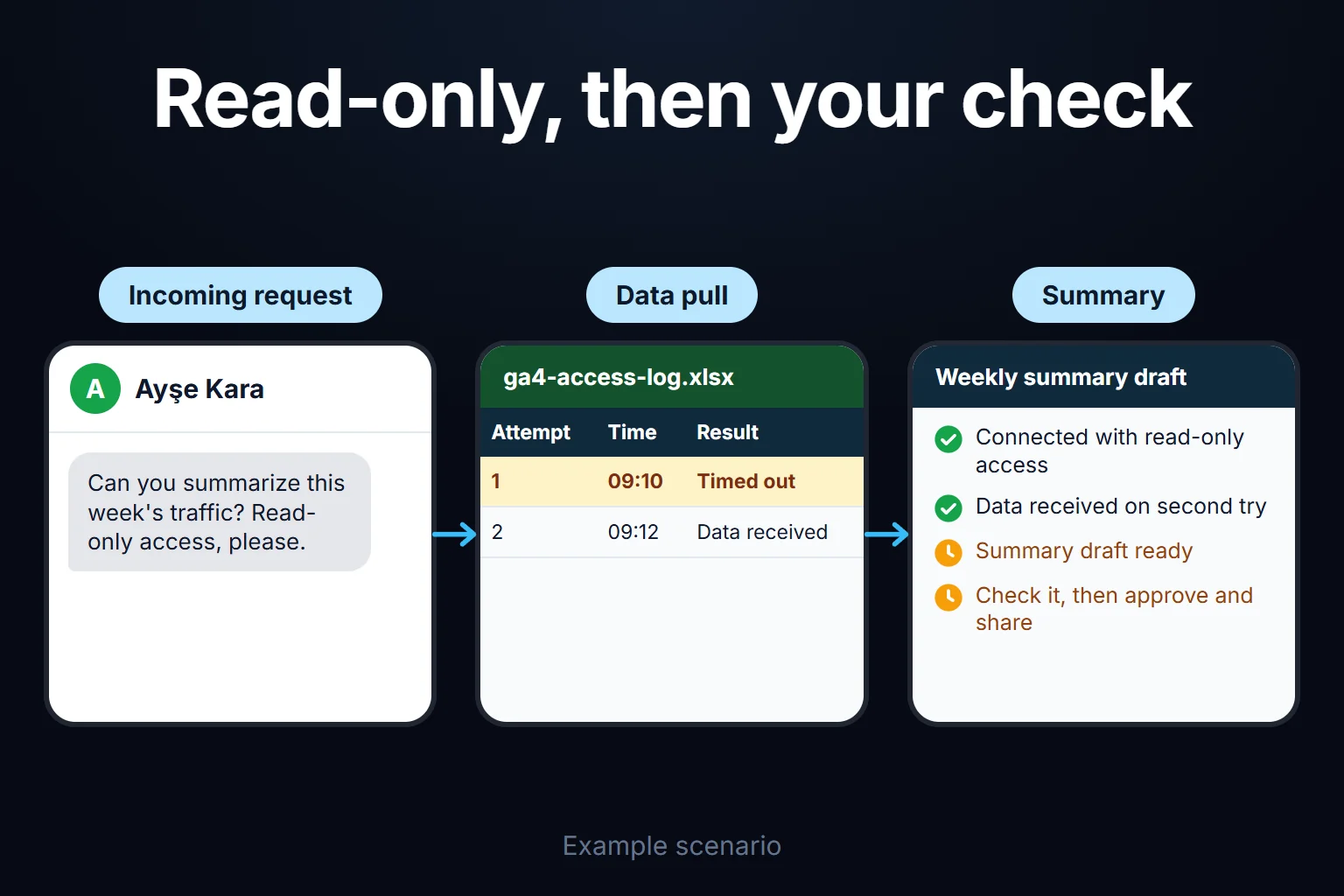
An AI agent is software that plans its own steps toward a goal you give it, uses tools, and checks the result. A chatbot answers a question; an agent does the job: it opens a file, connects to a tool, looks at the outcome, and retries if needed. Agentic AI is the general name for systems that work this way.
This page is a map, not a glossary: the articles below each cover one topic, and here you see which one fits your situation. You don’t need to read them all in order. If you’re new, the first three articles in the first group are enough; if you’re deciding between an agent and plain automation, jump to the second group.
One caution: not every job needs an agent. A task with fixed steps and fixed rules (writing every incoming form into a spreadsheet, say) is cheaper and more predictable as ordinary automation. An agent earns its place when the steps change depending on the situation.
Core concepts first
The terms get mixed up; this group separates them.
- What Is an AI Agent: the definition, how it differs from an assistant and from RPA, a real example.
- What Is Agentic AI: how it differs from generative AI, and what to watch for given the hype.
- AI Agent vs Chatbot: “answering” versus “doing the work”, and which one you need.
- AI Assistant vs Agent: whether the two words mean the same thing, and the risk of misusing the term.
- AI Agent vs LLM: the model (the brain) versus the agent (the system).
- AI Agent vs Agentic AI vs Agent Skills: the hierarchy of three terms: an approach, a system, a capability package.
- Types of AI Agents: from reflex agents to autonomous ones, the five main types and which job each suits.
- What Is a Harness in AI Agents?: the software layer that turns a model into an agent, and why the same model behaves differently.
Agent, automation, or how many agents?
- AI Agent vs Workflow: is an n8n or Zapier flow really an agent? A one-question test.
- AI Agent vs Automation (RPA): RPA runs on fixed rules, an agent interprets context; a hybrid setup example.
- MCP Server vs Zapier: a ready-made automation bridge versus a key handed to an assistant.
- What Is a Multi-Agent System: several agents with divided roles; when it’s needed and when it’s overkill.
Models, cost and limits
- What Is Claude AI, What Does It Cost: Anthropic’s Claude, pricing, use in Turkey, a ChatGPT comparison.
- Claude or ChatGPT: A Business-Use Comparison: code, writing, Turkish quality, price; an honest look.
- ChatGPT vs Claude vs Gemini in 2026: with a focus on Gemini’s Google Workspace integration.
- What Is a Token: why cost depends on tokens, and why Turkish costs more than English.
- The Context Window: how much text a model can process at once, and practical fixes.
- What Is Hallucination: why AI states wrong information confidently, and how to catch it.
- What Is RAG: the technique behind AI that answers from your documents, and its limits.
Connecting tools: MCP and Claude Skills
- MCP and API Guide for Digital Marketers: how agents connect to ad and analytics accounts, which platforms are read-only and which can write.
- What Is Claude Skills: reusable instruction packages that teach Claude a whole job.
- How to Write a SKILL.md: step by step, with a full example, no coding.
- Prompt vs Skill vs Agent: when each one is enough.
- Agentic AI Skills vs Tools vs MCP: a comparison table for the three concepts.
- What Are Agentic AI Skills: Claude Skills, general capabilities, and the resume meta-skill: three separate meanings.
- Claude Skills Marketplaces: how to evaluate third-party packages and what the risks are.
Safe and real-world use
- Is It Safe to Give an AI Agent Account Access: risk levels, safe-setup rules, data-protection notes.
- Briefing an AI Agent: context, task definition, constraints and success criteria.
- My Agentic Stack: Claude Code + Skills + MCP: a one-person setup and its honest limits.
- Claude Skills I Actually Use as a Consultant: weekly reports, GA4 summaries, SEO tone of voice, backup discipline.
- How I Manage My Google Ads Accounts With Claude Skills: access structure, reporting, and decisions that need human sign-off.
- Before You Put ‘Agentic AI Skills’ on Your Resume: the four competencies that should stand behind the buzzword.
If you prefer video
For more terms, see the Glossary of Autonomous AI Systems. If you’d rather watch, How Do AI Agents Work? and Give AI the Address, Not the Route are a good place to start; all videos are on the Agentic AI Skills page.
Frequently Asked Questions
Where should I start with agentic AI?
Read what an agent is first, then the agentic AI concept and the chatbot difference. If you have a decision to make, go to the “Agent, automation, or how many agents?” group.
Is agentic AI the same as an AI agent?
In everyday use they overlap. If you need to separate them, an agent is a single system; agentic AI is the approach behind systems that take a goal and work by using tools.
What is agentic coding?
A model that doesn’t just write code but also reads files, runs commands, runs tests and fixes things based on the result. Tools such as Claude Code and Codex CLI do this; see the harness article above for how they are put together.
Which AI agent should I pay for?
“Agent” isn’t one product; usually it’s a model subscription plus the tools that model can use. Write down the job you want done first, then try a model on that job. Prices change often, so check the provider’s own page for current figures. For model comparisons, see the “Models, cost and limits” group.
How do I apply this to my own business?
The lowest-risk route is to start small: pick one task, limit the agent’s access to read-only, and check the output yourself. The “Safe and real-world use” articles above cover access and briefing.