
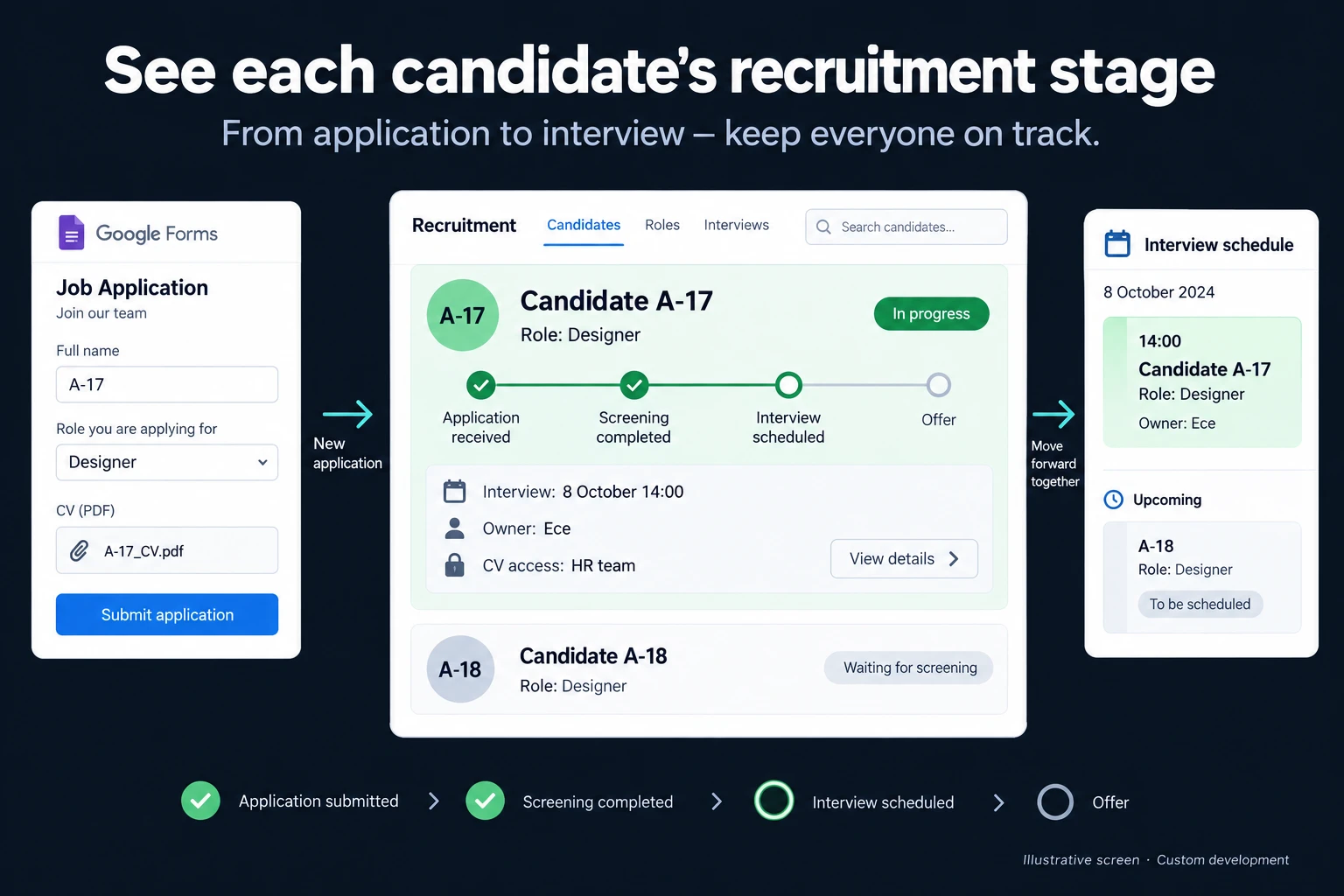
Applicant Tracking: Stage History, Duplicates, Scorecards and an Excel Setup
Applicant tracking starts by separating three records: the position, the candidate (the person) and the application (that person applying for one position). With that structure and a few COUNTIFS formulas, Excel shows duplicate candidates, candidates left waiting and rejection notices that never went out. The spreadsheet falls short not on calculation but on access: CVs in a file everyone opens, interviewer notes in personal inboxes.
Why are position, candidate and application three separate records?
Without the split, one result spills into another position. The position record says why the hiring exists: requesting department, who approved the headcount and when, number of hires, shop-floor or office role, status. The candidate record holds name, phone, email, CV and the date the privacy notice was given. The application links the two and carries stage and decision. A press operator rejection then does not close the same person’s forklift application, and a withdrawn headcount approval shows all its applications together.
For a candidate with an earlier application, the rule I suggest: HR sees its date, position and outcome; the new interviewer does not see the old interview notes, written against other criteria. Ask your lawyer whether this meets the purpose-limitation and minimisation principles that apply to you.
Stages: the date and owner of every transition
Every stage change is a movement row: application number, stage, date, owner, note. Overwrite a status column and you lose when the interview ended and who held up the decision.
| Stage | Shop floor | Office | Owner |
|---|---|---|---|
| Screening | yes | yes | HR specialist |
| Phone screen | no | yes | HR specialist |
| Interview | yes | yes | Line manager + HR |
| Test or trial | machine trial | technical test | Line manager |
| Offer | yes | yes | HR manager |
| Start | yes | yes | HR specialist |
Rejection and “withdrew” can come at any stage; when a position is cancelled, each linked application gets a “Cancelled” movement. A rescheduled interview is a new row at the same stage.
Example: one half-year at a 450-employee automotive supplier
The company, positions, people and every number are fictional; each figure comes from a Python script tested with asserts.
An automotive parts supplier opened 14 position records in one half-year: 6 shop-floor roles (CNC, press, welding, quality inspection and forklift operators, maintenance electrician; 25 hires) and 8 office roles (8 hires, excluding the cancelled one). A logistics planner position lost its headcount approval and was cancelled with 23 applications. Applications from a careers-site export, email and referrals sat one row each in a single Excel file.
| Stage reached | Shop floor | Office |
|---|---|---|
| Applied | 780 | 319 |
| Passed screening | 312 | 98 |
| Phone screen | – | 54 |
| Interview | 168 | 29 |
| Test or trial | 74 | 15 |
| Offer | 31 | 8 |
| Start | 24 | 6 |
30 of 33 positions were filled and 9 offers declined. The file showed:
- 1,160 rows, 978 people. Besides 1,099 applications, 61 rows were a second application to the same position (careers site and email). 100 people applied for several positions. Of 182 rows belonging to someone already on file, 56 differed in phone or email, 8 in both.
- 194 applications waited more than 10 working days for an answer: 98 at screening, 96 at a later stage. With no stage dates in the file, the team could not see this.
- 187 of 1,019 rejection or cancellation notices never went out: 23 for the cancelled position, 118 email applications rejected at screening (the bulk email only reached careers-site flags) and 46 whose decision stayed in an interviewer’s inbox.
- In 58 of 197 interviews the assessment lived only in email; the file said “positive” or nothing.
- 64 people had applied in earlier half-years; those records sat in another file, unseen before the interview.
Where do the candidate sheet and the inbox break?
- Everyone in one file. An interviewer who opens it also sees CV links and other positions’ notes. Microsoft states that worksheet-level protection is not designed as a security feature; hiding a column does not separate access.
- The stage is overwritten. Who has been waiting, and for how long, goes unanswered.
- Duplicate rows. The same person arrives twice with another email or a differently written phone.
- Notes stay in email. The decision reaches the file late or never, and so does the rejection notice.
A three-table setup: candidate, application, stage movement
If you stay in Excel, use four sheets: Position, Candidate, Application, Movement, plus Holidays.
Candidate: A CandidateID · B Name · C Phone · D Email · E Phone10 · F CleanEmail · G Check
The example’s 1,160 rows are the old file pasted in as-is; afterwards each person keeps one row and the formula flags new duplicates.
E2: =RIGHT(SUBSTITUTE(SUBSTITUTE(SUBSTITUTE(SUBSTITUTE(C2," ",""),"-",""),"(",""),")",""),10)
F2: =LOWER(TRIM(D2))
G2: =IF(OR(AND(E2<>"",COUNTIFS($E$2:$E$2000,E2)>1),
        AND(F2<>"",COUNTIFS($F$2:$F$2000,F2)>1)),"Check","")
COUNTIFS applies all criteria together; ranges must be the same size (Microsoft: COUNTIFS). Column E reduces any phone format to its last ten digits; adjust to your national format. In the example, the uncleaned check catches 116 of the 182 rows, the cleaned one 174. Without E2<>"", 23 blank-phone rows count each other as duplicates. The last 8 surface only by name, a match that also paired 2 sets of different people. First records are flagged too, so 311 rows show “Check”.
Application: A ApplicationID · B CandidateID · C PositionID · D Source · E LastStage · F LastMove · G Waiting · H OtherApps · I SamePosition · J RejectionNoticeDate
E2: =XLOOKUP(A2,Movement!$A$2:$A$9000,Movement!$B$2:$B$9000,"No movement",0,-1)
F2: =XLOOKUP(A2,Movement!$A$2:$A$9000,Movement!$C$2:$C$9000,"",0,-1)
G2: =IF(OR(F2="",E2="Start",E2="Rejected",E2="Withdrew",E2="Cancelled"),"",
        MAX(0,NETWORKDAYS(F2,TODAY(),Holidays!$A$2:$A$30)-1))
H2: =COUNTIFS($B$2:$B$3000,B2)-1
I2: =COUNTIFS($B$2:$B$3000,B2,$C$2:$C$3000,C2)>1
XLOOKUP’s last argument, -1, searches last to first (Microsoft: XLOOKUP), so Movement rows are only appended, never sorted. Excel 2016 and 2019 lack XLOOKUP; there, add a key to Movement, H2: =A2&"#"&COUNTIFS($A$2:A2,A2), and get the last stage with =IFERROR(INDEX(Movement!$B$2:$B$9000,MATCH(A2&"#"&COUNTIFS(Movement!$A$2:$A$9000,A2),Movement!$H$2:$H$9000,0)),"No movement"). For F, use the same formula with Movement!$C instead of Movement!$B.
NETWORKDAYS counts both ends, so -1 gives working days elapsed, and MAX(0,…) stops a weekend movement showing -1: Friday’s movement is 1 day old on Monday. =COUNTIFS(G2:G3000,">10") counts waiting applications; exactly 10 does not trigger. In the example, 8 of 23 in-progress applications would show past it at half-year end. After merging people, column I flags the 61 second applications to the same position on 122 rows.
Movement: A ApplicationID · B Stage · C Date · D Owner · E Note · F PositionID · G FirstEntry
F2: =VLOOKUP(A2,Application!$A$2:$C$3000,3,FALSE)
G2: =IF(COUNTIFS($A$2:A2,A2,$B$2:B2,B2)=1,1,0)
Funnel (P-02, Interview):
=SUMIFS(Movement!$G$2:$G$9000,Movement!$F$2:$F$9000,"P-02",Movement!$B$2:$B$9000,"Interview")
In SUMIFS the sum range comes first. Column G counts a rescheduled interview once: 52 for press operator, where a plain COUNTIFS says 55 because of 3 reschedules. For missing notices, =COUNTIFS(E2:E3000,"Rejected",J2:J3000,"")+COUNTIFS(E2:E3000,"Cancelled",J2:J3000,"") returns 187 in the example.
Interview scorecards: how do interviewers score against the same criteria?
Notes like “good” or “positive” cannot be compared across interviewers; a scorecard turns them into criteria. Put 3–5 criteria on the position record, score each 1–4, and define each score in one sentence (1: could not explain, 4: explained with an example from their own work). The rule I suggest: interviewers score without seeing each other’s scores, and a gap of 2 or more on any criterion calls for calibration before averaging.
Example: B-0836, a process engineer applicant:
| Criterion | Interviewer 1 | Interviewer 2 | Gap |
|---|---|---|---|
| Process flow and FMEA | 3 | 3 | 0 |
| Press and die process | 3 | 1 | 2 |
| Problem solving with data | 2 | 3 | 1 |
| Technical writing | 4 | 4 | 0 |
| Average | 3.0 | 2.75 |
The form has no field for age, marital status, health or religion.
Waiting candidates and rejection notices
An unanswered candidate is an application at an open stage more than 10 working days past its last movement. In the example, B-0836 has been waiting 12 working days after the interview for the department manager’s decision.
A rejected or cancelled application should not count as closed until column J has a notice date. It can state position, outcome, how long data is kept and whether the candidate wants other roles considered. Giving a reason is for your HR policy and lawyer. Candidate self-service status checks are separate: application status portal.
Personal data: how long is a CV kept, and who sees it?
I could not find a CV-specific retention period in KVKK, the Personal Data Protection Law; the controller sets it in its policy. I read the law on 01.11.2026 in the Authority’s English text. Art. 4(2)(d) ties storage to the period legislation or the purpose requires; Art. 7(1) requires erasure, destruction or anonymisation once the purpose ends. The erasure regulation (Official Gazette 28.10.2017/30224), read on 01.11.2026, requires a retention and destruction policy from controllers (Art. 5), periodic destruction at most every six months (Art. 11) and, once processing conditions have ceased, erasure requests concluded within 30 days (Art. 12/1-a).
- Notice and consent: Art. 10 requires telling people at collection who processes the data, why, to whom it is transferred, by what method and legal basis, and their rights. Art. 5(2) lists cases without explicit consent; which applies, and whether keeping a candidate for future roles needs separate consent, is for your lawyer. The candidate record holds the notice date and any pool permission as separate fields.
- Special-category data: Art. 6 lists special categories such as health, religion and criminal convictions. The form never asks for it; agree with your lawyer what to do when a CV contains it.
- Access: Art. 12(1) requires technical and administrative measures against unlawful access. Interviewers see only assigned applications; HR downloads CVs.
One HR specialist or five interviewers: where is a spreadsheet enough?
What decides it is not the number of positions but the number of people touching a decision. If a few positions open each year and one HR specialist keeps both sheet and notes, the three-table workbook is enough. If your HR software or careers site already covers stage history, interviewer permissions and rejection notices, do not build a second system.
| Route | When | Limit |
|---|---|---|
| One list with a status column | A few positions, one HR person | No history, no waiting count |
| Three-table Excel | Notes reach HR, one file owner | CV and note access not separable |
| Existing applicant tracking feature | Stages, permissions and notices covered | Test scorecards and your own stages |
| Web application to be built | Many interviewers, both role types | Stages and retention decided in writing first |
In the application to be built: from position to start date
The functions below can be built; they can be set up to fit your needs, and the scope is defined in writing in the first step.
- Position record: can block an advert without headcount approval; on cancellation its applications, like the example’s 23, can join the rejection notice queue.
- Candidate entry: a phone or email match can ask “same person?”; a name match is only a hint.
- Movement: a stage change may require date and owner; waiting applications can be listed per owner, with a record change history.
- Scorecard: interviewers view only assigned applications and CVs; scores are independent, a 2-point gap asks for calibration.
- Closing: a rejection or cancellation may not close without a notice date; we choose the sending channel together in the first step.
- Retention: a deletion date and destruction list can be kept; with the application number left after deletion, funnel counts hold.
AI can suggest fields such as years of experience and certificates from a CV. It can be set up not to score or reject, so people decide. Art. 11(1)(g) lets people object to an adverse result produced solely by automated analysis. Only applications within the user’s permissions can be sent to the model.
The server can run in your company’s name; the records are yours and export to Excel or CSV at any time. Small and mid-sized teams pay no per-user licence; the ongoing cost is server and maintenance. The source code sits in a repository you can access, with run instructions, dependencies and known limitations.
The first meeting is paid. Prepare your stage list, your position record fields and a few de-identified rows from last half-year’s file, and write to me through the contact page.
What I have not verified
- I did not run the formulas in Excel; I tested their logic in a script on the fictional 1,160 rows and 2,976 movements. Microsoft’s NETWORKDAYS page does not say both ends are counted; test two identical dates in Excel (expect 1).
- I read KVKK in English, not the consolidated Turkish text, and did not search for later amendments to the regulation. I give no ruling on retention, consent or rejection reasons.
- The 10-working-day threshold and 2-point calibration rule are my suggestions, not measured values.
- I have not examined careers sites’ export formats or bulk notification features.
Frequently Asked Questions
Does a scorecard slow down high-volume shop-floor hiring?
Not with few criteria. The supervisor watching an operator’s machine trial can mark three criteria on a phone or paper, and every applicant for the position is compared on the same criteria.
How is a referred candidate recorded?
Source is “Referral” and the referring employee goes in a separate field. The rule I suggest: the referrer does not interview that candidate.
What happens to the records if a candidate asks for the CV to be deleted?
Movement rows hold the application number, not the name, so deleting the candidate record leaves funnel and waiting counts intact. In Turkey, a request must be concluded within 30 days once processing conditions have ceased. Decide with your lawyer which records are deleted and which may be kept.
How do I work?
Work-hour packages
Tell me about your business and what you need on WhatsApp or by phone; we agree on a work block of somewhere between 5 and 40 hours and I start doing what is needed. What you get is not a calendar window — it is net working hours spent directly on your business. I can use 40 hours working three days straight, or deliberately spread it out and finish it over a year — whatever the work calls for. I do not spend my time estimating how long something will take, I spend it doing the work; every hour I spend leaves a lasting result in your business. We keep going for as long as you find it useful.
Why not monthly?
Is 40 hours a week?
On a fixed monthly fee both sides are watching the wrong thing: you watch a fixed cost, the other side watches how many more contracts like this they can line up. Working by the hour puts us both in front of the same thing — the real value of the work that got done. I know not having an upfront answer to "how much will this cost in total?" is the natural cost of this model. But instead of paying a fixed fee for months to a setup that is not producing results, you only pay for the qualified time spent on your work — and you see exactly where that time went, start to finish. That is why my clients keep coming back.