
Custom Google Forms Alternative for Your Workflow
Collecting an answer and managing the work that follows are different needs. Google Forms can collect requests well. If your team then copies each response into another list, assigns an owner by email and answers status questions manually, I can connect those steps in a custom web application.
The useful starting point is one business record. The submission, staff screen and customer view should refer to the same request, with defined permissions and a history of changes. A custom app for your team becomes worthwhile when that shared process matters more than adding another survey question.
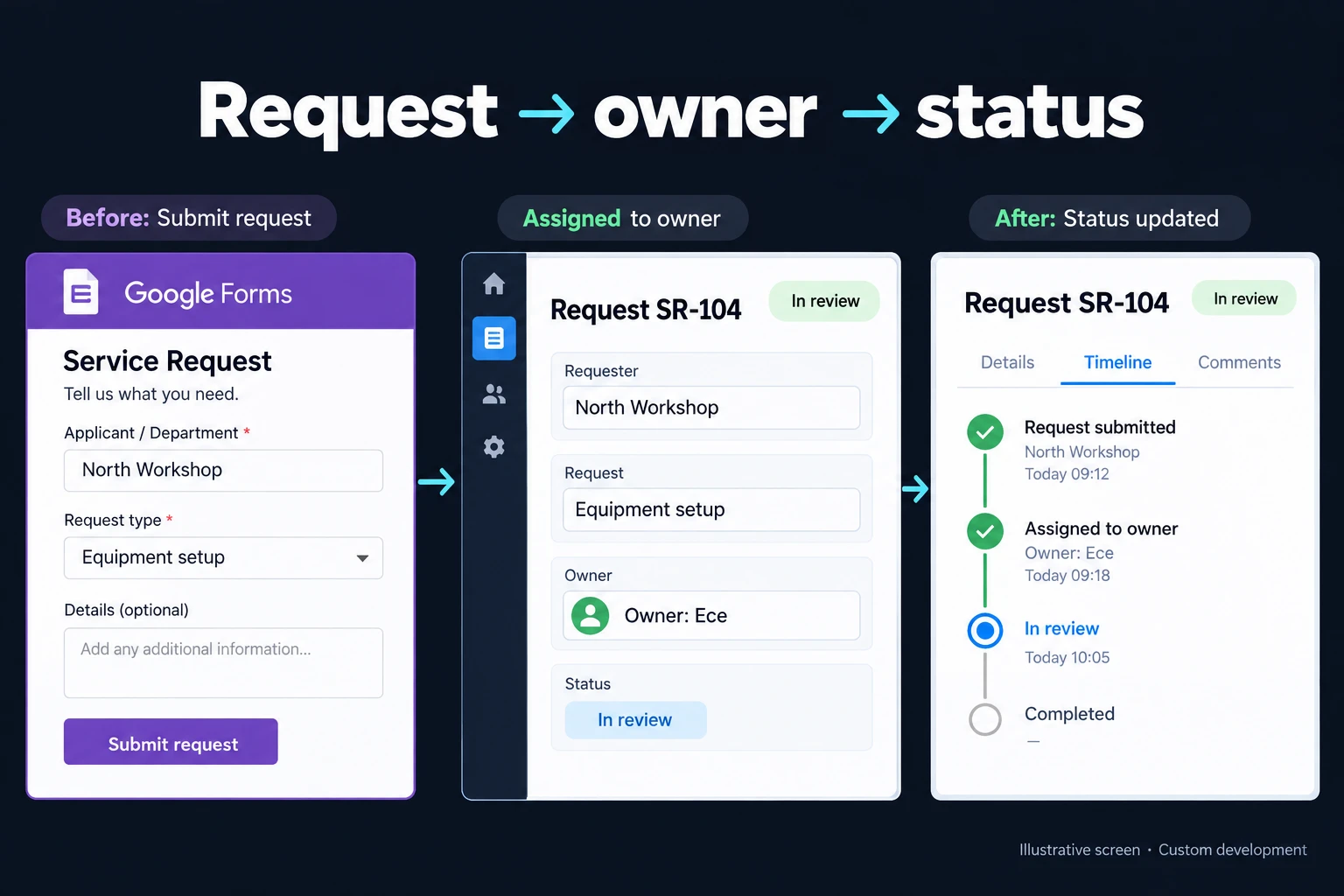
Example: a form response becomes request SR-104
The illustration is a fictional example. North Workshop submits an equipment setup request. The app creates SR-104, assigns Ece and shows In review. These are connected views of one request, rather than three copies that someone must keep aligned.
If Ece asks for clarification, the applicant returns to SR-104. Their correction appears alongside the previous information and the reason for the request. Reassigning the work does not require a new application. Internal comments stay with the team, while the customer sees the action they need to take.
When the existing form is enough
Google Forms already supports answer-based section routing. A linked spreadsheet and suitable automation can handle many small workflows. I would first assess that option if one person reviews the answers, all reviewers may see the same data and applicants do not need a continuing view of their requests.
A dedicated app becomes useful when customers need access to their own records, different staff roles control different fields, documents depend on the request status or another system must receive approved data. Conditional form fields can help, but they are one part of that wider process.
Rules behind the form
Double-clicking Submit should not create duplicate requests. Two staff members editing an open request should not silently overwrite each other’s decision. I define the record identifier, update checks and permitted status changes together. Reopening a completed request can require a reason and the appropriate role.
The external view receives only the information the applicant is authorised to see. A notification can contain a link instead of copying the whole application into an email. When customers need to follow progress, an application status portal uses the same underlying records.
Delivery and maintenance
I start with your fields, roles, statuses and a complete example of an accepted request. The delivery scope covers existing response imports, validation messages, mobile entry and recovery from a failed operation. We also agree who owns the integration account, how long documents remain available and who may change the form.
Adding a question later should not accidentally invalidate older applications. Where the process changes materially, I separate form versions so the team can understand which rules applied when a request was submitted. Ongoing support and external service costs belong in the written scope, rather than being assumed to disappear after launch.
Frequently Asked Questions
Must the existing Google Form close immediately?
No. It can remain in use during a planned transition. We choose when new requests move to the application and reconcile any responses collected during that period.
Does every customer need an account?
That depends on the information involved. A verified sign-in or an expiring access link may fit. Either approach must be tested to ensure that one applicant cannot retrieve another applicant’s record.
Discuss your workflow
Send me your current form and the steps that follow submission. I can separate what your existing tools already handle from the application work that would make the process easier to run.
How do I work?
Work-hour packages
Tell me about your business and what you need on WhatsApp or by phone; we agree on a work block of somewhere between 5 and 40 hours and I start doing what is needed. What you get is not a calendar window — it is net working hours spent directly on your business. I can use 40 hours working three days straight, or deliberately spread it out and finish it over a year — whatever the work calls for. I do not spend my time estimating how long something will take, I spend it doing the work; every hour I spend leaves a lasting result in your business. We keep going for as long as you find it useful.
Why not monthly?
Is 40 hours a week?
On a fixed monthly fee both sides are watching the wrong thing: you watch a fixed cost, the other side watches how many more contracts like this they can line up. Working by the hour puts us both in front of the same thing — the real value of the work that got done. I know not having an upfront answer to "how much will this cost in total?" is the natural cost of this model. But instead of paying a fixed fee for months to a setup that is not producing results, you only pay for the qualified time spent on your work — and you see exactly where that time went, start to finish. That is why my clients keep coming back.