
Customer Wrote at Night, Request Ready by Morning: A Guesthouse's WhatsApp Night Watch
On YouTube
Customer wrote at night, request ready by morning
Small-business customers mostly write while we sleep, and they pick whoever answers first. Here is how one guesthouse solved it: an automated WhatsApp line keeps watch overnight.
Full description
- Instead of a "we'll reply in the morning" note, the line asks the guest for the missing details itself
- It merges a messy message with typos and a follow-up message into one request
- The model doesn't make up the price: code calculates the offer from the price list and checks dates and capacity
- The moment you write, the line goes quiet and the chat is yours
- You can write freely for a day; after that, only a short pre-approved note can be sent
Any business that loses customers at night has this problem; the rest is for another video.
🤖 The voice and avatar in this video were generated with AI.
In a small business, customers write most when you are asleep. By the time you reply in the morning, they have often already gone with someone else. It isn’t that you were slow in any way that matters: a person writing at night messages several places at once and picks whoever answers first. At one guesthouse we handled this with an automated line that keeps watch on WhatsApp overnight. The video shows it in a few minutes; here I walk through what happens from the first message to the morning. For the wider picture, see the Agentic AI Guide.
Whoever answers first gets the guest
A guest messaging around midnight isn’t writing to one guesthouse. They write to several and talk to whichever one replies first. A message that waits until morning has already been lost by then.
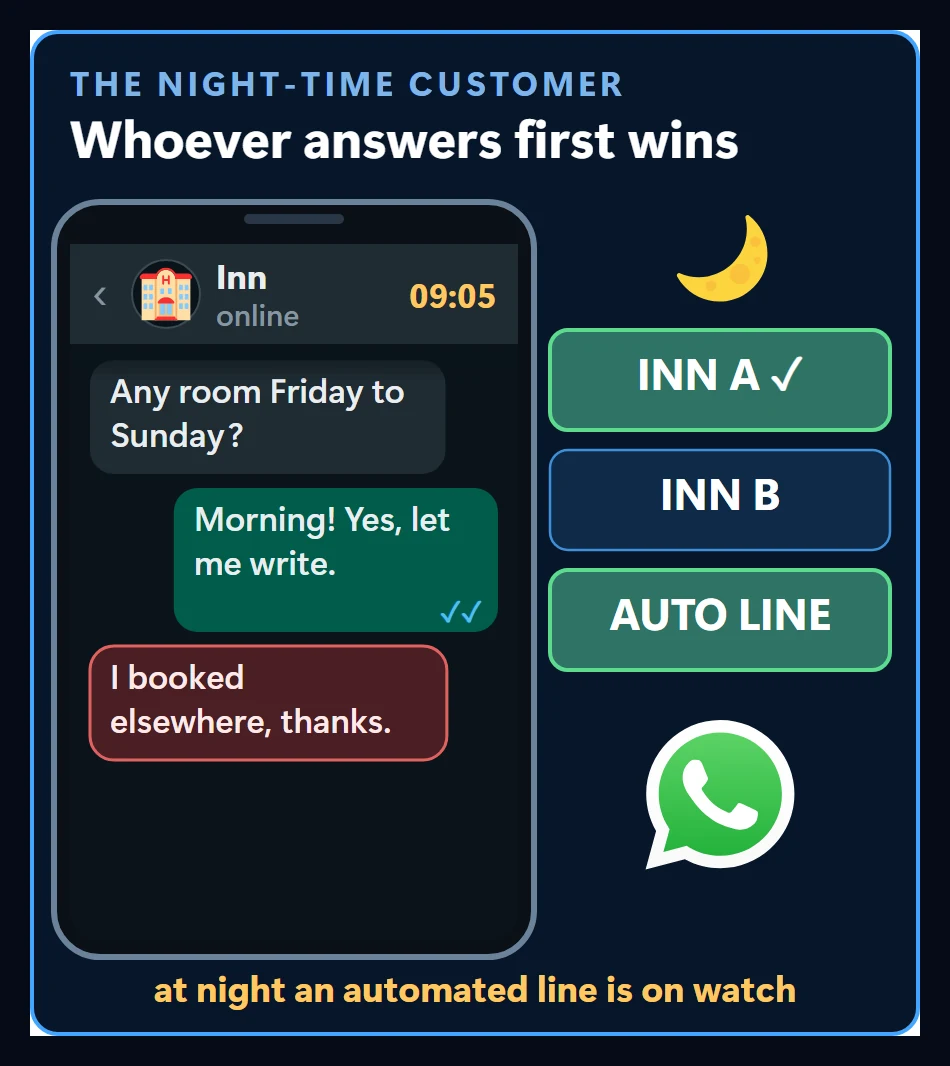
The usual first fix is an auto-reply saying “we’ll get back to you in the morning.” All that tells the guest is to wait, and the question stays unanswered. The line at this guesthouse says up front that it is automated and then asks the guest for the missing details itself. A guest who gets an answer at midnight stops writing elsewhere.
It reads typos and merges the second message
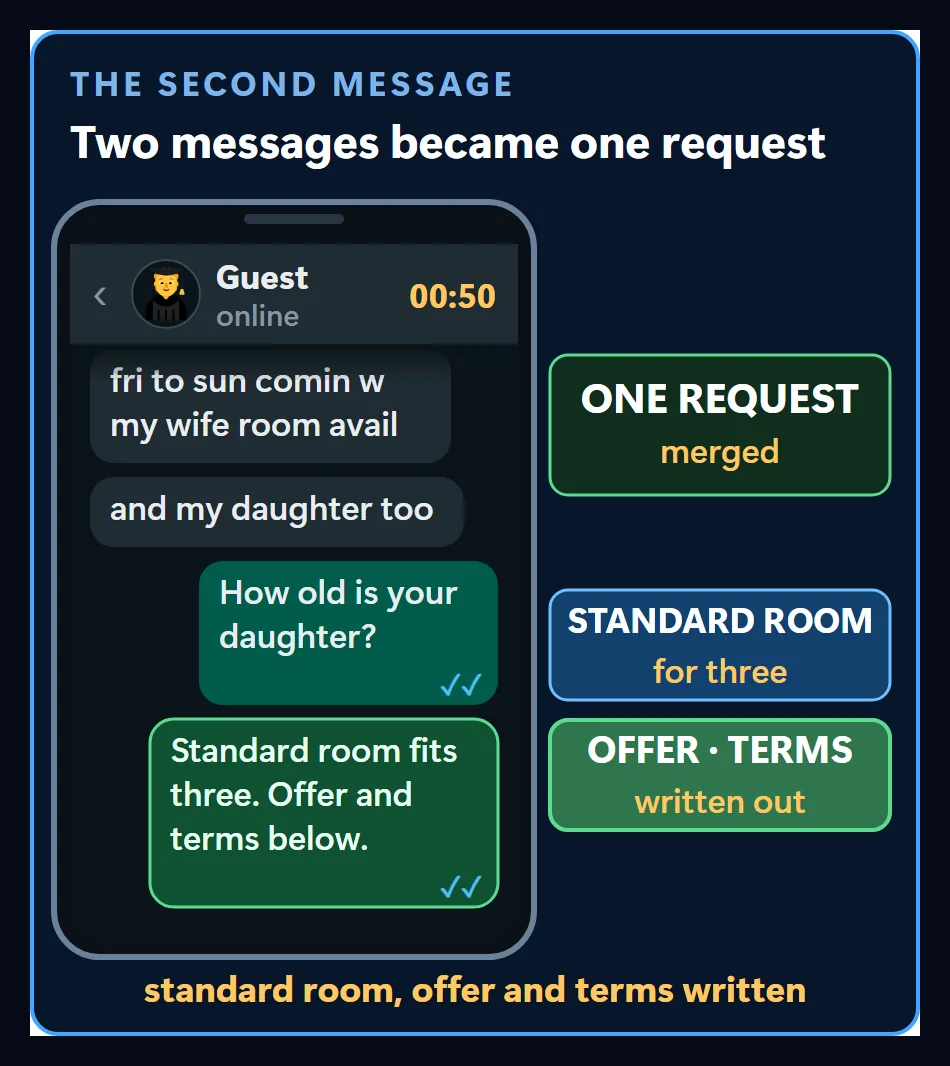
The obvious objection is that a machine won’t cope with messy late-night writing. Last night, around midnight, a guest wrote, typos and all, that he and his wife were coming Friday to Sunday. The line read that as two adults, two nights. Some lines annoy customers over small misreadings; this one didn’t.
Half an hour later the guest sent another message and added his daughter. The line merged both messages into a single request, asked how old the daughter is, picked the standard room that fits three, and wrote out the offer and the terms.
The model doesn’t make up the number
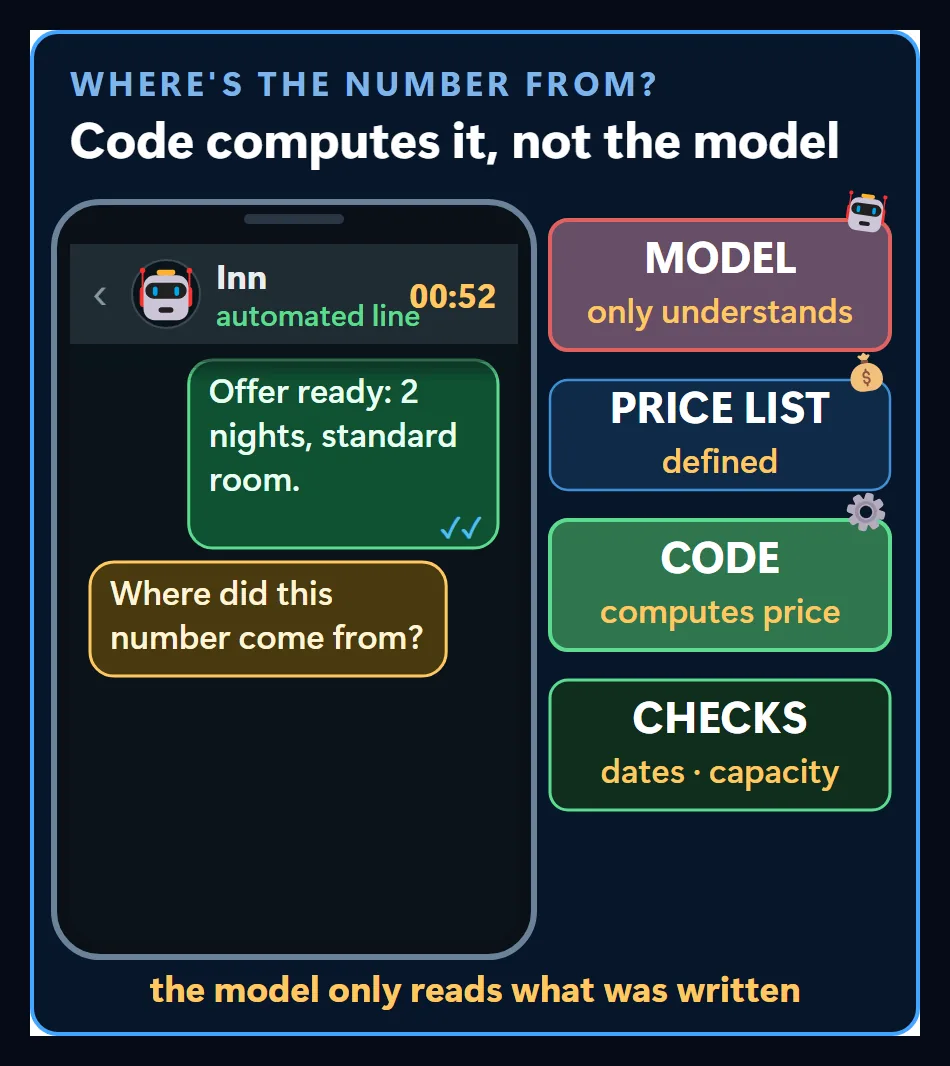
Seeing the offer, a guest will naturally ask where the number came from. The answer has to be clear. The model doesn’t produce it; code calculates it from the price list. Code also checks dates and capacity. The model only understands what was written.
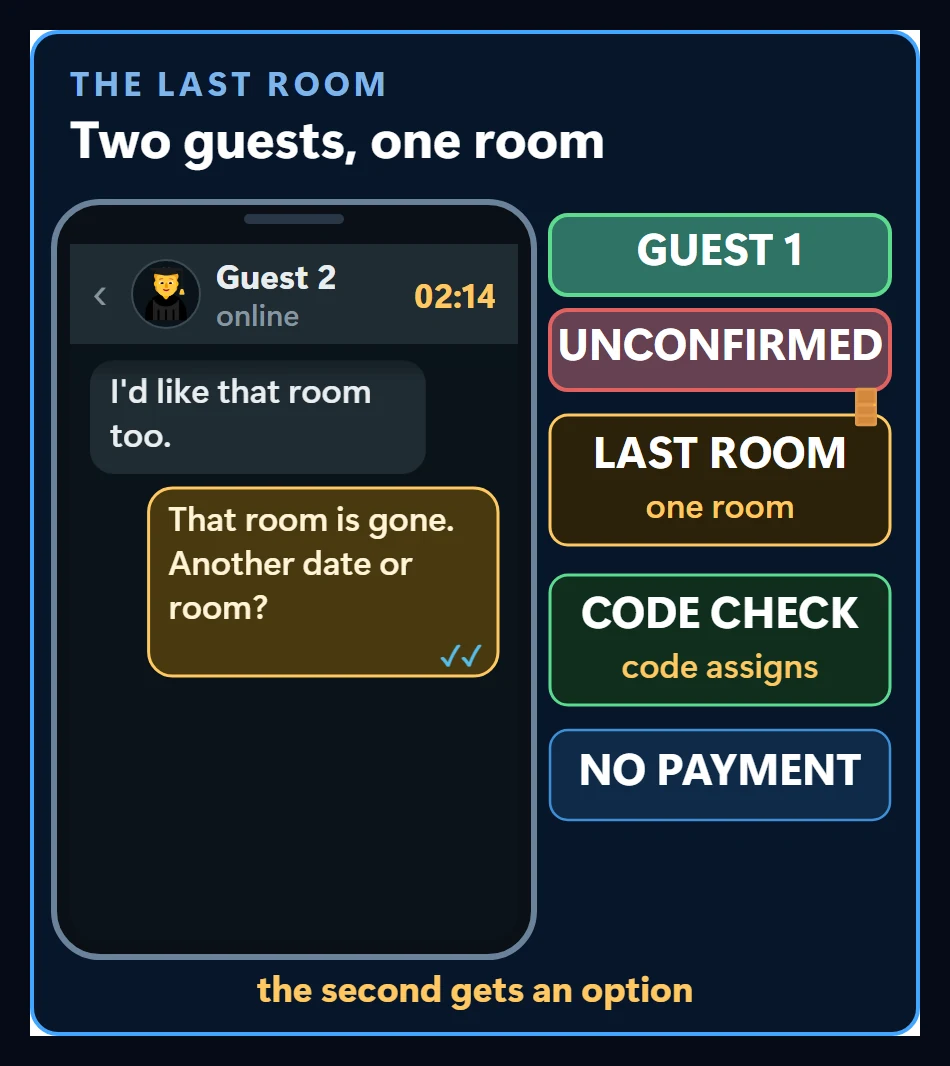
The line takes no payment. If two guests ask for the same room in the same night, the availability check decides. As the video puts it: if the last room was confirmed to the first guest, the second one gets no confirmation, and the line writes back offering another date or room.
When you write, the line goes quiet
The biggest worry about writing to the guest in the morning was the line butting in. The moment you write, it goes quiet and the chat is yours. The guest doesn’t have to repeat what they wrote overnight; it is all in one conversation, with a single request waiting for your approval.
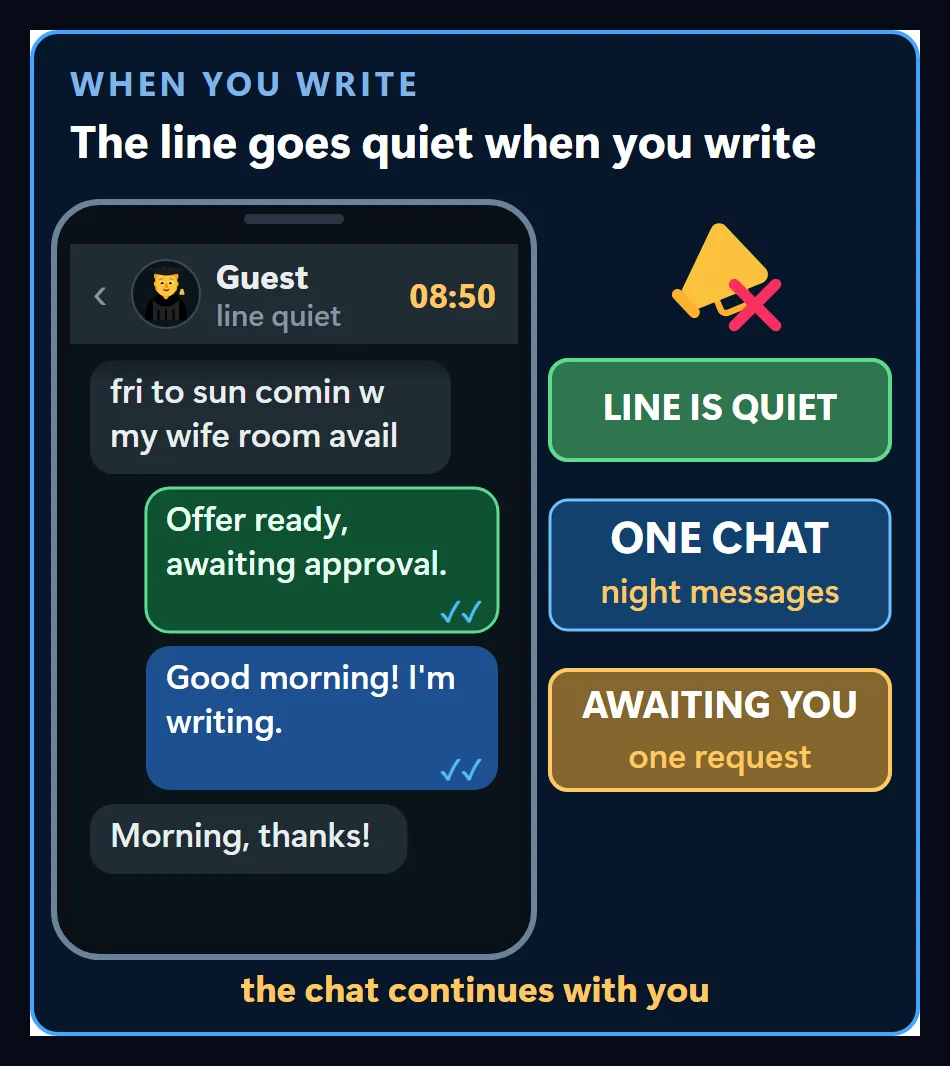
On a busy day you can even leave it until noon. Within a day of the guest’s last message you can write freely. There is a catch: after that day passes, only a short pre-approved note can be sent, and the chat reopens when the guest replies.
What changes
The customer gets an answer at the hour they write, and you start the day with a request that is already prepared. This isn’t only a guesthouse problem; it belongs to any business that loses customers at night. Customers who come from ads land on the same line, and that part is another video.
If you don’t want to miss it, follow the channel.
Follow for content about AI
More videos
 Give AI the Address, Not the Route: Why Smart and Simple Models Give the Same Work
 Stop Using Excel and Google Sheets as a Database: From Spreadsheet to Web App
 ADHD Didn't Change. The Tools Did: A Scattered Brain and an AI Agent
 Can AI Fix Its Own Mistakes? I Checked It Is Not I Fixed It
 OpenRouter and Hugging Face Aren't Models: Three Ways to Reach One
 How Do AI Agents Work? Same Model, Different Results
 AI Agents for AEC Firms: How the Five-Layer Setup Works