
What Is a Multi-Agent System: How Agents Work Together
A multi-agent system splits a task across several AI agents with roles instead of giving it all to one: for example, one researches, one writes, one checks. The agents either run in sequence and hand their output on, or a lead agent breaks the task up and distributes it to the others. Most tasks don’t need this; a single agent is enough. Consider multi-agent when the task can genuinely run in parallel or splits into parts that exceed one agent’s context.
I covered what an agent is in What Is an AI Agent and its types in Types of AI Agents. Here I only talk about building several agents to work together.
How do multiple agents work together?
There are two common layouts.
A chain. Agents run in order, each taking the previous one’s output as input. In content production: the researcher scans sources and extracts raw findings, the editor decides which matter and from what angle the piece should be approached, the writer writes the text from the approved frame. Each agent’s job is narrow; the writer doesn’t do its own research, and the researcher doesn’t write.
A lead and workers (orchestrator-workers). A lead agent plans the task, hands subtasks to the other agents and combines the results. The subtasks aren’t fixed in advance; the lead decides from the incoming request. Anthropic’s “Building effective agents” post presents this layout as suited to coding changes across many files and to multi-source research (Anthropic).
The same post separates two things: a workflow is a system where LLMs and tools are orchestrated through predefined code paths, while an agent is a system where the LLM directs its own process and tool use. A multi-agent setup can include both.
Single agent or multi-agent?
According to Anthropic’s engineering post on its own multi-agent research system (dated June 13, 2025 and still published as of October 2026; the measurements come from Anthropic’s own system and internal evaluation, not an independent benchmark), these are the tasks that go well and the ones that don’t (Anthropic):
| Multi-agent helps | Multi-agent is a poor choice |
|---|---|
| Broad questions where many directions are checked at once | Tasks where agents must share the same context |
| Parts that can run in parallel | Tasks whose parts depend heavily on each other |
| Information that doesn’t fit in one context window | Most coding tasks (per the post, they have fewer parallelizable parts than research) |
| Many complex tools | Single-step tasks: summarizing an email, tidying a table |
My own test: if you handed the task to a person, would you split it across several people with different expertise, or would one person do it start to finish? If one person would, a single agent is enough. Anthropic points the same way: start with the simplest solution possible and add complexity only when it clearly improves the result.
What does it cost?
According to the same Anthropic post, agents use about 4 times the tokens of a chat interaction, and multi-agent systems about 15 times; the authors say multi-agent only makes economic sense for high-value tasks. Those ratios were measured on their own systems in June 2025; yours may differ. The direction is clear, though: every agent is an extra model call, extra delay and extra cost.
Problems the same post reports, which you can also meet in your own setup:
- Starting dozens of subagents for a simple question.
- Subagents duplicating work when the task description is vague.
- Errors compounding in long-running agents that keep state.
- Debugging getting harder because runs don’t give the same result every time.
Example: a weekly topic scan
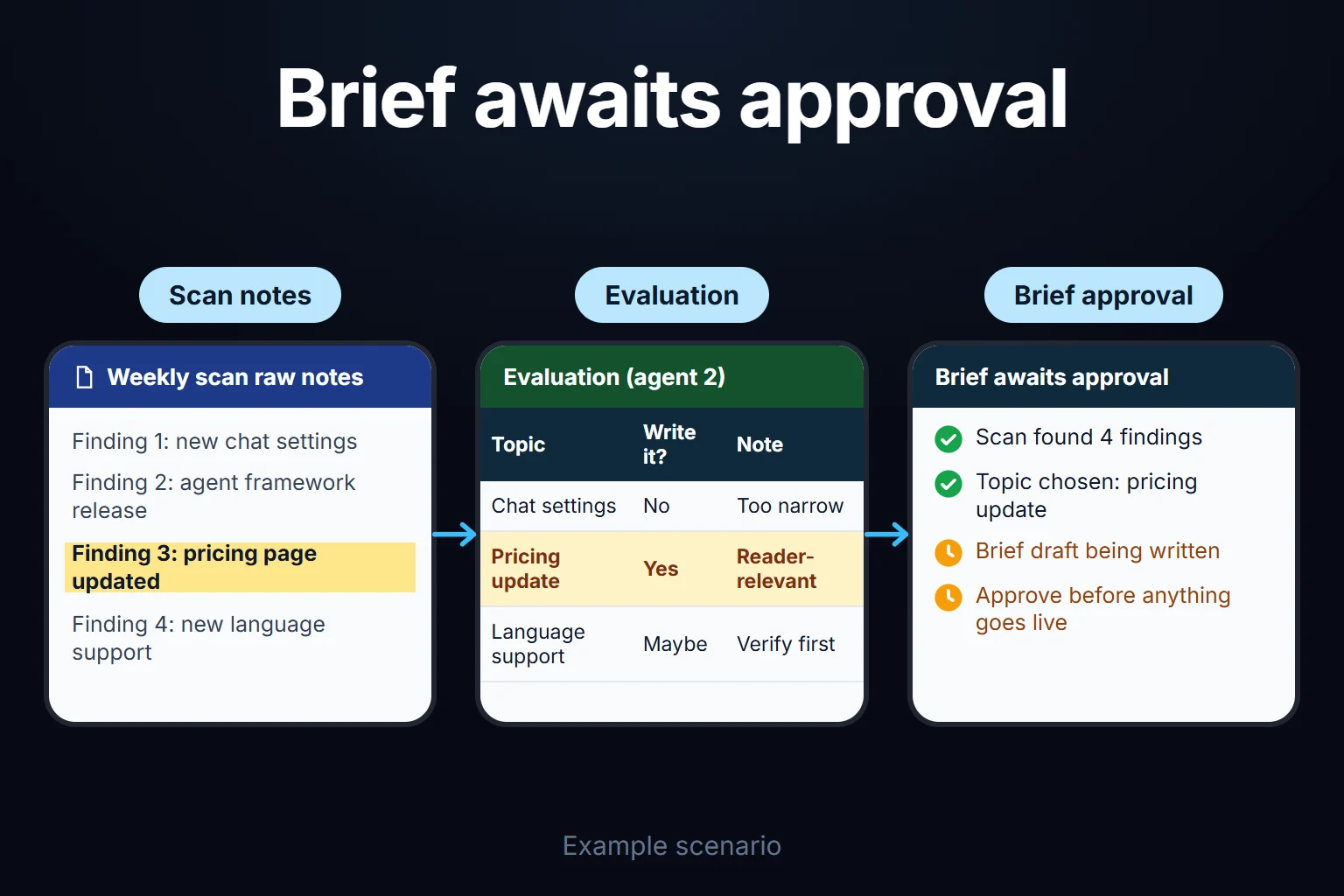
A sample scenario: you want a weekly content agenda. One agent scans the week’s developments, a second decides which are worth writing about, a third drafts a brief for the chosen topic. If you tell one agent “scan the week and suggest content,” scanning, judging and brief-writing blend in one context and the result tends to stay shallow. The reason to split here is that these are three different jobs. If you only needed the scan, one agent would be enough.
A person doesn’t have to step in at every hand-off, but put an approval step in before the result is used.
What do you build it with?
You need an orchestration layer that manages the order and data flow between agents; it can be a framework or custom code. Anthropic says frameworks like the Claude Agent SDK make setup easier but can add layers that obscure the underlying prompts and responses, and it recommends starting directly with the model API and understanding what sits under any framework (Anthropic). Each agent can be the same model or different ones; in Anthropic’s research system the lead agent and the subagents were different models.
You can ask me for this
We can evaluate together whether your work needs multi-agent. It is typically a 2-hour to 2-week engagement, remote and billed hourly. Details: Your Own AI Assistant. For the general approach, see the Agentic AI Guide.
Frequently Asked Questions
Does each agent have to be a separate model?
No. The same model can take different roles through different instructions. Picking a different model makes sense when part of the work can go to a cheaper or faster one.
Does multi-agent always give a better result?
No. If the task is simple, extra agents only add delay and cost. In Anthropic’s internal research evaluation the multi-agent setup beat a single agent; that result is specific to research work, not true for every task.
How many agents should there be?
I can’t give a number in advance. The number of roles follows how many genuinely different skills the task needs; adding unnecessary roles brings coordination overhead and cost.