
Prompt vs Skill vs Agent — In One Table
All three are different layers of working with AI, but they don’t substitute for each other. In short: a prompt is a one-off request — you ask, you get an answer, it’s over. A skill is a saved instruction package written so you can repeat the same task in the same format every time. An agent is an autonomous system that runs those instructions across multiple steps, makes its own decisions, and does it without you. Below I compare all three on the same example, in one table. For broader context, see the Agentic AI Guide.
Prompt, Skill, Agent: Comparison Table
| Criteria | Prompt | Skill | Agent |
|---|---|---|---|
| Reusability | None — you write it from scratch every time | High — set it up once, call it forever | High — once set up, it triggers itself |
| Autonomy | Zero — you manage every step | Low — you say “run it,” it applies the format | High — it decides, sequences the steps itself, reports the result |
| Setup difficulty | None — write and send instantly | Medium — define instructions, examples, output format once | High — needs a trigger, error handling, approval points |
| Typical use | One-off question, quick draft, an instant decision | A recurring report, checklist, or fixed format | Scheduled monitoring, multi-step workflow, self-triggered intervention |
| Example | “Shorten this Google Ads headline to 30 characters” | Producing the same weekly performance report every Monday, same format | Spotting a campaign burning through budget, pausing it, and notifying you |
| Time / cost | Seconds, zero setup cost | One-time setup, then minutes | Setup takes longer, then runs continuously — needs maintenance |
Which One Is Enough — When?
The decision comes down to a simple question: how many times will I do this, and how much judgment does it need?
- A prompt is enough — when the question is one-off and the answer is all you need. If you won’t ask the same thing again, building a skill isn’t worth it.
- Build a skill — when you’re doing the same task in the same format, repeatedly. If the format is fixed and only the inputs change, this is exactly skill territory. See What Is a Claude Skill.
- Build an agent — when the work is multi-step, requires judgment, and doesn’t need you to trigger it every time. An agent runs on its own and brings you the result.
Another distinction people often mix up is agent vs. chatbot — they’re not the same thing; details on the AI Agent vs Chatbot page.
The Same Task at Three Levels: Weekly Competitor Price Checks
Let me show the same task at three levels so the difference is clearer.
- Prompt: Every week you sit down and type “check these 5 competitors’ prices, make a table.” It works, but you have to remember to do it and re-explain the details every time.
- Skill: You write which competitors, which products, and what format the output should be — once, into a skill. After that you just say “run the price check” and get the same quality result every time.
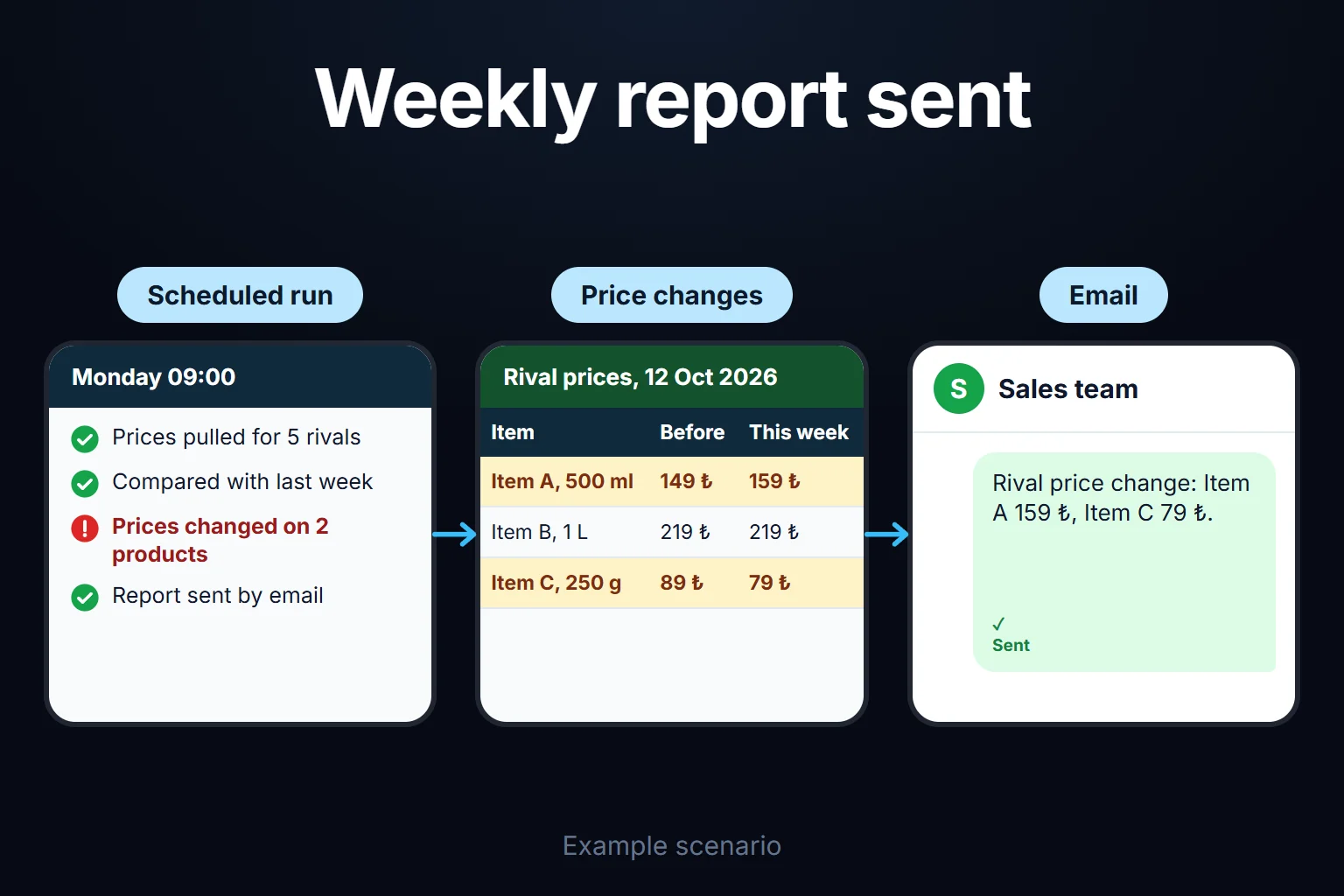
- Agent: It runs on its own every Monday morning, pulls the prices, compares them to last week, and emails or WhatsApps you a report if something changed. You never trigger it — you just read the result.
An Observation From My Own Operation
I’ve lived through all three levels in my own work. Managing my whole ad account portfolio solo, every account check used to be a prompt — I’d write a GAQL query and interpret the result one at a time. As the work repeated, I turned it into a skill: same thresholds, same format, one command scans all of them. Today some checks (a campaign burning through budget abnormally, an account whose CPA spiked) run at agent level — it scans on its own, notifies me when a threshold is crossed, and I give the approval. The progression happened in order: first find the right question with a prompt, then make it repeatable with a skill, then finally hand it to an agent. Skip the order and try to build an agent straight away, and the format still hasn’t settled — the agent ends up automating the wrong thing.
You Can Hire Me for This
You can make the prompt-to-skill-to-agent transition yourself, but skip the order and you’ll end up automating the wrong thing. You can hire me for this: it’s usually a 2-hour to 2-week, fully remote, hourly-billed job. Reach out to set up your own AI assistant.
Frequently Asked Questions
Can I turn a skill into an agent later?
Yes, and that’s actually the recommended path. Run the skill manually first, refine it until the format is solid, then attach that same logic to a trigger (time, email, a data change) and turn it into an agent.
Is building an agent always better?
No. For rarely-run, low-risk tasks, building an agent is a waste of time — a prompt is enough. Agents make sense for frequently repeated tasks where the cost of an error is low.
Is “skill” a Claude-specific concept?
No, the concept is universal. ChatGPT’s “Custom GPTs” and “Actions,” Gemini’s “Gems” do a similar job. Different name, same idea: a reusable instruction package.
Is building an agent expensive?
Setup is a one-time cost, after which the running cost is close to zero. The real cost is time: defining the right trigger, error handling, and approval points.