
What Is Agentic AI? A Plain-Language Definition
Agentic AI is an AI system that, instead of answering a single question, plans the steps toward a goal you give it, uses tools such as search, email, code or an API, checks the result, and changes its approach if needed. You do not manage every step; you give the goal and the boundaries. That is why, when an agentic system gets something wrong, it is not just an answer that is wrong but possibly an action, such as an email sent or a budget spent. Drawing the boundaries clearly matters for that reason.
What does “agentic” mean next to “AI agent” and “autonomous AI”?
There is no single settled definition. You will see these terms used for the same idea, with slightly different emphasis:
- AI agent: usually one concrete system that pursues a goal with tools.
- Agentic AI / agentic system: the way such systems work, or a setup where several agents work together.
- Autonomous AI: puts the emphasis on “working without humans”; used interchangeably in everyday talk, but not exactly the same.
- Agentic workflow: autonomy added into an existing process rather than a standalone system.
For the “agent” concept at the root of the term, see What Is an AI Agent; for the full picture, the Glossary of Autonomous AI Systems.
How does it work?
Most agentic systems repeat the same loop: read the situation → plan → act with a tool → check the result → replan if needed. For example, it reads an inbox, separates the emails that need a reply, looks up an order status in a system, and drafts an answer.
What separates it from classic automation is that the steps are not written out in advance. In Anthropic’s distinction: in workflows, models and tools are orchestrated through predefined code paths; in agents, the model directs its own process and tool use. The difference is who controls the flow (Anthropic: Building effective agents, December 2024).
How it differs from generative AI
Generative AI (like asking ChatGPT to draft an email) produces content from an input. An agentic system carries out a task across several steps and tools. In practice most agentic systems use a generative model inside, and add planning, tool use and checking on top.
| Generative AI | Agentic AI | |
|---|---|---|
| What it does | Produces content: text, images, code | Runs a task end to end |
| Number of steps | Usually one (prompt → response) | Many, in a chain it plans itself |
| Tool use | Mostly none | Search, APIs, file operations, running code |
| What a mistake looks like | A wrong answer | A wrong action (a sent email, spent budget) |
| The human | At every prompt | Sets goal and limits upfront; approves critical steps |
I compare it with chatbots separately in AI Agent vs Chatbot.
A concrete example (hypothetical)
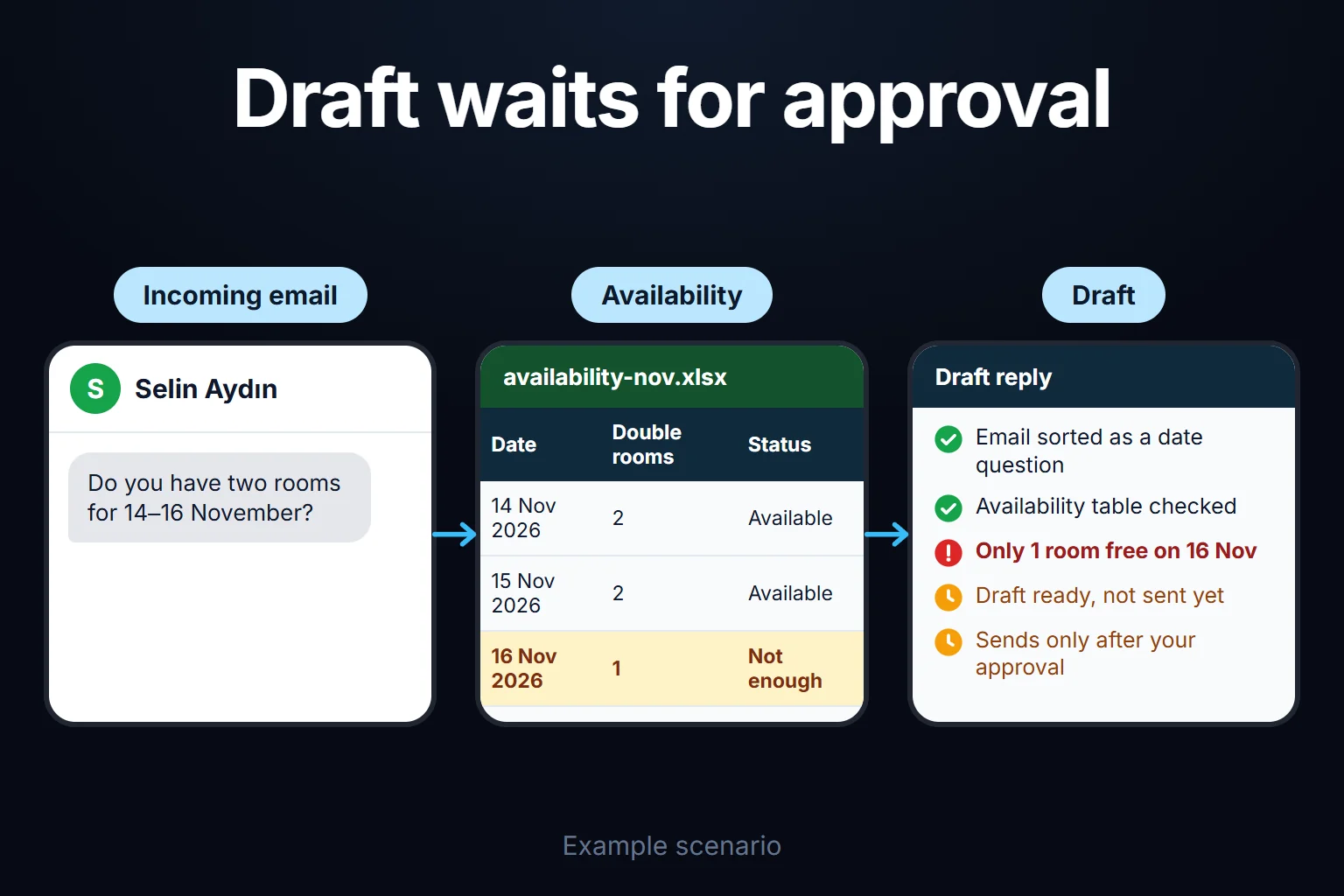
Think of the reservation emails of a small hotel. With an ordinary AI assistant you paste an email in and say “write a reply”; you do that for every email. In an agentic setup, the system watches the inbox itself, tells whether an email is a date question or a cancellation, checks an availability table, drafts a reply, and puts it in front of you for approval before it is sent. For steps with a money impact, such as a price change or a cancellation, the system does not decide; it hands them to you.
This is a scenario, not a particular client’s result. What matters is the shape of the example: a repetitive job, clear rules, and human approval on steps that affect money.
When you do not need an agentic system
For most jobs you do not. Anthropic’s guide also advises looking for the simplest solution first and adding complexity only when needed; agents can perform better, but at the cost of latency and money, and their autonomy raises the risk of compounding errors. For a job whose steps are known and fixed (say, producing a report from a spreadsheet every morning), an ordinary workflow or a single model call is more predictable and cheaper.
An agentic setup makes sense when the number of steps is not known in advance, when you cannot write a fixed path, and when the steps are reversible or pass through human approval.
Watch the hype
Gartner predicts that over 40% of agentic AI projects will be canceled by the end of 2027, citing rising costs, unclear business value and inadequate risk controls. The same release says many vendors are relabelling existing chatbot or RPA products as “agentic” (agent washing) (Gartner press release, 25 June 2025). That is a forecast, not a measured result, but it shows why starting with a narrow, measurable task makes sense.
Before you start, ask three questions: Can this job really not be written as rules? What does a wrong step cost, and can it be undone? At which step will I put human approval?
You Can Ask Me For This
If you have a repetitive job that cannot quite be reduced to rules, and you want to talk through whether it suits an agentic system or an ordinary automation, you can get in touch through Your Own AI Assistant. To see the topic in a broader context, check the Agentic AI Guide.
Frequently Asked Questions
What does agentic AI mean, in plain terms?
AI that runs a task through several steps and tools on its own, toward a goal you set. You will also see it called “autonomous AI” or “an agentic system”; they all describe the same idea.
Is agentic AI the same thing as an AI agent?
Often the terms are used interchangeably. Those who separate them describe an AI agent as one concrete system, and agentic AI as how such systems work, or a setup where several agents cooperate. There is no single exact definition; check which sense an article uses.
Is there an everyday example of agentic AI?
A trip-planning agent does not just list hotels; it checks available dates, compares prices, and completes the booking with your approval. A chatbot expects you to ask for each of those steps separately.
Is agentic AI expensive to set up, and how long does it take?
It varies a lot with scope, and I cannot give a general time or price. Starting with a small, narrowly scoped task lowers both cost and risk.