
Custom CRM and Proposal Workflows for Sales Teams
I can develop a custom CRM and sales workflow application for sales directors, connecting the first customer enquiry with proposal approval and the handover to operations. I bring spreadsheet lists, WhatsApp conversations and information held by individual employees into connected records. Your team manages its opportunities while you see outstanding proposals, commercial commitments and progress.
This service describes workflows that can be developed. The screens and integrations are selected around your business. If you already have a CRM, I can use the data it makes available and fill gaps in proposal management, approvals or operational handovers. The starting point is a workflow your team can use in practice.
Stop searching for the correct list in the sales meeting
A representative may mark an opportunity as won before finance can see an order. The latest proposal may be in another folder. A discount was approved over the phone, while nobody checked the delivery date with operations. Collapsing these situations into one “sale complete” cell hides the point where a manager should intervene.
I can define separate states for an enquiry, requirements discussion, proposal, commercial approval, customer acceptance, order and collection. Each transition has an owner and the evidence it needs. Instead of rebuilding a presentation before every meeting, the team can review overdue next steps and opportunities awaiting decisions. The application’s view becomes useful through current records and agreed business rules.
An example technical product proposal from enquiry to collection
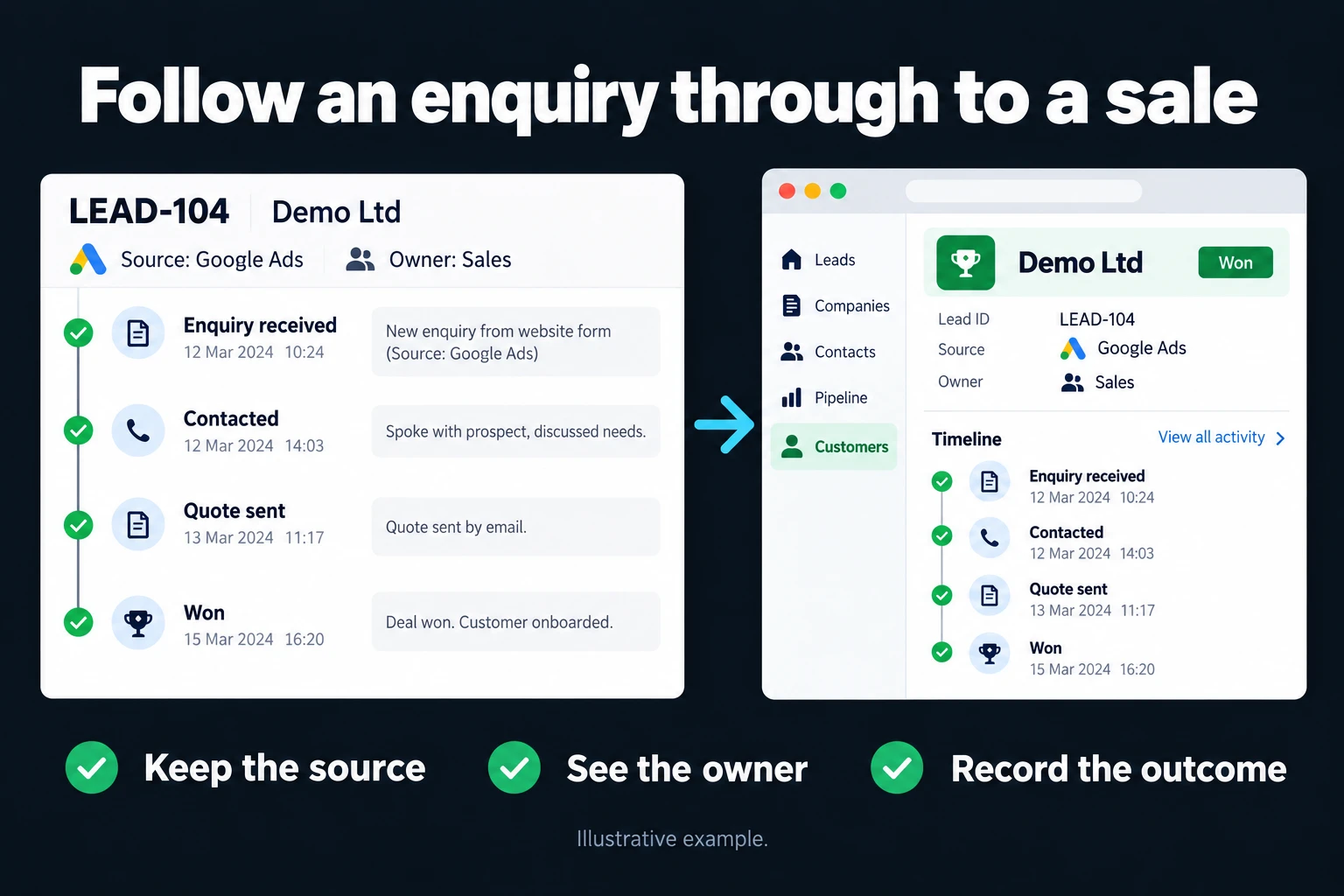
The following is an illustrative scenario, not a customer case or completed implementation. A manufacturer requests a technical product through the website. A representative clarifies the requirements, technical sales checks suitability and a manager approves the commercial terms. If the customer requests changes, earlier proposals remain available.
| Event | Record created | Owner | Next check |
|---|---|---|---|
| Proposal enquiry arrives | Company, contact and opportunity | Sales representative | Missing technical information |
| Requirements are clarified | Requirements and document list | Technical sales | Product or service suitability |
| Proposal is prepared | Versioned proposal | Representative | Discount and delivery approval |
| Customer requests a change | Revision reason and new version | Proposal owner | Difference from earlier commitments |
| Acceptance is received | Acceptance evidence and terms | Sales manager | Order handover |
| Operations takes over | Delivery or service preparation | Operations | Sales commitments |
| Payment becomes due | Receivable status | Finance | Collection confirmed by its source |
This chain shows how the business fulfils a commitment, as well as when a proposal was sent.
Keep companies, contacts and opportunities separate
I would not build a B2B CRM as a phone directory. A single company may have different contacts for purchasing, technical evaluation and payment. Contacts belong to a company record, while each opportunity identifies its requirement, product group, territory and owner.
The customer record can contain discussions, open proposals, accessible service history, commitments and appropriate communication preferences. A representative without permission cannot see another team’s confidential prices or financial information. A person’s history at different employers, and separate legal entities within a group, are not merged without review. The application can suggest duplicates; an authorised person decides whether they should be combined.
Practical screens for the team
| Screen | Work it supports |
|---|---|
| Daily follow-up | See overdue calls, responses and next actions |
| Companies and contacts | Find stakeholders and discussion history |
| Opportunity view | Track requirements, stage, expected date and owner |
| Proposal preparation | Assemble products, services, scope, currency and terms |
| Proposal versions | Compare changes in price, scope and delivery commitments |
| Commercial approval queue | Decide on discounts, payment terms and exceptions |
| Operational handover | Transfer the accepted scope to the delivery team |
| Collection view | Link source-system receivables with the sale |
| Lost opportunity analysis | Distinguish recorded reasons from missing information |
| Management summary | Review workload, stages and data freshness together |
You do not need every screen in the first release. Its business rule, user role and acceptance example belong in the agreed scope.
Proposal revisions and commercial approval
Exclusions, delivery terms, validity, currency and customer-specific commitments matter as much as the product name. I can record these fields and compare proposal versions. The team can identify exactly which version was sent and which one the customer accepted.
Approval rules can cover discounts, payment periods, additional services or non-standard delivery dates. If changing an approved proposal requires another approval, the workflow enforces that requirement. Producing a PDF does not establish legal acceptance; the source of any signed document or acceptance message is recorded separately. Without a reliable stock or production-capacity connection, the application waits for operational confirmation before promising a delivery date.
Permissions for sales, technical staff and finance
| Role | Available work | Additional control |
|---|---|---|
| Sales representative | Assigned customers, opportunities and proposals | Approval above discount authority |
| Sales director | Team pipeline, commercial approvals and handovers | Critical action history |
| Technical sales | Requirements, technical documents and suitability notes | Limited commercial access |
| Operations | Accepted scope and delivery commitments | New commitments return to sales |
| Finance | Accounts, due dates and confirmed collections | Official records remain in their system |
| Customer | Specifically shared proposal or document | Secure, limited access |
Permissions also govern exports and AI queries. When an employee leaves, access is removed and open work moves to a new owner. Changes to discussion records retain the user and time.
Controlled follow-up through WhatsApp and SMS
Checked 30 October 2026: outside the 24-hour service window following the latest user message, WhatsApp Business Platform requires approved message templates. WhatsApp policy.
With an appropriate official WhatsApp Business Platform connection, I can link a team inbox to customer records. Internal notes stay separate from customer messages. Automated replies can stop when an employee takes over. I cannot promise to migrate all historical personal-account conversations without inspecting the account arrangements.
| Trigger | Recipient and communication | Sending condition |
|---|---|---|
| Required enquiry details are missing | Request information from the contact | Correct company/opportunity match |
| Proposal is approved | Send the current proposal link to the customer | Commercial approval and channel permission |
| Meeting is approaching | Remind the participant | Current time and cancellation check |
| Proposal follow-up is overdue | Create a task for the representative first | Customer message assessed separately |
| Order has been accepted by operations | Send the confirmed status | Operational source and authority |
| Payment date approaches | Inform the relevant authorised contact | Current balance and appropriate process |
Messages outside WhatsApp’s service window use approved templates and the necessary permissions. SMS connects through an appropriate provider with consent, opt-out and, where applicable, Turkey’s IYS checks. Repeated events do not create duplicate notifications, and opt-outs affect the marketing queue. WhatsApp policy, IYS guidance.
Where AI can help the sales team
I can build an assistant that extracts requirements, objections and next steps from notes, prepares proposal fields from an email and summarises a long customer file. Technical answers rely on approved product documents. Their source and version remain visible; missing information is not filled with guesses.
AI can explain why an opportunity appears delayed or draft a follow-up. Prices, discounts and margins come from defined calculation rules. Decisions about creditworthiness, contractual obligations or ending a commercial relationship remain with authorised people. If opportunity prioritisation is used, its reasons should be visible; it should not independently determine employee evaluation or exclude a customer.
Checks when moving from spreadsheets
I identify how customer lists, proposal files and sales reports relate. We define reliable keys such as company codes, opportunity numbers and proposal versions. Identical names, incomplete company details and different currencies receive separate checks. Each list has an agreed data owner.
The import preview identifies new, changed, duplicate and rejected rows. Uploading a file again does not double sales totals. After migration, record counts, proposal totals by currency and selected customer histories are reconciled with the source. Approvals represented through colours or informal notes need explicit interpretation. Moving cells alone does not migrate a sales process.
Work with the existing ERP and CRM
Approved CSV or Excel exports can support an initial tracking and reporting workflow before API access is available. For an automated connection, we define readable fields, refresh frequency, ownership and failure handling. Opportunities, orders and invoices retain their distinct source identifiers.
Writing an order into an ERP requires different permissions and tests from reading its status. “Sent” in the custom application does not mean the receiving system accepted the record. Acknowledgements and exception queues are monitored. If your existing CRM already provides the essentials, improving its configuration or developing a limited extension may be more appropriate than rebuilding the entire system.
Reports that separate forecasts from actual results
Management reports can cover stage transitions, ageing proposals, overdue follow-up, loss reasons and operational handovers. The aim is to show where intervention is needed through usable evidence. Reports display their data date, filters and missing fields.
An opportunity value is not order revenue; an order is not a collection. If you want probability-weighted forecasting, its assumptions are labelled and the result is not presented as certain revenue. Historical stage changes are not invented when the source does not contain them. Comparison can begin with events recorded after launch. Advertising source information connects to an opportunity only where consent and technical matching permit.
Initial scope, training and ongoing operation
During a paid scope assessment, I review a representative sales file, approval process and handover with your team. The first delivery might include an opportunity list, proposal versions and an approval queue. WhatsApp, ERP connections and more advanced reports follow according to data readiness and operational priorities.
A limited workflow is piloted with a team. We agree which system becomes authoritative and from what date; independently maintaining the same opportunity in two places should not become permanent. Training follows actual tasks. Support hours, incident priorities, backups, exports, integration charges and AI or messaging usage costs are documented in the agreement.
Acceptance examples to review together
- Importing the same file again must not create another opportunity or proposal.
- An old proposal link must make the version’s status clear.
- A discount above the user’s authority must not be sent without approval.
- Operations must see the accepted version and delivery commitments.
- An unauthorised representative must not obtain confidential prices through AI.
- A disconnected source must not leave an old order status labelled as current.
- A person who opts out must be removed from the relevant marketing queue.
- A restore test must recover selected opportunities, documents and relationships.
These are proposed acceptance examples, not claims that undeveloped software has passed tests. The final list follows the selected modules.
When a custom application may not be appropriate
If the process is undefined, first agree who approves a proposal and under which conditions. A complex multi-role application may be unnecessary for one person’s basic contact list. When a standard CRM already meets your needs, using it properly can be the shorter route.
Custom development makes sense when several teams work around the same records and an essential workflow is missing from the current tools. It does not include guaranteed sales, unrestricted customer-data collection or handing the team’s responsibilities entirely to AI. An integration is not promised before access to its source is verified.
Frequently Asked Questions
Do I need to replace the existing CRM?
No. I review its data access and the capabilities that already work. A missing approval, operational handover or reporting screen can be developed separately. A complete migration needs its own transfer and fallback plan.
Can the team’s WhatsApp conversations connect to the application?
Team communications can connect through a suitable official number and platform access. Existing number arrangements, historical migration and permissions are reviewed. Unlimited access to personal-account history is not promised.
Can AI send proposals automatically?
It can draft proposals from approved scope and price sources. Missing prices, non-standard requests and exceeded approval limits go to an authorised person. Final proposals require the agreed rules and commercial controls.
Can we understand why opportunities were lost?
Recorded loss reasons can reveal patterns. The model may suggest a possible explanation from a conversation, but it must not turn an unspoken reason into a fact. Unknown outcomes remain clearly identified.
Can we compare representatives’ performance?
Defined activity and outcome measures can be reported. Territory, portfolio, product and data-quality differences must remain visible. An automated score should not independently determine pay, penalties or dismissal.
What is delivered after the first assessment?
The paid scope assessment documents the initial screens, roles, sources, integration status and acceptance conditions. Development and ongoing operation are then scoped against this concrete plan.
Define your sales team’s first shared workflow
We can map who approves a proposal today, which version reaches the customer and how the accepted work moves to operations. I use that workflow to define the application’s first scope.
Request a scope assessment for sales, proposals and customer follow-up.
How do I work?
Work-hour packages
Tell me about your business and what you need on WhatsApp or by phone; we agree on a work block of somewhere between 5 and 40 hours and I start doing what is needed. What you get is not a calendar window — it is net working hours spent directly on your business. I can use 40 hours working three days straight, or deliberately spread it out and finish it over a year — whatever the work calls for. I do not spend my time estimating how long something will take, I spend it doing the work; every hour I spend leaves a lasting result in your business. We keep going for as long as you find it useful.
Why not monthly?
Is 40 hours a week?
On a fixed monthly fee both sides are watching the wrong thing: you watch a fixed cost, the other side watches how many more contracts like this they can line up. Working by the hour puts us both in front of the same thing — the real value of the work that got done. I know not having an upfront answer to "how much will this cost in total?" is the natural cost of this model. But instead of paying a fixed fee for months to a setup that is not producing results, you only pay for the qualified time spent on your work — and you see exactly where that time went, start to finish. That is why my clients keep coming back.