
Excel Sales Report Preparation and Automation
When store sales, online orders and refunds arrive in different files, the reporting problem starts before the chart. I define which records count, how returns relate to orders and which period each amount belongs to. The service suits owners reviewing daily totals and teams comparing branches, products or channels.
Sales less returns is not profit
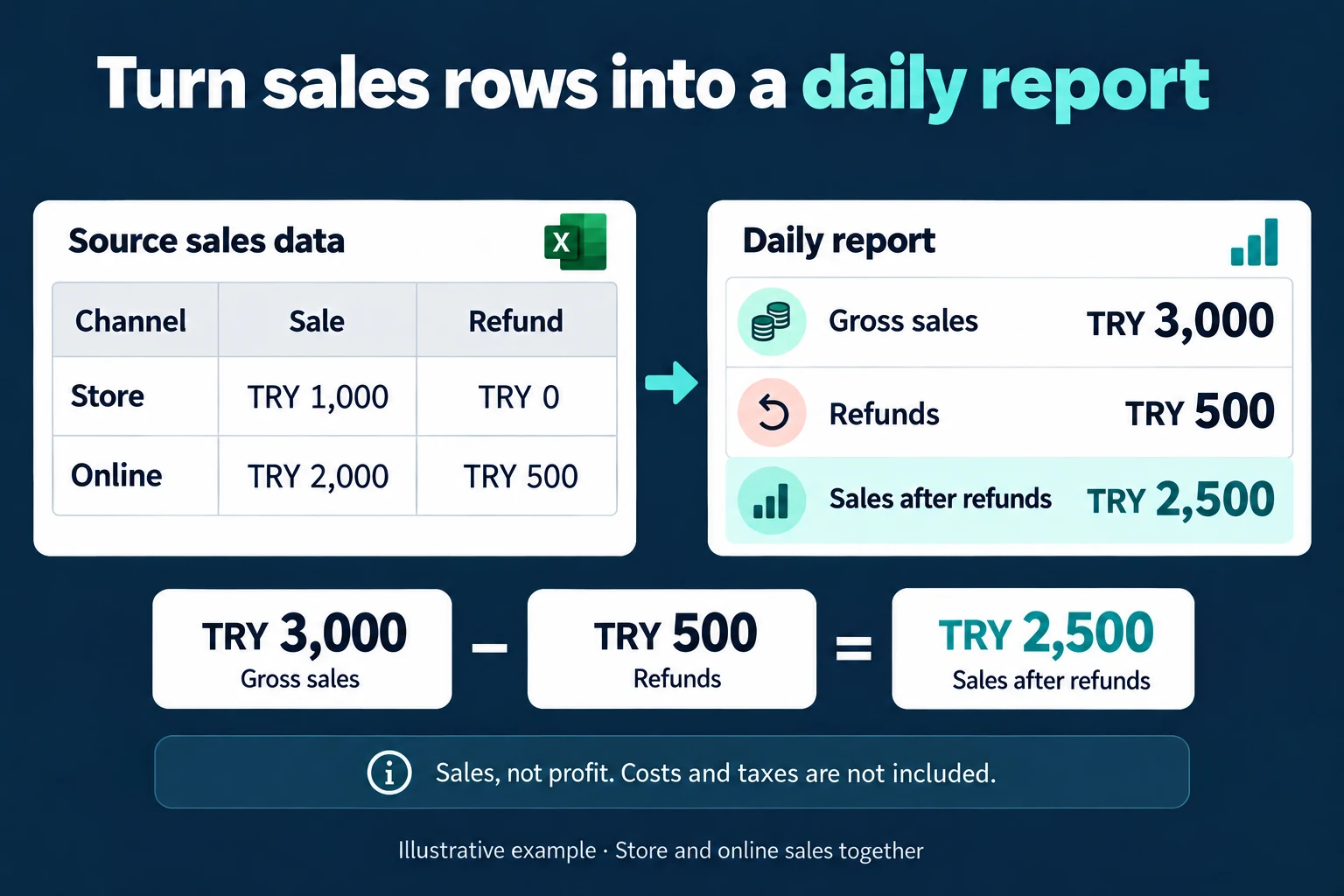
The fictional example has store.xlsx: S-101, €1,000, and online.xlsx: S-102, €2,000. Sales total €3,000. A €500 return against S-102 leaves €2,500 sales less returns. Without costs and expenses, that result is not profit.
VAT, discounts, shipping and commissions may need separate definitions. A later return can be recorded on the return date or applied to the original sales period under your agreed management-reporting rule. I do not present a management report as a substitute for accounting records.
Make the input repeatable
I align order number, date, channel and amount fields. Source identifiers help prevent the same file or order being added twice. Cancelled orders, completed sales and unpaid orders must not enter one total without an explicit rule. Missing order identifiers, unreadable amounts and unmatched returns go to a review list.
Excel and Power Query may be enough for a few stable files handled by one person. Microsoft documents combining files from a folder. Different branch upload permissions, approval stages and private cost fields may justify a custom reporting screen.
Check the report against the source
For a sample period, I reconcile included sales, returns and excluded records. A branch file dated yesterday and an online file dated today do not mean every channel is current through today. The report should expose the coverage of each source.
The deliverable can be a workbook, a repeatable refresh process or a permission-controlled screen. Calculation definitions, recurring preparation steps and maintenance scope are agreed alongside the appearance.
Website-to-Excel imports cover collecting data before reporting; competitor price tracking supports a different decision about outside prices.
Frequently Asked Questions
Frequently Asked Questions
Is a template enough?
It can be if its columns and calculations match your files. Repeated corrections or inconsistent channels may need a tailored process.
Can the report include profit?
If the relevant cost and expense data and calculation scope are supplied. Sales and return files alone do not establish profit.
Discuss your input files and the decision the report should support.
How do I work?
Work-hour packages
Tell me about your business and what you need on WhatsApp or by phone; we agree on a work block of somewhere between 5 and 40 hours and I start doing what is needed. What you get is not a calendar window — it is net working hours spent directly on your business. I can use 40 hours working three days straight, or deliberately spread it out and finish it over a year — whatever the work calls for. I do not spend my time estimating how long something will take, I spend it doing the work; every hour I spend leaves a lasting result in your business. We keep going for as long as you find it useful.
Why not monthly?
Is 40 hours a week?
On a fixed monthly fee both sides are watching the wrong thing: you watch a fixed cost, the other side watches how many more contracts like this they can line up. Working by the hour puts us both in front of the same thing — the real value of the work that got done. I know not having an upfront answer to "how much will this cost in total?" is the natural cost of this model. But instead of paying a fixed fee for months to a setup that is not producing results, you only pay for the qualified time spent on your work — and you see exactly where that time went, start to finish. That is why my clients keep coming back.