
Lot and Serial Number Traceability App
A stock quantity tells you how many units exist. Lot and serial tracking tells you where a particular unit came from and where it went. I build an application linking supplier receipts, lots, individual items and shipments, so a serial-number search reveals the records behind its current status.
A lot may identify a group of products, while a serial number identifies one unit. The required level of detail needs to be agreed first. If the source only tracks lots, I do not invent a historical serial-level trail and present it as fact.
Example: Two units from one lot take different paths
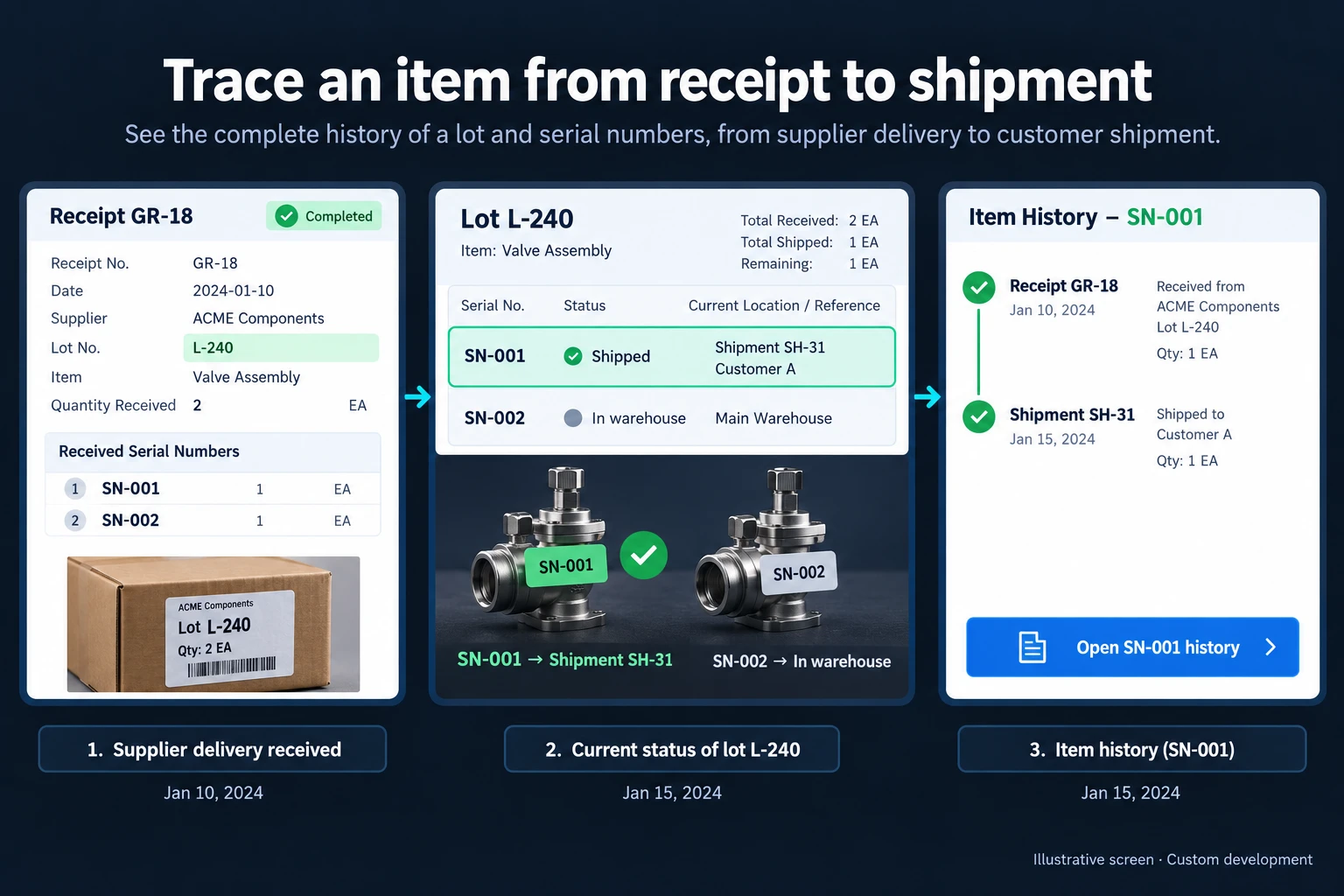
The illustration is fictional. Lot L-240 links to receipt GR-18 and contains serials SN-001 and SN-002. SN-001 has been sent to customer A in shipment SH-31. SN-002 remains in the warehouse. Sharing a lot does not mean both units have been shipped.
Opening SN-001 shows its receipt, lot relationship and SH-31 in one history. That view does not change the warehouse status of SN-002. If a shipment is cancelled or an item returned, the new movement links to the previous record instead of deleting the evidence of the earlier shipment.
Define identity before building the history
I establish whether serial numbers are unique across the whole business, within a product family or within a supplier. Different suppliers may reuse the same number, so its context matters. A barcode simplifies entering an identifier; it does not automatically make an incorrect item relationship valid.
One serial should not be active in two shipments at the same time. Split lots, warehouse transfers and customer returns need their own linked movement rules. Missing evidence remains visible as a gap, rather than being filled with a guessed document. Authorised corrections retain the reason and the previous relationship.
Start with the stock system you already use
An existing inventory or resource planning system may already support the lot and serial relationships you need. A simple product list may also work well in Excel. A custom application is useful when traceability must connect your own receipt and shipment records across different sources. Product or sector compliance requirements remain separate; a tracking screen is not itself a certification.
Making the scope testable
I start with a de-identified example of your current file or screen and the roles of the people using it. The written scope defines where each field comes from, who can change it and where the result goes. I test selecting SN-001 for a second shipment, retaining SN-002 in the warehouse and a return linked to SH-31. Lot totals must agree with the individual serial states.
The scope also covers exports, the backup approach and who handles failures. We review the first version against one real workflow before planning further connections.
Frequently Asked Questions
Are a lot number and a serial number the same?
In this design, a lot identifies a group and a serial identifies one unit in that group. If your business only records lots, the screen must not imply that it can prove individual-item history.
Does a returned item lose its earlier history?
No. A return is designed as a new movement linked to the previous shipment. We separately define when the item can become available for use or sale again.
Can old Excel records be imported?
Yes, after validating their identifiers and relationships. Missing lot or shipment references go to review. I do not claim a complete historical trail where the source records cannot support it.
Discuss your workflow
To count units still in the warehouse, such as SN-002, and compare them with recorded stock, see barcode inventory counts. Explore custom web applications for your team or contact me with an example of the process you want to improve.
How do I work?
Work-hour packages
Tell me about your business and what you need on WhatsApp or by phone; we agree on a work block of somewhere between 5 and 40 hours and I start doing what is needed. What you get is not a calendar window — it is net working hours spent directly on your business. I can use 40 hours working three days straight, or deliberately spread it out and finish it over a year — whatever the work calls for. I do not spend my time estimating how long something will take, I spend it doing the work; every hour I spend leaves a lasting result in your business. We keep going for as long as you find it useful.
Why not monthly?
Is 40 hours a week?
On a fixed monthly fee both sides are watching the wrong thing: you watch a fixed cost, the other side watches how many more contracts like this they can line up. Working by the hour puts us both in front of the same thing — the real value of the work that got done. I know not having an upfront answer to "how much will this cost in total?" is the natural cost of this model. But instead of paying a fixed fee for months to a setup that is not producing results, you only pay for the qualified time spent on your work — and you see exactly where that time went, start to finish. That is why my clients keep coming back.