
Bank Reconciliation and Finance Workflow App
If your team rebuilds the connection between bank transactions, card settlement reports, corporate card statements and accounting exports every month, I can develop a web application around your own control rules. Finance leaders can investigate differences, team members can own their tasks, and source documents and approvals can remain attached to the same record.
This is a custom development service for organisations with multiple companies, branches, bank accounts, collection channels or expense owners. The aim is to build a control and workflow layer around your existing accounting and ERP records. We agree at the start which system remains the official source and which information is held only for operational follow-up.
Which four sources does card reconciliation compare?
Card and bank reconciliation checks whether four separate sources agree, and each answers a different question.
| source | where it comes from | question it answers |
|---|---|---|
| Sales record | Till, ERP or online order | What did we sell, on which card type, in how many instalments? |
| Terminal batch | Terminal end-of-day report, online gateway report | Was the card actually charged, or voided? |
| Merchant statement | Acquirer’s statement or settlement report | What fee was deducted, and when will it be paid? |
| Bank account | Bank export (Excel, CSV or PDF) | Which day did the money arrive? |
Stripe’s payout reconciliation report follows the same logic: it matches each bank payout with the transactions it settles and itemises every payment, refund, dispute and fee. The app keeps those lines separate, because one “deductions” figure would hide the deviation you are looking for.
If you sell through a marketplace or a payment provider, the four layers stay the same; two of them change source. The provider’s transaction report takes the place of the terminal batch, and its payout or settlement report takes the place of the merchant statement. Such reports often combine the net of many orders into one payout, so the single bank line closes through a many-to-one match. The app imports each order’s gross, fee and payout date as separate lines, so a payout can be traced down to the order number.
A worked month: three channels, two acquirers
The business and every figure below are fictional and shown without a currency symbol. It sells by card through a terminal at the main store (acquirer A), an online gateway (also A) and a terminal at a branch (acquirer B). Rates and holding periods are an example agreement, not any provider’s pricing. “Paid after a hold” means the acquirer pays card sales a fixed number of days after the sale instead of the next day; in this example it charges no fee in return. The example follows Turkish card-acquiring practice, where a merchant can choose next-day payout with a fee or a fixed holding period without one, and customers can split a card payment into instalments at the till. The four-layer comparison itself is not specific to any country.
| September (example data) | Main store · A | Online · A | Branch · B |
|---|---|---|---|
| Settlement terms (example) | Next day, fee deducted | Next day, fee deducted | Paid after a hold, no fee |
| ERP / order record | 1,240,000 | 350,000 | 480,000 |
| Terminal batch / gateway report | 1,236,500 | 352,400 | 480,000 |
| Fee on the statement | 32,882.50 | 9,867.20 | 0 |
| Refunds on the statement | −12,000 | 0 | 0 |
| Received in September | 1,189,267.50 | 341,732.80 | 414,500 |
| Difference needing correction | 3,500 + 270 | 2,400 | none |
The fee line is taken here by transaction date. If your statement deducts fees on the payout date, align the date ranges before comparing.
One equation links all three channels:
Received = terminal gross − fees − refunds − net carried to later months + net arriving from earlier months
For the main store: 1,236,500 − 32,882.50 − 12,000 − 41,300 + 38,950 = 1,189,267.50. Read from totals alone, the branch looks 65,500 short. The equation shows nothing is missing.
Three kinds of item appear below. A difference needing correction has a known cause but stays open until someone acts (a void, an overcharged fee, a duplicate charge). A timing item is not an error, just money whose payout date has not arrived or arrived last month (held receivables, month-end drift). An unexplained difference fits neither and goes to the top of the queue.
Main store: a void, an overcharged fee and month-end drift
The ERP shows 1,240,000 in card sales; terminal batches total 1,236,500. The app finds the 3,500 on 17 September: a sale voided on the terminal before the batch closed is still invoiced in the ERP. A void does not reach the statement (check how your acquirer handles this), so the correction belongs in the ERP.
The fee check uses the example agreement. All rates are fictional:
| breakdown (example) | batch amount | example rate | expected fee |
|---|---|---|---|
| Credit cards, single payment | 616,500 | 2.50% | 15,412.50 |
| Debit cards | 400,000 | 1.00% | 4,000 |
| Three-instalment sales | 220,000 | 6.00% | 13,200 |
| Total | 1,236,500 | 32,612.50 |
The statement shows 32,882.50. The app narrows the 270 to one line: an 18,000 debit transaction charged at the credit rate, 450 instead of 180. It goes to the finance manager to dispute.
Timing explains the rest. With next-day settlement, 30 September’s net (41,300) arrives on 1 October and 31 August’s net (38,950) arrived on 1 September. Weekends and public holidays widen the drift. The app flags “late” only after the expected payment date.
Online: one order, two charges
The gateway shows 2,400 more than the order system: one order was charged twice. A rule catches two successful charges on one order number; the item stays open until the refund settles. With the example 2.80% fee and the same month-end drift (11,200 carried to October, 10,400 in from August), 341,732.80 arrived in September.
Branch: sold, but not in the bank yet
Acquirer B pays credit card sales after 30 days and debit card sales after 15. Instalment sales arrive one instalment a month. September sales were 480,000: 300,000 credit, 100,000 debit and 80,000 in four instalments.
| Received in September (example data) | amount |
|---|---|
| August credit card sales, hold released | 286,000 |
| Late-August debit card sales | 45,500 |
| Early-September debit card sales | 52,000 |
| September instalments from earlier sales | 31,000 |
| Total | 414,500 |
September’s 480,000 splits in two: 52,000 already paid, and 428,000 still on hold at 30 September (300,000 credit, 48,000 debit, 80,000 of instalments over four months). The same equation for the branch: 480,000 − 428,000 (still on hold) + 362,500 (from earlier months: 286,000 + 45,500 + 31,000) = 414,500. No fees, no refunds; the whole 65,500 gap is a timing item.
What comes out at month end
Differences needing correction are assigned to a person; timing items are checked automatically on their due date.
- 3,500, main store (correction): store fixes the ERP, accounting approves.
- 270, main store (correction): finance manager disputes.
- 2,400, online (correction): accounting refunds; closes when the refund settles.
- 428,000, branch (timing): each amount listed with its payment date.
- 41,300 main store and 11,200 online (timing): checked automatically on 1 October.
In this example there is no unexplained difference. The team reviews 6,170 needing correction instead of 2,070,000 of card sales. If your acquirer pays next day with a fee, look at fee lines first; if it pays after a hold, look at the receivables schedule first.
What is the expected fee table?
The expected fee table is the app’s record of what each acquirer should charge, by card type, instalment count and settlement terms, so every fee line on a statement can be checked against it. I pay attention to three details when setting it up:
- Tax included or not. Some acquirers quote rates with local tax included. If the table does not fix this from the start, every line shows a false deviation.
- Instalment count gets its own row. Where instalments exist, the fee and the holding period can rise with the number of instalments, so one “instalment rate” is not enough.
- Early release is a separate fee. If you draw held money early, a separate fee line may appear. Mixed into the sales fee, it looks like a rate deviation.
When your agreement changes, a new dated version of the table is opened and earlier months are still checked against the old rates.
Try it on your own statement:
- Write down your contract rates by card type and instalment count, and decide whether tax is included.
- Total your terminal batches with the same breakdown. If your report lacks it, ask the acquirer for a report that has it.
- Multiply each line by its rate, add them up and compare with the fee on the statement. Make sure both sides cover the same date range: if the statement deducts fees on the payout date, the month edges shift by a day.
- If they differ, check misclassified card types first, then early release fees, then tax.
For a dispute, prepare: the statement line and date, transaction date and amount, card type and instalment count, the authorisation code on the receipt, the dated version of the contract rate, and the expected versus charged amount. Check the dispute deadline in your contract.
Instalments, refunds and chargebacks in brief
An instalment sale here means the customer splits a card payment into monthly instalments at the till, an option acquirers offer in some markets, including Turkey. Depending on the acquirer, the merchant may be paid one instalment a month, in full the next day with a higher fee, or in full with interest added to the cardholder’s instalments (Halkbank, for example, documents these three models). The app opens one expected receipt per instalment and closes each as it arrives.
A refund arrives as a separate negative line with its own date, so it matches the ERP’s credit note rather than the original sale. In the worked month, the main store’s −12,000 is a 22 September refund of a 9 September sale; the app matches it to the credit note and links it to the original sale. Whether the fee is returned on a refund depends on your contract; the example assumes it is not, so the refund does not change the 32,882.50 fee. A chargeback (a cardholder disputing a charge through their bank) arrives as another negative line; a foreign currency sale stores its settlement currency and rate.
Bank transfers: which invoice does this line belong to?
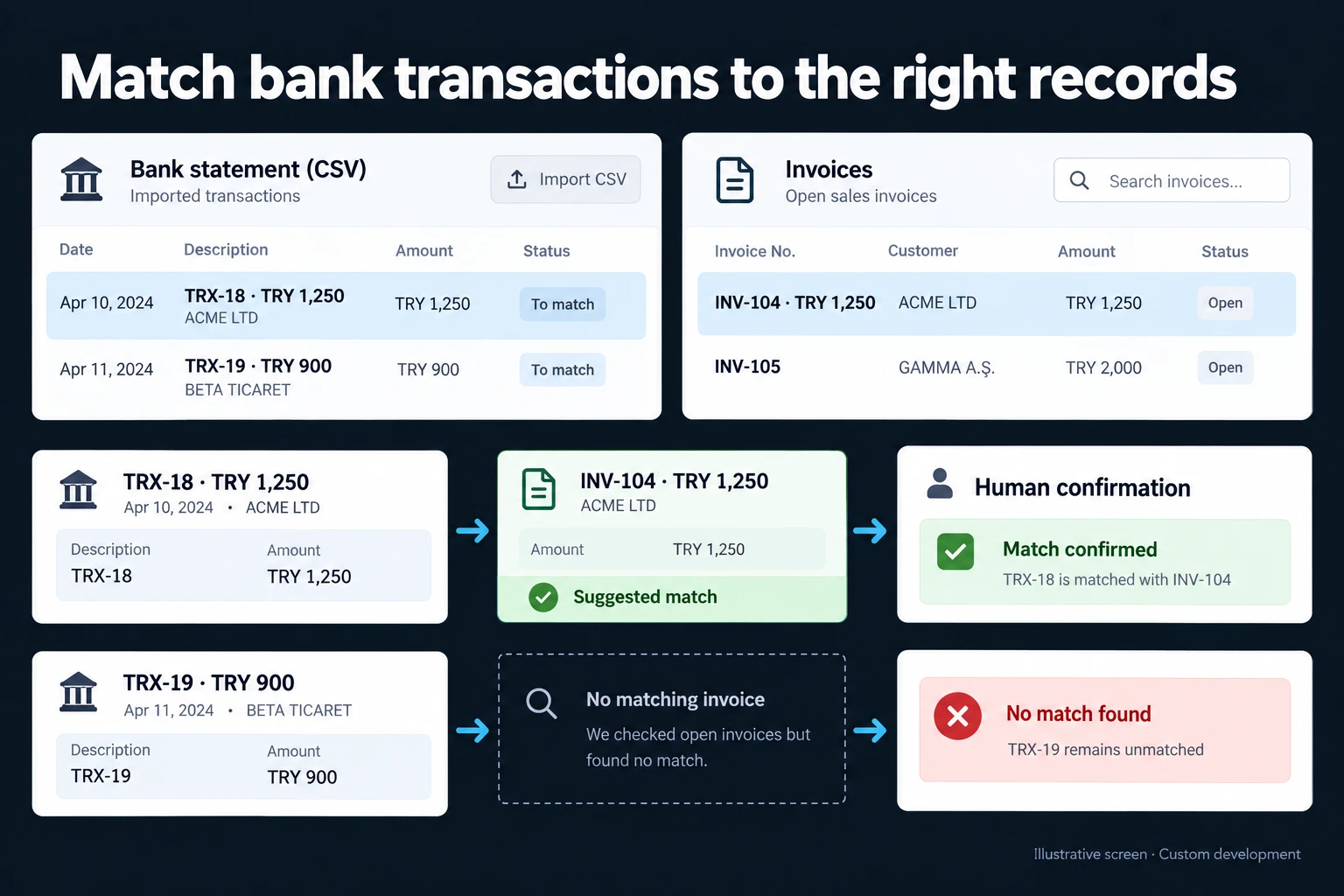
For customer bank transfers the question is which customer and invoice a bank line belongs to. The illustrated records are fictional; the worked month above is currency-neutral, and only this illustration uses Turkish lira (TRY). Bank line TRX-18 is TRY 1,250, and open invoice INV-104 is also TRY 1,250. The screen suggests the match on amount and customer; it is not confirmed until a reviewer approves it. TRX-19, TRY 900, has no suitable record and stays open.
Matching rules: which rule for which situation?
Matching runs from strict to loose rules, and every match records the rule that produced it. A strict rule with one candidate suggests; a loose rule only lists candidates.
| rule | example | how it works |
|---|---|---|
| Exact reference | INV-107 on bank line and invoice | Reference and amount agree: strong suggestion |
| Amount + date window | One open 1,250 invoice in the last 10 days | One candidate: suggestion; several: a list |
| Tolerance | Batch 52,418.40, statement gross 52,418.38 | Within a pre-agreed rounding tolerance; its approver is recorded |
| Many-to-one | 214 terminal transactions, one deposit | Gross day total minus fee matches the deposit |
| One-to-many | One transfer pays three invoices | Screen shows the split; a person approves it |
| Partial | 6,000 against a 10,000 invoice | Part-paid; 4,000 stays open |
A fully allocated bank line cannot quietly be reused, and when two open invoices share an amount, the app shows both.
Who does what: roles and permissions
Role separation means one person cannot match, approve and reverse the same item. The access model follows the agreed business rules.
| action | branch cashier | accounting | finance manager | auditor |
|---|---|---|---|---|
| Uploads own branch’s batches and voids | ✓ | ✓ | — | — |
| Uploads bank and merchant statements | — | ✓ | ✓ | — |
| Approves a suggested match | — | ✓ | ✓ | — |
| Takes ownership of and closes an exception item | ✓ (own branch) | ✓ | ✓ (disputes) | — |
| Changes tolerance or expected fee table | — | — | ✓ | — |
| Reverses a confirmed match, with a reason | — | ✓ (open period) | ✓ | — |
| Closes or reopens a period | — | — | ✓ | — |
| Sees everything, changes nothing, exports the audit trail | — | — | — | ✓ |
A cashier sees only their own branch. If accounting and finance are one person, “no approving your own match” goes to a second person or is switched off on record. The same approval logic for corporate card statements and receipts is on the expense receipt and document tracking page.
Daily unresolved work comes before the month-end spreadsheet
Reconciliation delays do not always start with difficult calculations. Nobody knows who should provide a receipt, sales has not passed on a customer’s payment explanation, or the same expense is waiting in two different files. The finance team must chase missing information while comparing numbers.
I can connect each transaction to its document, clarification request and responsible person. A team member can see why a difference remains open and what should happen next. A manager can review unresolved work by person, company, period and reason for delay.
The purpose is to make rule-based matches and cases requiring review easy to distinguish. It is also to avoid requesting the same explanation repeatedly and to retain the evidence supporting a closing decision. Automatic approval of every transaction is not the objective.
Finance CRM gives ownership to customer and supplier relationships
For a finance team, CRM can be a record of who is waiting for payment confirmation, which supplier has not responded to a statement reconciliation, and which colleague has already spoken to them. It is more than a sales pipeline view.
A customer or supplier record can hold authorised adult contacts, the responsible team, open tasks and conversation notes. The accounting balance is shown with its source and update time. A conversation note must not change that balance, and a promise to pay must remain distinct from a received payment.
A disputed invoice, missing delivery document or payment sent to the wrong account can become a separate tracked task. Sales can see a clarification request relating to its customer without receiving access to every bank transaction or other customers’ balances.
Ten practical screens for the team
| Screen | What the user can do |
|---|---|
| Daily finance desk | Review open differences, missing documents and overdue tasks |
| Bank transactions | Inspect the source row, account and matching status |
| Card settlement reconciliation | Trace gross collections, deductions, refunds, holds and net receipts |
| Corporate card expenses | Connect a statement entry to its document and expense owner |
| Account relationship record | Follow payment confirmations, disputes and statement discussions |
| Missing-document queue | Request an invoice or explanation |
| Approval queue | Review corrections and exceptions within the user’s authority |
| Period closing list | See completed controls alongside unresolved differences |
| Cash view | Separate received payments, expected collections and planned payments |
| Import and activity history | Inspect files, rules, users and connection failures |
All these screens do not need to be delivered in the first stage. If bank and settlement comparison consumes most effort, the first release can centre on that workflow. Corporate cards, supplier confirmations and management reporting can then be added to the same underlying record structure.
WhatsApp and SMS should remind the right person about an open task
Checked 30 October 2026: outside the 24-hour service window following the latest user message, WhatsApp Business Platform requires approved message templates. WhatsApp policy.
| Trigger | Recipient | Check before sending |
|---|---|---|
| Missing expense document | The expense owner | Correct person, open task and repeat interval |
| Collection needs clarification | Authorised customer contact | Finance approval and correct account relationship |
| Statement confirmation is pending | Authorised customer or supplier | Message purpose, record and communication authority |
| Dispute review has finished | The adult who raised the dispute | An approved response |
| Manager approval is pending | Internal approval owner | Authority, delegation and task still being open |
| A secure link is available | The relevant record owner | Link expiry and authentication requirements |
Messages should avoid unnecessary account statements and information about other people’s debts. Where appropriate, recipients can use a secure link to a record they are authorised to access. Reprocessing the same event must not create another message. Sent, failed, cancelled and awaiting-response states should remain visible.
WhatsApp uses the official Business Platform under its permission and template requirements. An approved template is required outside the service window following the customer’s last message. SMS uses an authorised provider and appropriate permission and opt-out records; Turkish commercial messaging requirements, including İYS where applicable, are assessed separately. A financial relationship is not unlimited marketing permission. The WhatsApp policy and İYS guidance inform the scope.
AI can read documents while authorised people make financial decisions
AI can support proposed field extraction from invoices or receipts, summaries of lengthy payment conversations, and drafts requesting missing information. The relevant source page or row can be shown alongside the suggestion. An unreadable amount, ambiguous date or conflicting company name must not become a confirmed fact.
When someone asks why a record is pending, the application can summarise source conversations and open tasks. That summary should not decide payments, set credit limits, provide a tax interpretation, issue a conclusive fraud finding or impose employee sanctions.
We also define which documents may be sent to external processing services. Unnecessary personal fields can be removed, and retrieval remains within each user’s permissions. Providing an AI feature does not justify opening the entire finance archive through a single unrestricted chat interface.
Excel migration needs source ownership and total checks
We first identify the file owner, the company and period represented, and the meaning of each field. Date formats, decimal separators, currency and debit/credit direction are checked using sample rows. Two separate accounts should not be merged because their names happen to look similar.
An upload first produces a preview and error list. Source row counts and amount totals are compared against accepted and rejected records. We define how a repeated upload is recognised and whether a changed row represents a new transaction or a correction.
Opening balances and historical periods become final only after authorised approval. We agree when the old spreadsheet becomes an archive. If corrections will continue in both places, migration is not complete until responsibility for reconciling those changes is clear.
Verify access before promising bank, ERP or e-document connections
An initial release can use controlled CSV or Excel imports. Real API access, contractual conditions and permissions for banks, settlement providers, accounting systems and e-document providers are investigated separately. Different providers may expose different information and history.
Reading and writing are distinct scopes. Reading accounting transactions, posting a journal entry and sending a bank payment instruction do not require the same authority. Any write connection needs its own approval rules, retries, duplicate protection and confirmation from the receiving system.
The application does not automatically replace official books, a professional accountant or an authorised e-document service. Producing a PDF is not the same as issuing a legally valid e-invoice. A connection failure should show the last successful update, with a control preventing critical actions when current source data is required.
Management reporting separates actual movements from expectations
Reports can show open differences, expenses waiting for evidence, confirmations sent to counterparties and corrections awaiting approval by company, bank, branch and period. Closing progress should reflect the required controls rather than merely counting checked boxes.
A cash view separates a bank-confirmed receipt, a customer’s promise to pay and a team’s proposed payment plan. A forecast must not appear as cash already received. Users should be able to see the calculation method, data timestamp and any excluded companies or accounts.
Amounts sitting in the error queue remain visible. Missing sources are flagged in the relevant report, and critical transfers can stop until an inconsistent record is resolved. A manager can trace a reported result back to the underlying row.
Paid scoping, a pilot period and team training
The initial paid scope uses representative or anonymised files to map the current process. We identify the most repetitive control, record owners, available connections and acceptance criteria. Pricing and scheduling follow the agreed scope.
A pilot compares the proposed application with the existing process for a selected company, account or period. Broader use follows explanation of differences and practical testing of users’ responsibilities. Training includes incorrect files, delegated authority, withdrawn approvals and connection failures, alongside everyday screen use.
Support scope covers backup, restoration checks, access removal, provider changes and updates to control rules. We define the escalation route during period closing and which changes require a fresh assessment.
Validate delivery with realistic acceptance scenarios
- Uploading the same bank file again must not create a second receipt.
- A transaction in the wrong currency must not silently match an account.
- Allocating one transfer across several invoices must preserve the total.
- A cancelled card transaction must remain linked to the original record.
- An expense owner must not open another employee’s document through a link.
- A source change after approval must trigger the required review.
- Retrying a failed notification must not create unnecessary copies.
- A critical transfer must stop under the agreed rule when ERP data is stale.
When a custom application may not be appropriate
If your existing accounting product already supports the workflow reliably, improving its configuration and use may be more valuable. A comprehensive custom system may be unnecessary where one person handles a small, straightforward transaction set.
Processes need clarification first when nobody owns the source, approval rules are disputed, or everyone is expected to see all bank information. Software cannot create financial accountability by itself. It can make agreed responsibilities practical and traceable.
Frequently Asked Questions
Do we have to replace our accounting software?
Usually not. The application can control files or permitted data from the existing system. We agree the source of record and transfer direction at the beginning.
Can you connect directly to every bank we use?
Access must be verified for each bank and account. Controlled file exchange may be an option where an appropriate API is unavailable. Connections are not promised in advance.
Will the application make payments?
This scope covers tracking and approval controls. Sending payment instructions to a bank requires a separate integration, authority and acceptance process.
What happens if AI reads an amount incorrectly?
The field is compared with the source document and uncertainty goes to review. Financial arithmetic does not depend on text generation, and critical actions cannot proceed on an unverified field.
Can historical spreadsheets be imported?
They can be assessed if their structure, quality and ownership support migration. A sample period is checked first, and duplicates and total differences must be explained before approval.
Will users from different companies see each other’s data?
Access can follow company and responsibility boundaries. Viewing, editing, approving and exporting are separate permissions, tested during acceptance.
Define the control that keeps your finance team waiting
Your scope enquiry can describe your company and branch structure, accounting system, file sources and most time-consuming reconciliation. You do not need to send real statements or employee documents for an initial conversation. Through a paid scope using sample data, I can define the screens, connections and acceptance conditions of an application suited to your operation.
How do I work?
Work-hour packages
Tell me about your business and what you need on WhatsApp or by phone; we agree on a work block of somewhere between 5 and 40 hours and I start doing what is needed. What you get is not a calendar window — it is net working hours spent directly on your business. I can use 40 hours working three days straight, or deliberately spread it out and finish it over a year — whatever the work calls for. I do not spend my time estimating how long something will take, I spend it doing the work; every hour I spend leaves a lasting result in your business. We keep going for as long as you find it useful.
Why not monthly?
Does a 40-hour block mean one week?
On a fixed monthly fee both sides are watching the wrong thing: you watch a fixed cost, the other side watches how many more contracts like this they can line up. Working by the hour puts us both in front of the same thing — the real value of the work that got done. I know not having an upfront answer to "how much will this cost in total?" is the natural cost of this model. But instead of paying a fixed fee for months to a setup that is not producing results, you only pay for the qualified time spent on your work — and you see exactly where that time went, start to finish. That is why my clients keep coming back.