
Guest File Upload Forms for Customer Documents
A customer sending a drawing, document or service photo does not always need a new account in another system. I build upload screens where a customer follows an invitation link and the team receives the file against the correct business request.
Guest access still needs boundaries. We define which request the invitation belongs to, when it expires, which files it accepts and who can download them afterwards. The result is a delivery point for a specific piece of work, rather than an unrestricted public file box.
Example: documents for RF-208
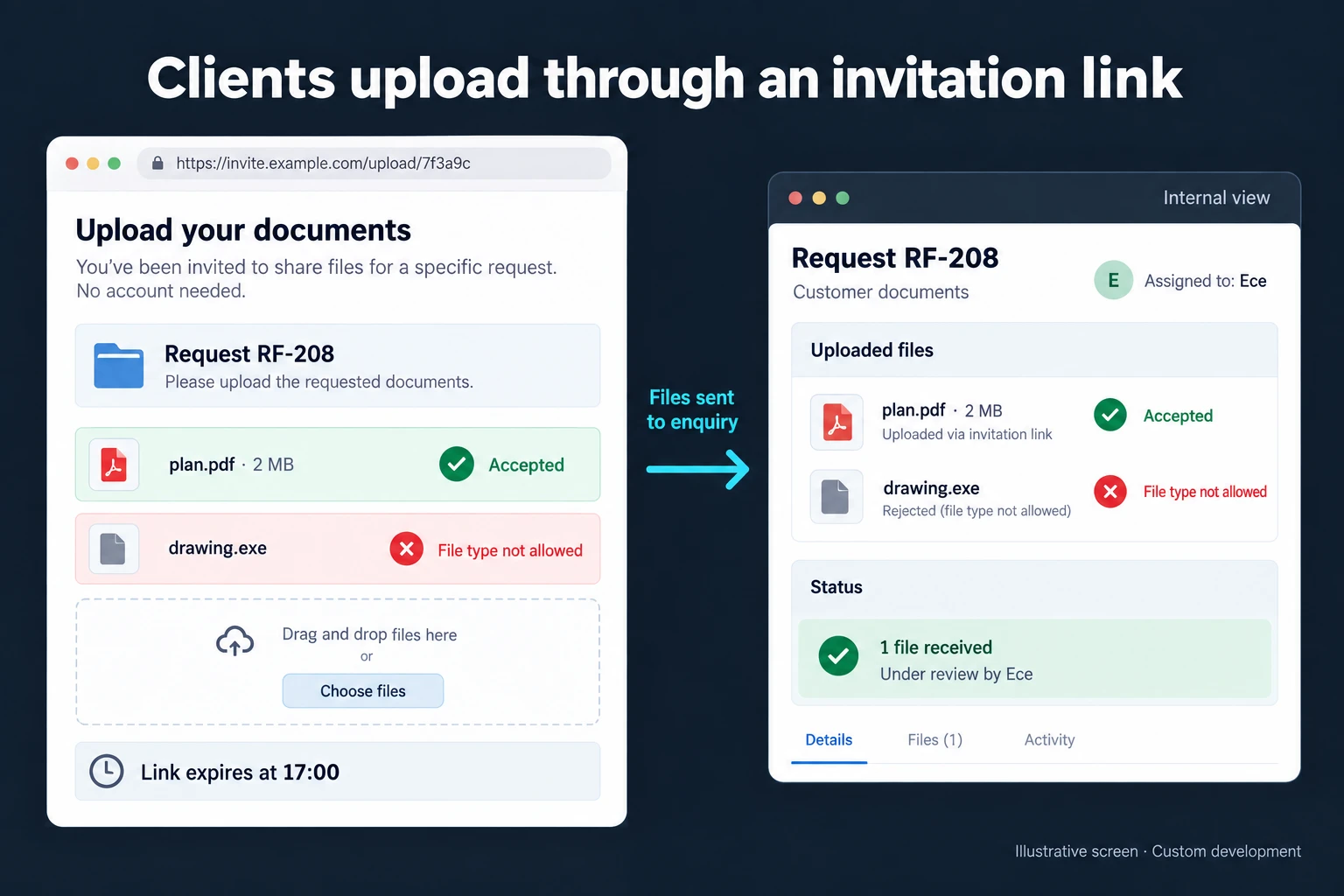
The illustration is a fictional upload flow for RF-208. plan.pdf · 2 MB is accepted. drawing.exe is rejected because its type is not allowed. The invitation expires at 17:00. That time belongs to the example invitation; it is not a fixed duration for every customer.
The accepted document appears within RF-208 for the authorised reviewer. The rejected file does not count as a completed requirement. If the customer’s connection drops, the screen needs to explain whether the upload finished. Retrying a file must not create a separate request or hide an earlier successful delivery.
How this differs from Google Forms uploads
Google’s respondent help page states that answering a file-upload question requires signing in to a Google account. This does not mean that every Google Form requires sign-in. If your customers already use suitable accounts, the existing upload flow may be entirely adequate.
A dedicated screen is useful when you need your own invitation method, request-specific permissions, different checks or document delivery independent of the customer’s Google account. If the applicant also needs to see missing items, the upload can connect to an application status portal.
Define the invitation and file rules
I use an unpredictable invitation reference and check its expiry and status on the server. A one-time invitation can close after successful delivery. If several documents are expected, we define when that delivery session counts as complete. Additional email verification can be included where possession of the link alone is not enough.
A filename extension is not the whole validation process. The scope specifies file types, size limits, content inspection and any quarantine requirement. Downloads are also checked against the request’s permissions; files are not simply placed at public addresses. Receiving a second file with the same name may create a version rather than overwrite the first document.
Ownership and ongoing operation
The delivery plan identifies who sends invitations, who can renew an expired link and how a document attached to the wrong request is corrected. Retention periods, deletion rights and the treatment of backup copies are explicit decisions. Building a custom screen does not settle them automatically.
I test mobile photo uploads, interrupted transfers, duplicate attempts and expired invitations. A longer application can combine this with a save-and-resume form. The broader review process can remain part of the same custom web form application.
Frequently Asked Questions
What if someone forwards the invitation?
Possession of a link may grant access under the chosen design. Where that is inappropriate, I add verification. Expiry, use limits and revocation narrow the invitation’s scope but are not substitutes for choosing the right identity check.
Can customers upload any file size?
No. Limits should match the work and storage arrangement. Large technical drawings and small service photos may require different upload and review behaviour.
Discuss your workflow
Tell me which documents you collect and how staff use them. I can outline a guest upload flow that stays connected to the right request and gives the customer a clear delivery result.
How do I work?
Work-hour packages
Tell me about your business and what you need on WhatsApp or by phone; we agree on a work block of somewhere between 5 and 40 hours and I start doing what is needed. What you get is not a calendar window — it is net working hours spent directly on your business. I can use 40 hours working three days straight, or deliberately spread it out and finish it over a year — whatever the work calls for. I do not spend my time estimating how long something will take, I spend it doing the work; every hour I spend leaves a lasting result in your business. We keep going for as long as you find it useful.
Why not monthly?
Is 40 hours a week?
On a fixed monthly fee both sides are watching the wrong thing: you watch a fixed cost, the other side watches how many more contracts like this they can line up. Working by the hour puts us both in front of the same thing — the real value of the work that got done. I know not having an upfront answer to "how much will this cost in total?" is the natural cost of this model. But instead of paying a fixed fee for months to a setup that is not producing results, you only pay for the qualified time spent on your work — and you see exactly where that time went, start to finish. That is why my clients keep coming back.