
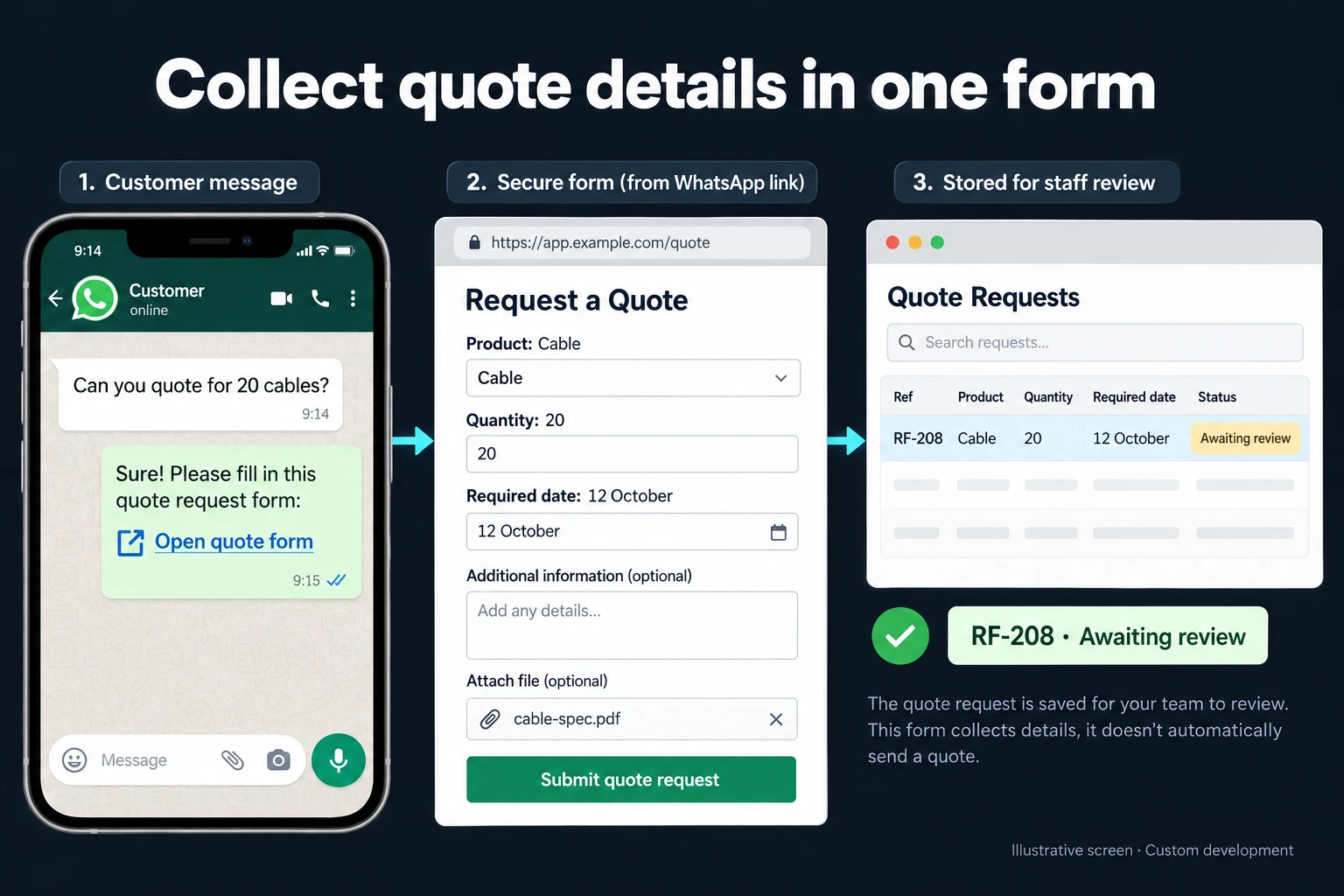
Quote Request Forms Opened from WhatsApp
Quote enquiries can become scattered across WhatsApp messages: quantities in one message, a drawing in another and a deadline mentioned later. I build a form that opens from the conversation and gathers the information into one request for the sales team to review.
Submitting the form does not automatically accept a price or promise a delivery date. It creates a structured starting point for preparing the quote.
Example: one request for 20 cables
In the illustrative conversation, the customer asks for a quote for 20 cables. A team member shares the form link. The customer selects Cable, enters a quantity of 20 and requests 12 October. A technical drawing can be attached to the same request.
Submission creates RF-208 with the status Awaiting review. The product, quantity, requested date and document remain attached to that identifier. The customer’s requested date is kept separate from any delivery date the business later confirms.
When a ready-made form is enough
Google Forms or an existing CRM form may be sufficient for a few fixed fields and a straightforward quoting process. WhatsApp Flows also offers structured interactions. I assess whether a separate web form is needed before proposing one.
A custom form is useful when product choices reveal different technical fields, customers have different catalogues or a request contains a variable number of items. Dependent dropdowns can restrict combinations to the models available for the selected product.
Keeping the conversation and request connected
A request-specific link needs an expiry rule and a defined record scope. Possessing the link must not expose other customers’ requests.
Repeated submission is handled explicitly: it either updates the current draft or creates a new request according to the agreed rule. If a product has been removed from the catalogue while the form was open, the server checks its availability again.
Changing a quantity or required date must not silently leave an earlier quote valid. Request versions can connect to quote revision tracking, so sales staff know which information they priced.
Uploads have file-type, size and access controls. A partially uploaded drawing is not shown as a completed attachment. Missing technical information is explained to the customer at the relevant field.
Form links and WhatsApp notifications
Staff can share the form link manually in a current conversation. Automated sending adds a separate scope: an official Business Platform connection, an eligible account and recipient permission.
The WhatsApp messaging policy governs the service window and approved templates. Building a form does not remove those requirements.
The first delivery can therefore focus on collecting requests. Acknowledgements and requests for additional information can be connected later using defined messaging rules.
Implementation and handover
I identify the information sales staff actually need to prepare a quote. Tests cover a complete request, missing documents, invalid products and repeated submissions.
The handover specifies who updates the catalogue, who can change form fields and how records can be exported. Additional pricing rules are scoped separately.
Frequently Asked Questions
Does the customer receive an immediate price?
That can be built where the calculation rules are clear. For work requiring technical review, creating a request without an automatic price may be more suitable.
Can the customer edit the request later?
Editing can depend on the request’s status and deadline. A change affecting an existing quote returns it to the responsible person for review.
Discuss your workflow
Share the information you currently collect through WhatsApp. We can design a form that gathers enough detail for quoting without adding unnecessary questions.
How do I work?
Work-hour packages
Tell me about your business and what you need on WhatsApp or by phone; we agree on a work block of somewhere between 5 and 40 hours and I start doing what is needed. What you get is not a calendar window — it is net working hours spent directly on your business. I can use 40 hours working three days straight, or deliberately spread it out and finish it over a year — whatever the work calls for. I do not spend my time estimating how long something will take, I spend it doing the work; every hour I spend leaves a lasting result in your business. We keep going for as long as you find it useful.
Why not monthly?
Is 40 hours a week?
On a fixed monthly fee both sides are watching the wrong thing: you watch a fixed cost, the other side watches how many more contracts like this they can line up. Working by the hour puts us both in front of the same thing — the real value of the work that got done. I know not having an upfront answer to "how much will this cost in total?" is the natural cost of this model. But instead of paying a fixed fee for months to a setup that is not producing results, you only pay for the qualified time spent on your work — and you see exactly where that time went, start to finish. That is why my clients keep coming back.