
Consent Mode V2 Setup | Measurement With Consent
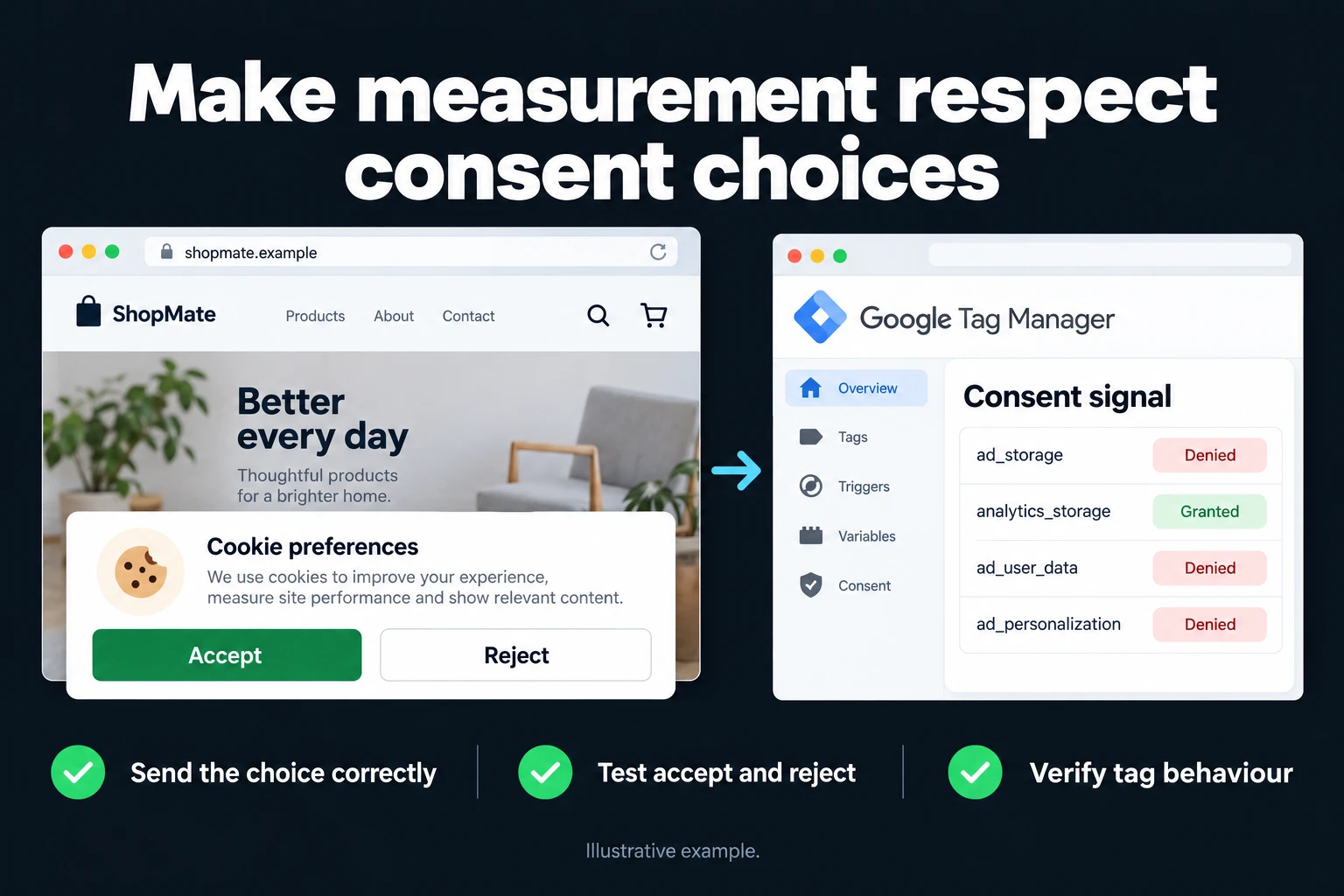
Consent Mode connects a visitor’s choices to Google tag behaviour. My deliverables are a consent-purpose map, tag rules and recorded acceptance, rejection and withdrawal tests. I review the existing site and banner before defining scope in writing; use the contact page to get started.
Does a business selling only in Turkey need this?
Google’s EU user consent policy covers visitors in the EEA, the UK and Switzerland. A Turkey-based business can receive such visitors through exports, tourism or overseas partners. Separately, Turkish cookie requirements need their own legal assessment. A geographic limit in Google’s policy is not an exemption from local obligations.
I implement the approved consent design so the choice in the banner reaches the tags. The legal adviser determines the applicable requirements.
Four signals in plain language
ad_storage: permission for advertising-related storage.analytics_storage: permission for analytics-related storage.ad_user_data: consent to send user data to Google for advertising.ad_personalization: consent for personalised advertising.
Map the banner categories to these signals deliberately. Set the initial defaults before measurement commands run, then update them when the visitor makes a choice. Region-specific defaults are possible, but need testing against the approved consent design. The presence of a banner alone does not establish either correct tagging or legal compliance.
Sources checked in October 2026: Consent Mode · Consent Mode · KVKK Çerez Rehberi.
How do basic and advanced mode differ?
Basic mode blocks Google tags until consent is granted. Advanced mode can load them with a denied default and send cookieless measurement signals. Blocking tags after rejection is not inherently a configuration fault: it may be the intended basic-mode behaviour.
Checked on 15 October 2026: Google’s implementation comparison. Cookieless signals do not mean no data transfer or establish legal anonymity. Choosing a technical mode does not replace a data-processing assessment.
What do I test?
| Scenario | Check | Evidence |
|---|---|---|
| First visit, no choice | Defaults, tag order and network requests | Clean-session record |
| Reject all | Tag and storage behaviour for the agreed mode | Network and storage inspection |
| Accept | Only permitted purposes activate | Consent state and event record |
| Withdraw and reload | Updated choice persists and applies | Repeat-visit test |
ad_storage, analytics_storage, ad_user_data and ad_personalization represent separate purposes. Google’s built-in checks do not automatically control Meta or custom HTML tags. I configure each third-party tag separately.
Implementation and modelling limits
I map the banner’s stored choice to the values used by the site. Then I check that defaults precede tags, updates apply on the current page and the choice persists during navigation.
Modelling estimates unobserved behaviour. It is not guaranteed to work for every site or recover every unmeasured conversion. Technical acceptance and reporting eligibility are separate checks; this does not establish individual tracking of every visitor.
Frequently Asked Questions
Is Consent Mode a banner?
No. A banner obtains the choice; Consent Mode communicates it to supporting tags. The connection between them must work.
Does setup guarantee legal compliance?
No. Processing purposes, notices and transfer conditions need separate assessment. I deliver technical behaviour and test evidence.
Should rejection prevent every request?
It depends on the agreed mode. Basic mode blocks Google tags; advanced mode can send cookieless signals. Acceptance criteria are defined beforehand.
I sell only in Turkey. Do I need this?
Google’s policy for European visitors and Turkish cookie obligations are separate questions. Assess visitor geography alongside the consent design approved by your legal adviser.
How do I work?
Work-hour packages
Tell me about your business and what you need on WhatsApp or by phone; we agree on a work block of somewhere between 5 and 40 hours and I start doing what is needed. What you get is not a calendar window — it is net working hours spent directly on your business. I can use 40 hours working three days straight, or deliberately spread it out and finish it over a year — whatever the work calls for. I do not spend my time estimating how long something will take, I spend it doing the work; every hour I spend leaves a lasting result in your business. We keep going for as long as you find it useful.
Why not monthly?
Is 40 hours a week?
On a fixed monthly fee both sides are watching the wrong thing: you watch a fixed cost, the other side watches how many more contracts like this they can line up. Working by the hour puts us both in front of the same thing — the real value of the work that got done. I know not having an upfront answer to "how much will this cost in total?" is the natural cost of this model. But instead of paying a fixed fee for months to a setup that is not producing results, you only pay for the qualified time spent on your work — and you see exactly where that time went, start to finish. That is why my clients keep coming back.