
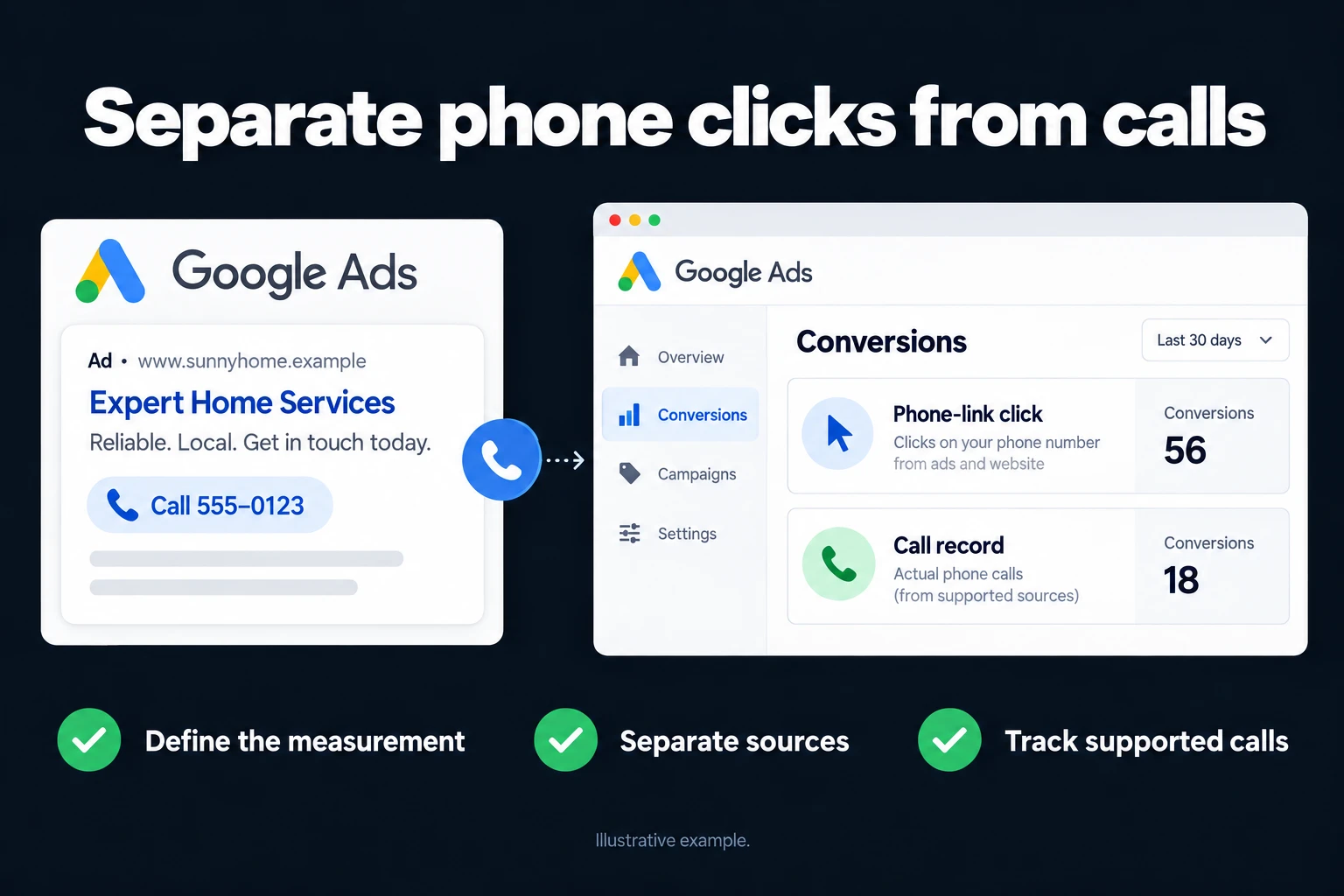
Call Conversion Tracking | Measuring Phone Enquiries
In many sectors customers do not fill in forms, they call. Clinics, law firms, repair services, local trades — the real conversion happens on the phone. If those calls are not measured, campaigns look worse in reports than they actually are.
Why it is critical
An unmeasured conversion is treated as a conversion that never happened. Because Google Ads only learns from the signals it sees, a campaign that converts by phone looks like it is wasting money, and smart bidding pulls budget away from it.
In local service businesses this is the most common structural measurement gap I encounter. In accounts running Maps ads the effect is even larger, since a large share of that interaction is a direct call.
Three measurement points
First, taps on the phone number on the site. A mobile user tapping the number can be measured; this is the easiest setup but the weakest signal, because not everyone who taps actually calls.
Second, calls from an ad call asset. Duration-based Google call reporting depends on forwarding-number availability and is not supported for Turkish numbers.
Third, dynamic numbers on a website. Availability varies by country. For Turkey, assess any independent provider’s coverage, cost and data handling separately.
Feed qualified outcomes back without promising unavailable call imports
For Turkey, distinguish an offline click conversion from Google’s phone-call conversion import. The latter requires a Google forwarding number. As checked in October 2026, Turkey is absent from Google’s forwarding-number availability list, so I do not propose that call-import workflow for a Turkish number.
Where forwarding numbers and call imports are supported, the workflow matches caller number and call start time to a later outcome. That is a country-dependent implementation, not a universal feature.
A workable outcome log for Turkish businesses
Record the enquiry date, source or retained click identifier, qualification status, sale date and business value. A visitor who reaches a website form or a coded WhatsApp enquiry may leave a usable ad-click identifier. If it is collected and matched lawfully, the later qualified outcome can be sent as an offline click conversion using an eligible integration.
A caller who goes straight from an ad call asset to the telephone does not open your site. Do not assume you therefore possess a GCLID or can match that call to a click conversion. Keep such outcomes in the business report unless a supported matching method has been established.
Test with a small upload, inspect accepted and rejected rows, and check counting rules so an enquiry and its later sale are not unintentionally optimised as duplicate successes. Call audio is unnecessary for this outcome log. Any recording requires a separate privacy and legal assessment.
Sources checked in October 2026: Call reporting and supported countries · Phone-call conversion tracking · Importing call conversions.
Filtering low-quality calls
Not every call is a customer. Wrong numbers, job seekers, suppliers, existing customers asking for support — counting all of them as conversions pollutes the data.
If your switchboard or an appropriate independent provider supplies actual call duration, it can be one useful filter: not counting very short calls eliminates most low-quality ones. The threshold has to fit your business; low where appointments are booked quickly, higher where calls need longer conversation.
The reality of opening hours
Directly related to measurement but frequently ignored: a call nobody answers is a loss. Aligning ad schedules with the hours the phone is actually answered produces gains independently of measurement.
The hourly distribution of calls gives enough data to make that adjustment. Raising bids during peak hours is another decision that comes out of the same data.
How do we start? First I work out which channel your customers actually use and how much of it current measurement captures. I send the setup plan in writing. You can reach me from the contact page.
Frequently Asked Questions
Is counting number taps enough?
Better than measuring nothing, but it is a weak signal; not everyone who taps calls, and some callers dial manually. Where possible, move to a method that measures the actual call.
Do I need to record calls?
Not for measurement. If you do record, the other party has to be informed and privacy requirements met; measurement and recording are separate matters.
How are WhatsApp enquiries measured?
That needs a separate setup; the tap can be measured but the outcome of the conversation cannot. I cover it on the WhatsApp conversion tracking page.
How do I work?
Work-hour packages
Tell me about your business and what you need on WhatsApp or by phone; we agree on a work block of somewhere between 5 and 40 hours and I start doing what is needed. What you get is not a calendar window — it is net working hours spent directly on your business. I can use 40 hours working three days straight, or deliberately spread it out and finish it over a year — whatever the work calls for. I do not spend my time estimating how long something will take, I spend it doing the work; every hour I spend leaves a lasting result in your business. We keep going for as long as you find it useful.
Why not monthly?
Is 40 hours a week?
On a fixed monthly fee both sides are watching the wrong thing: you watch a fixed cost, the other side watches how many more contracts like this they can line up. Working by the hour puts us both in front of the same thing — the real value of the work that got done. I know not having an upfront answer to "how much will this cost in total?" is the natural cost of this model. But instead of paying a fixed fee for months to a setup that is not producing results, you only pay for the qualified time spent on your work — and you see exactly where that time went, start to finish. That is why my clients keep coming back.