
WhatsApp Conversion Tracking | Making Chat Measurable
In many markets, and especially in Turkey, first contact comes through WhatsApp. The customer does not fill a form or call, they send a message. Yet in most accounts this channel is never measured, and advertising decisions are made on incomplete data.
What happens when it is unmeasured
When a WhatsApp enquiry is invisible in Google Ads, the campaign that produced it looks like it is wasting money. Smart bidding learns from that signal and can pull budget away from the campaign that actually brings the most customers.
In WhatsApp-heavy sectors such as local services and healthcare, this becomes the largest measurement gap in the account.
What we can and cannot measure
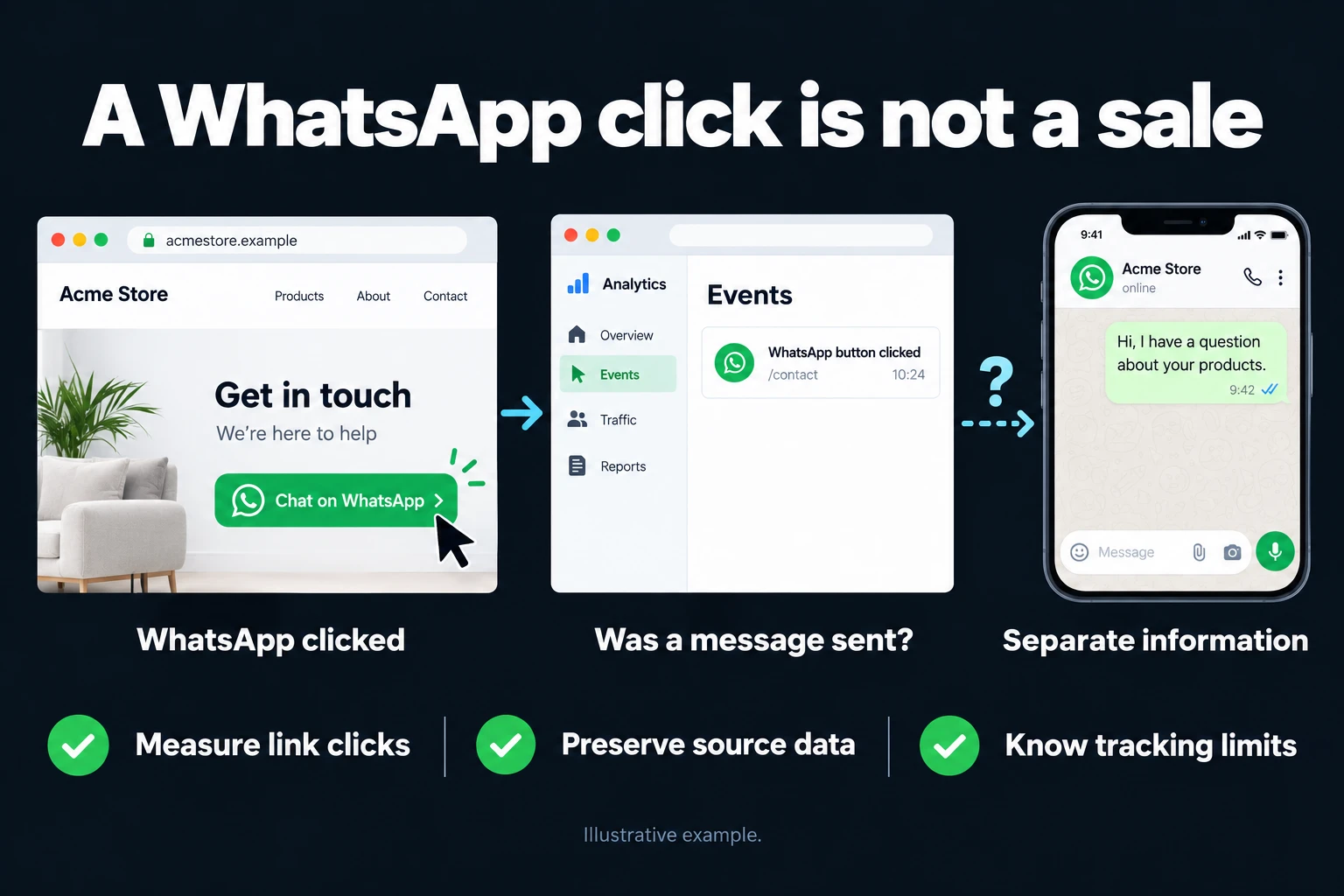
What we can measure is the tap on the WhatsApp link. When a user taps the button on the site, that can be recorded as an event and sent to Google Ads as a conversion.
What we cannot measure is the outcome of the conversation. Whether they wrote, what they asked, whether they bought — all of that stays inside WhatsApp and does not come back automatically. So the signal we hold is not a real conversion but an intent signal. Building the setup knowing that matters.
Setup
Tap tracking is built through Tag Manager: clicks on the WhatsApp link are captured as an event and sent to GA4 and Google Ads.
The key point is not to make this the primary conversion. Because tap counts exceed real enquiries, if bidding targets only this the algorithm drifts toward people who tap easily but never buy. I usually set it up as a secondary conversion, or assign it a low value proportional to real enquiries.
Inventory every WhatsApp entry point
A floating button, contact-page link, product enquiry button and mobile footer icon may use different implementations. Some open wa.me, others api.whatsapp.com, and some construct the destination in JavaScript. A trigger covering only one format undercounts the site’s interactions.
List each entry point, the pages and devices where it appears, its actual destination and its prefilled message. Test each on a phone and desktop, including the consent behaviour. A click records interest in opening WhatsApp; it does not establish that a message was sent or a conversation took place.
Connect conversations with business outcomes
Keep a simple outcome log with date, the page or campaign reference in the message, and outcome: information request, quote or sale. Compare it with click reporting to understand the gaps. This is directional reporting unless you retain a reliable identifier linking the enquiry to the ad interaction.
For an eligible offline conversion import, capture that identifier with the appropriate consent and preserve it through the enquiry process. A campaign label alone is not enough to upload a matched conversion. If an integration performs the upload, ask the provider to verify its current supported method and receipt/error reporting.
Not losing the source
Campaign information can be added to the WhatsApp link: when the user lands in the message window, the prefilled text shows which page they came from. That way whoever handles the conversation knows which service the enquiry relates to.
Businesses that want to go further feed the outcome back manually: conversations that turn into sales are marked and uploaded as conversions. That is the most practical way to bring measurement closer to real revenue.
How do we start? First I work out the volume of your WhatsApp traffic and its current measurement state. I send the setup plan and how that signal should be used in bidding, in writing. You can reach me from the contact page.
Frequently Asked Questions
Can I make the WhatsApp tap my primary conversion?
You can, but I do not recommend it. Because taps exceed real enquiries, the algorithm may chase low-quality traffic. As real conversion data accumulates, making that the primary target is healthier.
Can I send people straight from the ad to WhatsApp?
It is possible on the Google Ads side, but skipping the site weakens measurement and the user starts a conversation with no information. In most accounts routing through a landing page performs better.
Is there no way to measure the outcome automatically?
Partly possible for businesses using a business messaging platform, but at small scale the setup cost exceeds the return. In that case manual feedback stays more practical.
How do I work?
Work-hour packages
Tell me about your business and what you need on WhatsApp or by phone; we agree on a work block of somewhere between 5 and 40 hours and I start doing what is needed. What you get is not a calendar window — it is net working hours spent directly on your business. I can use 40 hours working three days straight, or deliberately spread it out and finish it over a year — whatever the work calls for. I do not spend my time estimating how long something will take, I spend it doing the work; every hour I spend leaves a lasting result in your business. We keep going for as long as you find it useful.
Why not monthly?
Is 40 hours a week?
On a fixed monthly fee both sides are watching the wrong thing: you watch a fixed cost, the other side watches how many more contracts like this they can line up. Working by the hour puts us both in front of the same thing — the real value of the work that got done. I know not having an upfront answer to "how much will this cost in total?" is the natural cost of this model. But instead of paying a fixed fee for months to a setup that is not producing results, you only pay for the qualified time spent on your work — and you see exactly where that time went, start to finish. That is why my clients keep coming back.