
WhatsApp Order Status Notifications
Changing an order status in a spreadsheet does not tell the customer what happened. I connect eligible order events to a WhatsApp notification queue, with rules for the recipient, message content and failed delivery attempts.
The important link is between the order record and the message. Its number, status and tracking code should come from the same source, so staff do not have to assemble them manually each time.
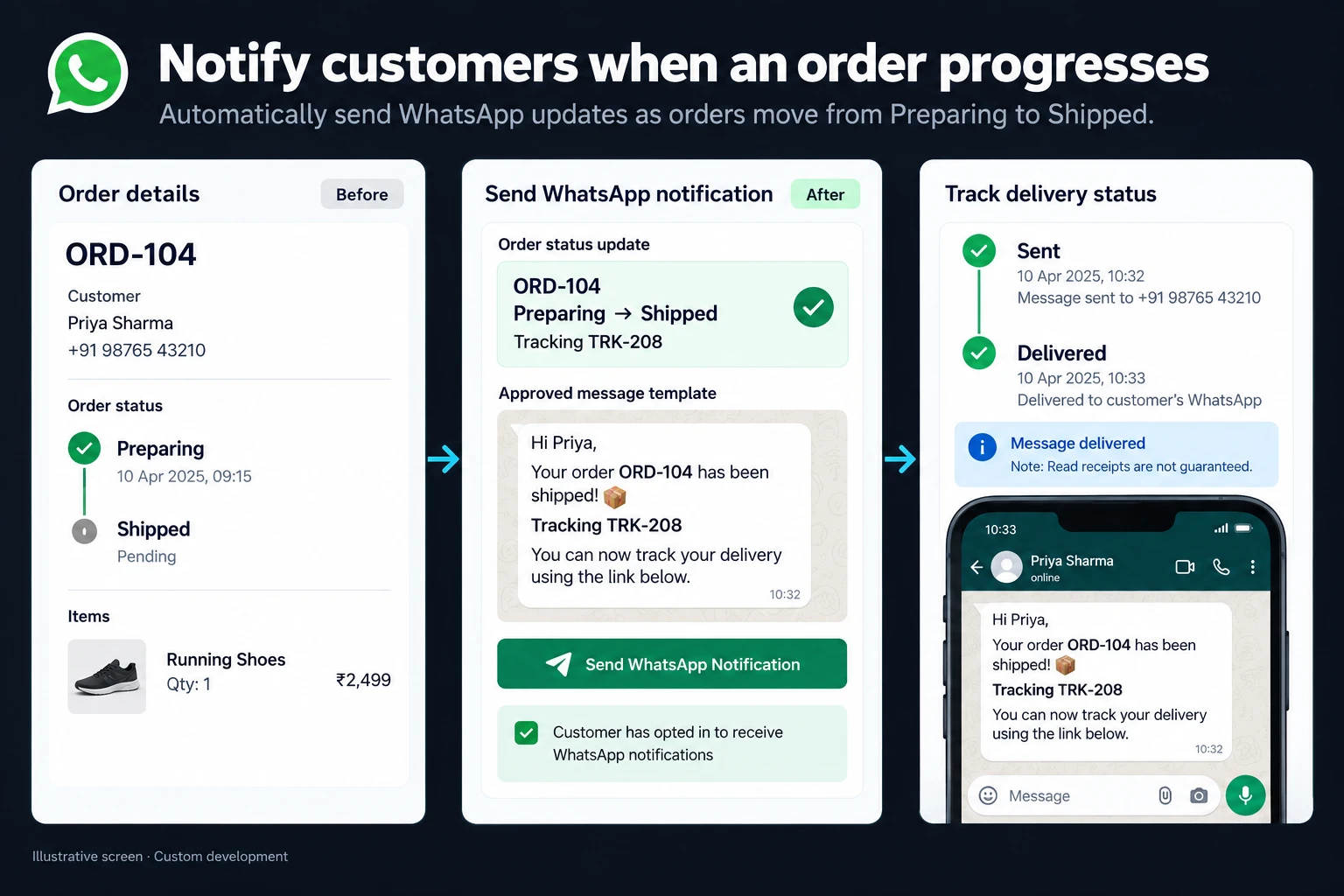
Example: ORD-104 has shipped
In the illustrative workflow, ORD-104 moves from Preparing to Shipped. Its tracking reference is TRK-208. When permission and messaging conditions are satisfied, those values populate an approved message template.
The notification enters a queue before its sending result is recorded. Sent and Delivered are separate states. Delivery also does not prove that the customer read the message or acted on it. Missing delivery information remains unknown rather than being presented as success.
When the existing order system is sufficient
An ecommerce or order-management product may already support the required WhatsApp updates. For a standard shipping notification, that integration can be the best option.
A custom connection is useful when orders come from several sources or an update depends on several business checks. A partially shipped order, for example, must not be described as fully dispatched simply because one parcel has a tracking number. The source can be your order preparation and delivery workflow.
One event should not become two messages
An order system may report the same change more than once. I use the event’s record identity and version to distinguish retries from new changes.
If the tracking code is missing, the notification waits. If the order is cancelled while the message is queued, its eligibility is checked again before sending. The workflow should not depend on recalling a message after it has already reached the platform.
Temporary connection failures are treated differently from permanent rejection. A limited retry may be appropriate for an interruption. An invalid recipient or unsuitable template requires review. The queue records each attempt so that an uncertain result does not lead to blind resending.
Permission and approved templates
The WhatsApp Business Messaging Policy requires recipient permission and respect for opt-out requests. Approved templates are used for business-initiated communication and outside the 24-hour customer-service window.
Placing an order is not permission for every kind of marketing communication. If these preferences need their own operating screen, an opt-in management panel can form part of the workflow.
I use the official Business Platform or a supported provider connection, checking the account, number and template setup before implementation.
Delivery and maintenance
The first scope can cover one order event. Testing includes a correct record, a missing tracking code, repeated events, cancelled orders and rejected sends.
The handover identifies who monitors the queue and who resolves each failure type. Additional message templates, provider charges and later changes to the order system are considered separately.
Frequently Asked Questions
Can the notifications be fully automatic?
Yes, for explicitly defined conditions. A staff review step can also be included. Ambiguous records stay outside automatic sending.
What happens when a customer opts out?
The preference is updated and relevant unsent notifications are checked again. Any alternative communication channel follows the business process agreed for that situation.
Discuss your workflow
Share the order stages customers need to hear about. We can define the connection around the actual records and messaging conditions.
How do I work?
Work-hour packages
Tell me about your business and what you need on WhatsApp or by phone; we agree on a work block of somewhere between 5 and 40 hours and I start doing what is needed. What you get is not a calendar window — it is net working hours spent directly on your business. I can use 40 hours working three days straight, or deliberately spread it out and finish it over a year — whatever the work calls for. I do not spend my time estimating how long something will take, I spend it doing the work; every hour I spend leaves a lasting result in your business. We keep going for as long as you find it useful.
Why not monthly?
Is 40 hours a week?
On a fixed monthly fee both sides are watching the wrong thing: you watch a fixed cost, the other side watches how many more contracts like this they can line up. Working by the hour puts us both in front of the same thing — the real value of the work that got done. I know not having an upfront answer to "how much will this cost in total?" is the natural cost of this model. But instead of paying a fixed fee for months to a setup that is not producing results, you only pay for the qualified time spent on your work — and you see exactly where that time went, start to finish. That is why my clients keep coming back.