
Custom Purchasing, Quotes and Approval App
If you manage purchasing by collecting approved requirements, the latest quote versions and incomplete deliveries from separate files, I can move that workflow into a custom web application for your company. Requests, supplier CRM, quote comparison, budget approval, purchase orders, receipts and invoice checks can connect through records employees use with individual permissions. This page describes a possible development scope, not an existing product or completed client application.
The first version does not have to replace your ERP. We choose the handover requiring the most investigation: a request awaiting approval, quotes that cannot be technically compared or an invoice that disagrees with delivery. Existing accounting and ERP records can remain authoritative while the application completes controls between teams. Request approval, order submission and payment remain separate events.
Questions left unanswered in the purchasing list
An urgent requirement does not necessarily have a complete technical definition or allocated budget. The lowest-looking quote may use a different pack size, currency, delivery arrangement or payment term. Stores may report goods received while quality acceptance is still pending.
I design the application to preserve those distinctions. Each line has its source request, technical attachment, owner, status and next action. A purchasing employee sees which clarification is needed instead of searching email again. A manager can inspect the quote version and terms supporting a decision, as well as the total. The system’s purpose is to bring the decision record and authority into one workflow, rather than make every decision automatically.
Example workflow: from production requirement to partial delivery
This scenario is entirely fictional. Production requests a maintenance material with a technical attachment and required date. A technical owner defines acceptable equivalents. Purchasing gathers and compares quotes, then requests budget approval. The order is sent after an authorised person approves the selection.
| Event | Record created | Owner | Completion criterion |
|---|---|---|---|
| A requirement is opened | Item, unit, technical attachment and required date | Requester | Missing specifications completed |
| Quotes are requested | Supplier and specification version sent | Purchasing | Response date and scope clear |
| Quotes are compared | Price, delivery and condition differences | Purchasing/technical team | Non-comparable fields visible |
| Selection is approved | Decision and budget record | Authorised manager | Valid approvals complete |
| A partial shipment arrives | Received quantity and acceptance status | Stores/quality | Accepted quantity verified |
| An invoice arrives | Order-receipt-invoice matching | Accounting | Differences resolved or approved |
The outstanding quantity remains visible after partial delivery. Goods awaiting quality clearance are not treated as usable stock. A supplier saying “dispatched” on WhatsApp does not establish warehouse receipt. An invoice placed on a payment plan is distinguished from a completed bank payment.
Purchasing screens I can develop
I build screens around your terminology and approval structure. The initial scope does not need every function.
- Requirement form: product/service definition, unit, quantity, project and reason.
- Request queue: missing technical information, pending approvals and owners.
- Supplier CRM: contacts, specialisms, documents and conversation history.
- Request for quotation: invitations using the same specification version and reply tracking.
- Quote comparison: currency, unit price, tax, delivery and payment terms.
- Budget/approval screen: cost centre, approval order, delegation and reasons.
- Order list: accepted terms and supplier submission status.
- Receipt/acceptance screen: partial deliveries, damage, rejection and quality holds.
- Invoice matching: quantity and amount differences between order, acceptance and invoice.
- Supply schedule: required date, expected delivery and delay owner.
- Document validity tracking: required supplier documents and renewal tasks.
- Management report: pending decisions, open orders and exceptions under investigation.
An “approved” status identifies its version. Price or quantity changes trigger a rule-based review of whether the earlier approval remains valid.
Supplier CRM is the history of the company relationship
Unlike sales opportunity tracking, purchasing CRM preserves the company’s relationship with suppliers. It shows product categories, quotes received, answers to technical questions and ownership of unresolved issues. Company records and individual contacts are separate, so staff changes do not erase history.
Potential matches can be suggested when the same supplier appears under different spellings. Appropriate tax or source system identifiers are checked; similar names alone do not trigger automatic merging. Bank account changes are critical actions requiring independent verification and approval. A new IBAN appearing in an employee’s message does not automatically alter payment instructions. Company documents, personal contacts and commercial terms are limited to relevant roles. Suppliers cannot see competitors’ quotes.
Compare quotations on consistent terms
The comparison screen does more than highlight the lowest total. Product definition, brand or accepted equivalent, unit of measure, packaging, delivery location, payment terms and validity sit together. Technically different offers are flagged; missing information is completed before they are called equivalent.
Currency conversions display their exchange rate, date and method. Tax inclusion, transport and other known costs are explicit. A lower price does not automatically select a supplier. Technical suitability remains with the relevant team and commercial selection with authorised decision makers. AI can extract document fields and summarise differences, but cannot approve suitability alone. Revised quotes retain the previous file and the link between each decision and its supporting version.
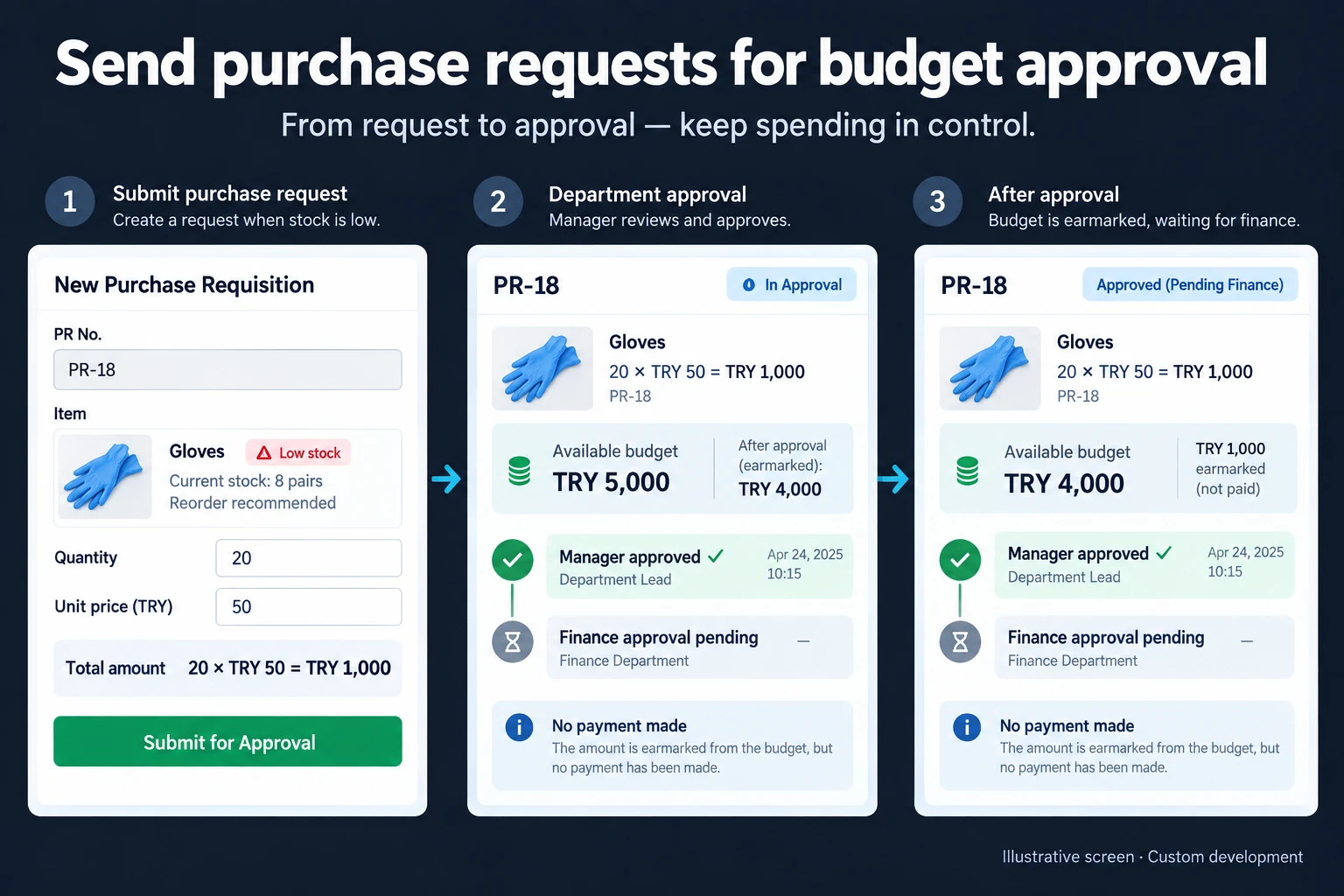
Example: PR-18 requests TRY 1,000
In the illustrative request, 20 gloves cost TRY 50 each, giving a total of TRY 1,000. The relevant budget has TRY 5,000 available. The manager has approved the request, while finance approval is still pending. No payment has been made.
In this example, budget is reserved only after the final required approval. Reserving TRY 1,000 would then leave TRY 4,000 available. A budget commitment is not a bank transfer.
If tax, delivery or other charges apply, the workflow defines whether they are included in the request total. The calculation must use a consistent basis.
Who approves the budget?
The budget approver is not the same role in every business. Your company’s authority matrix defines the route for the request amount, department, product group and budget. The application follows that matrix; a job title does not automatically grant signature or payment authority.
First separate four decisions: confirming the need, authorising budget use, selecting the supplier and instructing payment. Your process may assign these decisions to one person or several. Completing one does not establish that the others are complete.
| Role | Example responsibility | What it does not establish alone |
|---|---|---|
| Requester | Explain the need, quantity and reason | Authority to approve their own request |
| Department owner | Assess whether the need is appropriate | Final reservation of budget |
| Budget authority / finance | Check the relevant budget and defined limits | Payment to the supplier |
| Purchasing team | Prepare quotations and supply conditions | Automatic selection of the lowest price |
| Final approver or authorised delegate | Make the last decision in the authority matrix | A bank instruction not separately defined |
These roles are illustrative, not a replacement for your company’s formal responsibilities. If requesters must not approve their own requests, that boundary is enforced. Delegation needs an identified person, start and end dates and permitted requests. Forwarding an email does not itself delegate authority.
Suppose the request’s unit price and technical attachment change after a manager reviews it. The previous decision stays with the original version. The new total and changed scope return to the relevant approver under the agreed rule. The effect of the change is explicit rather than automatically carrying every approval forward or unnecessarily restarting them all.
The approval view should show which request version, budget and explanation the person is deciding on. Available budget is checked again at the final required approval. Insufficient funds or missing authority keep the request waiting with an explanation or route it for reassessment.
The decision retains its owner, time, reason and version. Withdrawing an incorrect approval also preserves the history. “Approved” can then explain who authorised what, while ordering and payment remain separately defined stages.
Roles, budgets and separation of duties
Requesting, approving an order, accepting goods and paying may belong to different people. The application applies that separation to records and transactions, rather than relying on menu visibility alone.
| Role | Visible work | Permission | Control boundary |
|---|---|---|---|
| Requester | Own requirement and status | Enter requirements and supporting details | Cannot give final approval to own request |
| Purchasing | Authorised requests and quotes | Collect quotes and prepare orders | Cannot submit an unapproved version |
| Technical team | Specifications and relevant technical offers | Suitability assessment | No payment decision |
| Budget owner | Relevant cost centre | Budget and exception approval | Defined authority/delegation |
| Stores/quality | Order and receipt fields | Counts and acceptance/rejection | Banking and confidential quote fields restricted |
| Accounting | Invoice, acceptance and account | Matching and payment preparation | Payment separately authorised |
| Supplier | Own invitations and order fields | Quote/delivery information | No competitor quotes or internal budgets |
Expired delegation, closed cost centres and changed lines are checked again. An urgent purchase exception can be defined, with a recorded reason and subsequent review. Departing employees lose access.
A stock-driven requirement can connect to minimum-stock tracking, while supplier quote comparison can support the same request.
Excel imports and outstanding order balances
I first review existing files with their owners. We establish whether “remaining quantity” means ordered minus delivered or the balance after accepted quantity. Item codes, supplier identifiers, units and dates connect to shared mapping tables. Free-text explanations can be preserved.
Uploading the same file again must not create another request, order or invoice. Source document and line references are used; unclear identifiers enter review. Duplicate invoices are not detected by filename alone. Imports compare row counts, outstanding quantities, totals by selected currency and supplier balances. Faulty uploads can be reversed. The latest file timestamp is visible and a data owner approves corrections. Required Excel exports can continue under control.
AI reads the document and shows the decision source
AI can extract products, quantities, currencies and delivery terms from quote PDFs. It can summarise email or WhatsApp correspondence and suggest tasks for missing technical information. It can answer a manager asking “Which open orders appear likely to miss the required date?” using authorised records. Source documents, reporting periods and filters remain visible.
Totals, currency conversion, budget usage and matching calculations follow defined rules. An unreadable amount is not estimated to close an invoice. Supplier selection, bank account changes, technical acceptance and payment depend on human authority. AI does not automatically exclude suppliers using hidden criteria. The model provider, commercial data shared, retention conditions and usage cost are agreed in scope. Prices and company documents unavailable to a user in the application are unavailable through chat too.
Recorded follow-up through WhatsApp and SMS
Checked 30 October 2026: outside the 24-hour service window following the latest user message, WhatsApp Business Platform requires approved message templates. WhatsApp policy.
Messaging can connect conversations on individual phones to company work records. Official WhatsApp API access, communication permission and necessary templates are checked under the WhatsApp policy. SMS requires assessment of the authorised provider, recipient type, message purpose and appropriate consent/opt-out/İYS records. The İYS FAQ explains the separate conditions for business recipients; a job title does not establish legal status.
| Trigger | Recipient | Sending control |
|---|---|---|
| Technical information is missing | Requester | Task assigned to the relevant record |
| A quote response is outstanding | Invited supplier | Current invitation and appropriate communication record |
| Approval becomes due | Authorised manager | Valid authority and delegation |
| A delivery date approaches | Supplier contact | Open order and owner approval |
| A receipt/invoice difference is found | Relevant internal owner | Verified discrepancy record |
| A document needs renewal | Relevant supplier | Required document and sending eligibility |
If approval is taken through messaging, the word “okay” alone is insufficient: identity, document version and authority are verified. Opt-out records apply to marketing workflows. Event/send identifiers prevent repeated reminders, and undelivered notifications remain visible. Instead of distributing supplier prices to an entire team chat, messages can link to an access-controlled record.
Read and write access are separate in ERP and accounting connections
CSV/Excel exports can provide a controlled starting point. Actual API access is tested for available documents and fields, refresh frequency and transaction permissions. Reading stock from the ERP does not mean creating an ERP purchase order. A write action is not complete before the source reference and successful result are obtained.
The authoritative systems for orders, deliveries, invoices and payments are established. Bank payment instructions or official electronic documents require separate connections supported by authorised providers. Storing internet banking passwords for payment automation is not standard. A failed connection displays the latest update time. Critical approvals may stop without current budget or account data; delayed information is not labelled live without explanation. Full ERP replacement cannot be inferred from the few screens on this page.
Closing delivery, quality and invoice differences
Ordered, physically received, accepted and invoiced quantities are kept separate. Partial deliveries, returns and quality holds affect the outstanding order through defined rules. Photos, reports and documents can sit alongside the record.
Accounting can open an investigation for price differences or invoices covering unaccepted goods. Any tolerance must state who approved it and for which line; there is no hidden blanket acceptance rule. Historical transactions retain their history through reasoned corrections. Invoice approval does not mean bank payment. The software supports commercial and operational tracking rather than replacing statutory accounting or the accountant’s responsibility. AI does not decide whether technical materials are safe or compliant with standards.
Reports for the purchasing manager
Pending requests, approvals, orders approaching required dates, partial receipts and invoice differences can be viewed together. Supplier evaluations state the underlying records, period and definitions. Records distinguish supplier delay from a later change to the requirement.
If savings reporting is required, the comparison baseline is defined separately: an old price, another valid offer and an approved budget mean different things. I do not present savings percentages without explaining volume and condition changes. Estimated delivery risks are distinguished from measured delays. Incorrect records enter a review queue. Managers can open documents from totals and see missing or stale information. Historical quote versions and supplier performance that were never recorded are not invented afterwards.
Initial scope and acceptance scenarios
The initial process and data review is paid. I identify business rules using sample requests, quotes, orders and invoices. The first delivery may cover request approval or order-receipt-invoice control. Screens, roles, integrations and acceptance criteria are written down; expansion follows actual use.
Training is task-specific. Data owners, support hours, backups and restore tests are planned. Development, hosting, maintenance, messaging and AI costs are considered separately. A controlled comparison period and rollback arrangement are established. Untested offline transactions or ready-made connections to every supplier portal are not promised.
- Re-uploading an order file must not duplicate outstanding quantities.
- A quote revision must show which approvals are affected.
- Partial receipt must leave the correct remaining quantity.
- Goods on quality hold must not count as accepted stock.
- Suppliers must not see competitor quotes or internal budgets.
- New bank details must not change payment instructions without independent verification.
- Invoice differences must not close without a reason.
- A backup must restore with open orders and balances compared.
Frequently Asked Questions
Do we need a custom application if our ERP module is sufficient?
If the existing module meets your needs, using its settings may be the right first step. Custom development should address a defined coordination or control gap.
Is an API essential at the start?
No. Authorised reports and controlled uploads can be used. Freshness is limited by the file timestamp and critical decisions must reflect that.
Does AI choose the best supplier?
It can prepare comparisons and missing-information summaries. Technical suitability and commercial selection remain with authorised people; automatic exclusion is not promised.
Does approval trigger automatic payment?
No. Budget approval, purchase orders and bank payments are separate statuses. Payment is scoped only with a separately supported connection and authority.
Can suppliers access the application?
If required, verified access can be provided only to their own invitations, quotes and order fields. Competitor prices and internal approval notes remain restricted.
Do you guarantee savings or faster delivery?
I can commit to delivering defined records and workflows. Commercial outcomes need a measurement baseline and comparable conditions; I do not invent percentages.
Define the scope of your first purchasing workflow
You can request a scope by saying, I want to connect requests, quotes, approvals and receipt checks in one record for my company. The first paid engagement documents screens, actual integration status and acceptance methods. The initial presentation can use sample documents without personal or confidential commercial data.
How do I work?
Work-hour packages
Tell me about your business and what you need on WhatsApp or by phone; we agree on a work block of somewhere between 5 and 40 hours and I start doing what is needed. What you get is not a calendar window — it is net working hours spent directly on your business. I can use 40 hours working three days straight, or deliberately spread it out and finish it over a year — whatever the work calls for. I do not spend my time estimating how long something will take, I spend it doing the work; every hour I spend leaves a lasting result in your business. We keep going for as long as you find it useful.
Why not monthly?
Is 40 hours a week?
On a fixed monthly fee both sides are watching the wrong thing: you watch a fixed cost, the other side watches how many more contracts like this they can line up. Working by the hour puts us both in front of the same thing — the real value of the work that got done. I know not having an upfront answer to "how much will this cost in total?" is the natural cost of this model. But instead of paying a fixed fee for months to a setup that is not producing results, you only pay for the qualified time spent on your work — and you see exactly where that time went, start to finish. That is why my clients keep coming back.