
How I Found My 6th-Generation Ancestors with AI and State Archives
AI cannot magically query closed government registries to build your family tree—but when you log into the Presidential State Archives with your own e-Devlet credentials, download 19th-century Ottoman census and tax registers, and pair them with AI paleography, you can cross the 1830s civil registry wall and trace 6th-generation ancestors born in the 1790s. Using this exact workflow across both my maternal and paternal lines, I traced 6th-generation ancestors back to original 1835 population and 1845 property folios and placed the full family story and documents inside a password-protected section on my site to share with relatives; whether you want to trace your own archive trail or set up a password-protected family page, you can get help from me.
I’m Oğuz Erol; professionally, I work on paid search, analytics and agentic AI workflows for businesses. In this guide—without revealing any names from my family tree or any geographic detail beyond Rize—I explain step by step why e-Devlet stops around the 1830s, how Ottoman registers bridge the gap to earlier generations, and how to share your findings privately with family without exposing personal data to the open web.
Why does Turkey’s e-Devlet lineage extract stop around the 1830s?
The family tree shown on e-Devlet is not a direct digitisation of early 19th-century Ottoman censuses; it comes primarily from the foundational civil registry books (Esas Kütük) opened during the 1904–1905 general registration (Sicill-i Nüfus). Because of how those registers were compiled, almost every family extract in Türkiye stops at the 4th or 5th generation, around ancestors born between 1825 and 1860.
Five concrete technical barriers explain why e-Devlet goes no further:
- The 1904–1905 general census cutoff: When the foundational registers transferred into MERNİS were opened, only individuals alive at the time (or recorded in the 1881–1893 provincial registers) received their own numbered row. Ancestors who died before 1904 have no standalone entry; they survive only as names inside the “Father’s Name” and “Mother’s Name” columns of their surviving children.
- Symbolic
01/07(1 July) birth dates: Almost every 19th-century ancestor in an e-Devlet extract shows a birthday of01/07/1835or01/07/1850. Early Ottoman registers recorded a person’s age (sinn) during the survey year rather than an exact birth date; when Republican clerks standardised the books, mid-year (1 July) was assigned as a placeholder. Day-and-month death dates likewise begin mostly after 1905. - No surnames before 1934 (
(-)marker): Ancestors who passed away before the 1934 Surname Law appear with(-)in the surname column. In Ottoman archives you cannot search by family surname; records are organised by patronymics (“Halil bin İbrahim” — Halil, son of İbrahim), clan nicknames and household (hane) numbers. - The 1913 and 1944–1965 village renames: This is the quietest yet hardest wall. Your e-Devlet extract prints today’s administrative neighborhood or village name. Yet thousands of settlements were renamed by the Interior Ministry decree of December 1913 and Republican toponymy commissions between 1944 and 1965. Searching the Ottoman archive catalogue by today’s neighborhood name returns zero nineteenth-century registers.
- Script and calendar shifts: Pre-1904 sources are not printed Latin tables. They are handwritten Ottoman Turkish folios penned in rapid scribal shorthand (Rik’a), fiscal numerals (Siyâkat) and red-ink inspection notes (sürh) dated across Hijri and Rumi calendars.
Can AI build a family tree on its own? How the workflow actually works
No—typing a surname into ChatGPT, Claude or Gemini and asking it to “find my ancestors” will either hit an access wall or produce plausible-sounding hallucinations. Civil registries and digitised Ottoman ledger sheets are not public web pages crawled by search bots.
What works is pairing authenticated human access to primary archives with AI as an analytical and paleographic co-pilot:
- What you do yourself (official archive access): First, you download your own Lineage Extract PDF (Alt-Üst Soy Belgesi) via e-Devlet. Next, you log into the Presidential State Archives Catalogue System (BETSİS) using your personal e-Devlet login to browse and download high-resolution scans of Ottoman population and tax ledgers for your ancestral district. For WWI/Gallipoli military records, you check the Ministry of National Defence Martyr Portal.
- What AI does (resolution and verification): Mapping
Volume–Household–Individualsequence numbers from your PDF, cross-referencing pre-1913 village names, identifying exact archive call numbers (NFS.dandML.VRD.TMT.d), transcribing cropped handwritten Ottoman entries letter by letter, and rejecting false namesake matches when ages or patronymics fail arithmetic checks.
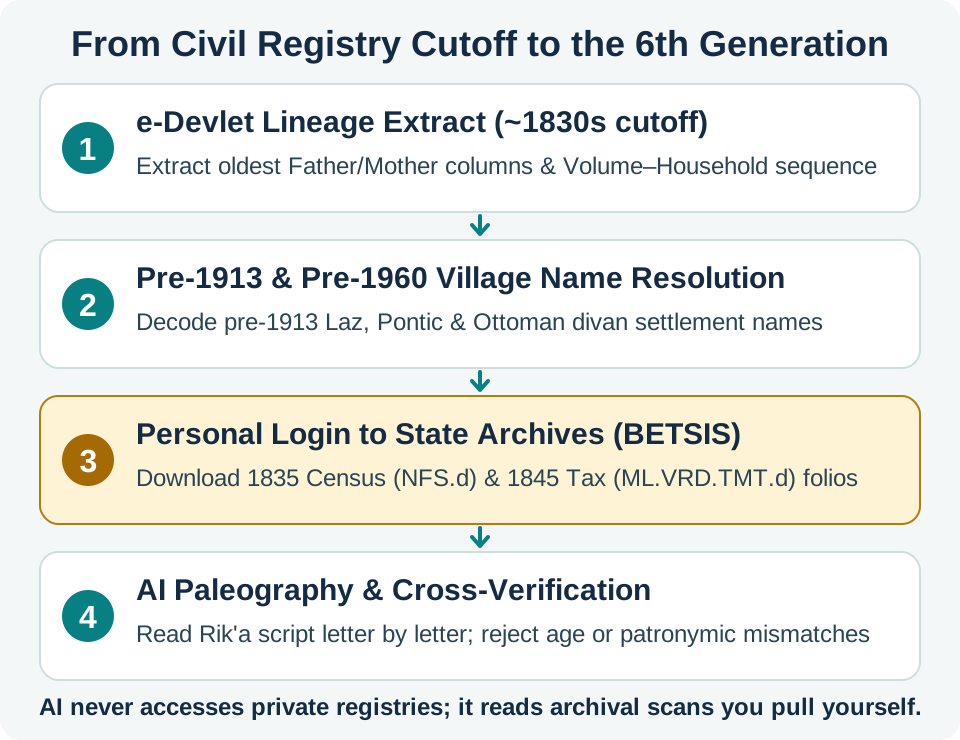
How I traced my own 6th-generation ancestors (~1790s) step by step
I ran this investigation across two Black Sea family branches—one in Rize and one in the Western Black Sea—ultimately pulling and verifying 39 original Ottoman archival sheets. While my e-Devlet PDF stopped at 5th-generation rows born in the 1830s, these five steps took the documented trail back to the late-1790s 6th generation and 1835–1845 household registers. For privacy, I omit every ancestor name and every location detail narrower than Rize, documenting only the structural method.
1. Extracting the hidden 6th generation and household structure from the e-Devlet PDF
Most people treat the oldest row in their e-Devlet table as the end of the trail. In reality, the Father’s Name and Mother’s Name cells inside your oldest 5th-generation rows (born 1830–1855) already name your 6th-generation ancestors—individuals born roughly between 1790 and 1820 who died before the 1904 general registration.
A second structural clue hides inside the Volume – Household – Individual Sequence numbers:
- Adjacent household splits: On my Rize branch, related family lines sat in consecutive household numbers, signalling that brothers or cousins had split into neighbouring houses—meaning I needed to inspect adjacent households together in the Ottoman register rather than hunting for a single isolated entry.
- Extended divan households: On my Western Black Sea branch, individual sequence numbers climbed past 90 within a single household block, reflecting the regional divan system where several hamlets were grouped into large extended clan units.
2. Cracking the village-name lock: 1913 and 1960 renames
Searching the State Archives for modern neighborhood names yielded nothing from the 1830s or 1840s. Ottoman scribes recorded pre-1913 and pre-1960 toponyms.
Cross-referencing academic toponymy inventories with the Ottoman Interior Ministry’s 16 December 1913 (17 Muharrem 1332) village-renaming register (BOA DH.İD. 97-2/25) explained the pattern. Villages on the Rize side carried historical names from Laz, Kartvelian (South Caucasian) and Pontic Greek linguistic layers, while Western Black Sea settlements appeared under multi-hamlet Ottoman divan clusters and older coastal names before mid-20th-century splits:
| Region / Record Layer | Ottoman Ledger Structure | Modern Civil Registry Form | How to Resolve It in Archives |
|---|---|---|---|
| Rize (Eastern Black Sea) | Pre-1913 names rooted in Laz, Kartvelian and Pontic Greek layers | New Turkish names assigned in the 1913 decree and post-1944 commissions | Match via official rename tables rather than literal meaning—new names described quarries, ridges, streams or markets |
| Western Black Sea coast & hills | Extended divan units grouping several hamlets + older coastal names | Individual neighborhood or village names split in the 1960s | Trace both the historical divan cluster and its subordinate villages inside BOA catalogue inventories |
| Pre-1934 personal identities | Patronymic (Name bin Father), family nickname and household number | Surname column marked (-) on e-Devlet | Follow individuals through father’s name, adjacent households and census age |
| Pre-1904 birth years | Survey-year age (sinn) and physical description | Standardised 01/07 (1 July) placeholder date | Cross-check child-parent age gaps against a 20–35 year generational window |
Notice a crucial linguistic detail: the Turkish names assigned in 1913 and the 1960s were not translations of the older Laz or Pontic Greek names—they were brand-new geographical labels referencing local terrain, stone quarries, slopes or market spots. Without BOA DH.İD. 97-2/25, guessing by word meaning leads to the wrong villages entirely.
3. Pulling the 1835 Census and 1845 Temettuat ledgers via BETSİS
Once you understand how the historical subdistrict (nahiye / divan) and village (karye) naming layers work, you log into BETSİS via e-Devlet and target the two core pre-1904 Ottoman series:
- Ottoman Population Registers (
BOA NFS.d., 1831–1846): The empire’s first household-by-household male censuses recorded for military conscription and taxation. For the Rize line, I examined the H. 1251 / 1835 CE Muslim Population Register series (BOA NFS.d.). Alongside names, patronymics and ages, scribes recorded physical descriptions (tall stature, black beard, fledgling moustache, beardless youth) and red-ink inspection notes tracking births, deaths and conscription (reft be-Asâkir-i Mansûre). - Temettuat Income and Property Registers (
BOA ML.VRD.TMT.d., 1844–1845): Tanzimat-era fiscal surveys of household wealth. For the Western Black Sea line, I downloaded the H. 1260–1261 (1844–1845) Temettuat register series (BOA ML.VRD.TMT.d.). Unlike population books, Temettuat entries list the household head’s occupation (farmer, naval forest guard), cultivated and fallow land in dönüm, oxen, dairy cows, beehives and exact annual tithe and tax assessments in kuruş.
4. Reading handwritten Ottoman folios letter by letter with AI
Here is where discipline matters most. If you upload an entire two-page handwritten Rik’a ledger spread to a vision model and ask “Who is listed on this page?”, the model will routinely guess the most common classical Ottoman male names wherever ink strokes blur together.
To prevent hallucination, I enforced three strict rules:
- High-resolution crops and letter-level transcription: Instead of full spreads, I cropped page headers, red-ink marginalia and individual household blocks, requiring both the exact Arabic-script spelling (
قريهٔ مزبوره— Karye-i mezbûre,شاب امرد— Şâbb-ı emred, orرفت بعساكر منصوره— Reft be-Asâkir-i Mansûre) and its transliteration. - Age and generation arithmetic: An ancestor listed with a
01/07/1835birth year on e-Devlet must appear either as an infant/child in an 1835–1846 register or inside his father’s household within a consistent age band. If the math fails, name similarity means nothing. - Explicit uncertainty over guessing: Wherever smudged Rik’a ligatures lacked dots or overlapped, the entry had to be marked “unreadable at scan resolution” rather than filled in by guesswork.
5. Eliminating false matches: why namesakes are traps
Good archival work is defined as much by what you reject as by what you confirm. While cross-checking the Ministry of National Defence Martyr Portal for WWI Gallipoli casualties, I found two instructive cases.
In one district, a 1915 Gallipoli soldier matched both given name and father’s name—an exciting find at first glance. Yet comparing his military birth year against the civil registry revealed a clear age discrepancy, and the civil registry recorded a completely different death date. I immediately ruled it out as a false namesake. Meanwhile, on my other branch, another 1915 Gallipoli casualty matched on multiple generational and geographical criteria—yet because the civil registry row lacked an explicit wartime death note, I recorded it strictly as a strong candidate pending verification rather than claiming 100% certainty.
Sharing findings without exposing family names: A password-protected archive
Publishing ancestor names, village identities and registry household codes openly on the web exposes living relatives and personal civil records to search engines and scrapers. That is why this public walkthrough keeps every family member’s name out of sight and gives no location narrower than Rize.
Instead, I placed my maternal and paternal family stories, the 6-generation interactive pedigree chart, the historical village-name notes and all 39 original Ottoman archival scans inside a password-protected section on my site specifically so I can show them to relatives and invited readers. The protected section is blocked from search engines and bots, and its contents remain encrypted until unlocked with the password in the visitor’s browser.
When you compile your own archival tree, adopting the same pattern solves sharing cleanly: rather than sending huge PDFs or posting private family trees on public social media, setting up an encrypted password-protected page lets you safely send just the link and password to relatives and others.
Where to start if you want to trace your own pre-1904 roots
You can run this workflow yourself using your own e-Devlet login and disciplined AI verification—or get help structuring the research and building a private sharing page.
- Turn your e-Devlet PDF into a generation table: Extract your oldest recorded ancestors’ birth years, the un-rowed Father/Mother names above them, and their
Volume–Household–Sequencenumbers. Redact national ID numbers before uploading anything to an AI tool. - Resolve pre-1913 and pre-1960 village names: Check academic toponymy databases, Republic-era Köylerimiz gazetteers and Ottoman rename registers (
BOA DH.İD. 97-2/25) so you search the archive under the settlement’s 19th-century name. - Log into BETSİS with your own e-Devlet credentials: At
katalog.devletarsivleri.gov.tr, search by Ottoman district (kaza) and historical village/divan name, focusing onNFS.d(1831–1846 Population Registers) andML.VRD.TMT.d(1844–1845 Temettuat Surveys). - Feed AI cropped household blocks, never full spreads: Zoom into single household entries, ask for letter-by-letter Arabic-script transcription before translation, and instruct the model to flag illegible ligatures rather than guessing.
- Require at least a three-way match: Never accept a given name alone—verify historical village + father’s name + survey-year age together before linking a generation.
- Publish privately behind a password: Place your resulting family tree and scans inside an encrypted, password-protected web page rather than an open post so you can safely send the link and password to relatives.
Frequently Asked Questions
Why does the e-Devlet family tree reach the 1820s for some families but stop in the 1870s for others?
It depends on when the foundational civil register in that specific district was compiled and whether older family members were still alive during the 1904–1905 general registration. Districts whose registry books were destroyed by fire, war or occupation and reconstructed later often start several decades closer to the present.
Are the 1 July (01/07) birth dates on e-Devlet real birthdays?
Almost never. Nineteenth-century Ottoman registers recorded a person’s age during the survey year rather than day and month of birth. When records were migrated into modern civil registries, 1 July (01/07) was assigned as a standard mid-year placeholder.
Can any citizen access the Presidential State Archives (BETSIS) for free?
Yes. Citizens can sign in to katalog.devletarsivleri.gov.tr free of charge using their standard e-Devlet login, search the Ottoman archive catalogue and inspect digitised population and Temettuat ledger scans online.
Can AI read handwritten Ottoman population registers without mistakes?
Not without strict supervision. Scribal Rika shorthand often omits consonant dots and compresses letters together, causing unsupervised models to guess common names. When given high-resolution crops of single households and constrained by age and patronymic math, however, AI becomes a remarkably effective paleography assistant.
Why are female ancestors missing from 1835 Ottoman census books?
Early Ottoman censuses between 1831 and 1846 were conducted strictly to assess military conscription and household taxation, so scribes recorded only males. Women began to be registered systematically in the 1881–1893 and 1904–1905 Sicill-i Nufus reforms.
Can I get help from you with archival lineage research and a password-protected family page?
Yes. You can get help from me to trace pre-1913 village name changes from your own e-Devlet extract, decode and cross-check Ottoman census or Temettuat folios with AI verification, and package the findings into a password-protected page whose link and password you can safely share with relatives.
A brief closing note
The oldest row on your e-Devlet lineage sheet is rarely where the paper trail truly ends—it is simply where modern civil registries hand off to 19th-century archival ledgers once you unlock the historical settlement name. In my day-to-day work, I build paid search systems, analytics pipelines and custom web applications for teams, using the same verification and structured data discipline described here.
If you want to trace your family’s archival trail, decode pre-1913 village renames or set up a password-protected family page so you can safely share the link and password with relatives without exposing private data online, reach out via my contact page and you can get help from me.