
AI Models and Agents: What Is the Difference?
On YouTube
AI Models and Agents: What Is the Difference?
Does a smarter model become an agent? No. An agent is a system that puts a model's intelligence to work with tools, permissions, and a goal.
Full description
We explain it with a job search: the model can interpret your resume, but it doesn't automatically know which openings are available today. An agent finds listings, compares them with your experience, asks you when a skill is missing, and prepares application drafts.
Permission to draft is separate from permission to send. Writing "ask me before sending" isn't a technical lock; you add an approval check. The agent picks the next step based on the previous result; if the route is predictable, simple automation may fit better.
Start with listings you've already reviewed and compare the differences.
The words “model” and “agent” are often used interchangeably, but they do not describe the same thing. A model interprets the text you give it and produces a response. An agent turns a model into a system that works with tools, permissions, instructions and a goal. This page explains the difference with one example: a job search. The example is schematic; it is not output from a real application and does not promise a result.
The same task, two different routes
You can give a model your resume and ask it to comment on your strengths and weaknesses. The model reads the text and writes an answer; you carry out whatever comes next. If you ask the same system to find current openings, compare them with your experience and prepare application drafts, the task has many steps: search, read, filter, compare and write. A setup that can run those steps in sequence is an agent.
| Working with a model | Working with an agent | |
|---|---|---|
| Who runs the task? | You, with help from the model | The agent runs intermediate steps |
| What stays with you | Every step | The goal, boundaries and final approval |
| Outside information | You paste it in | It searches and reads using tools |
| Best suited to | One-answer tasks | Multi-step tasks with traceable results |
Why is a stronger model not enough?
A stronger model can interpret text better. It still cannot know by itself which openings are available today or where you are able to work. Missing or current information does not appear because a model is more capable; it has to be supplied to the system. The difference is therefore less about intelligence than about what the model is connected to. OpenAI’s practical guide to agents describes an agent through three components: a model, tools and instructions.
Context: what does the model have in front of it?
You state your goal and rules: “I want remote work, I have experience in this field, and do not add a skill I do not have.” Those instructions, your resume and the listings it finds make up the model’s working context. That makes it visible what the comparison is based on. Context is not an unlimited store either; Anthropic’s article on context engineering treats it as a finite resource and recommends giving the model only the information that helps.
Tools and permissions are separate
Tools let an agent search listings, read pages and create documents. Permissions define what it may do with them. The key distinction is that permission to draft is not permission to send. Reading, creating documents and submitting an application are separate permissions.
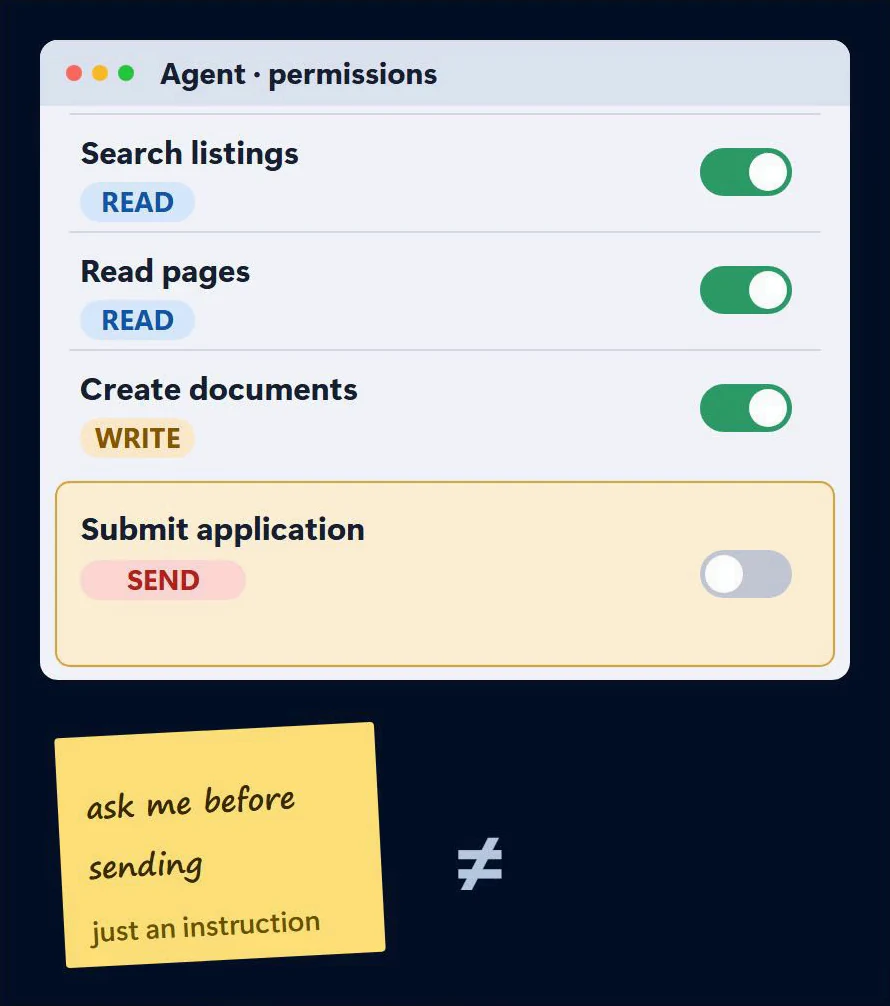
Writing “ask me before sending” in an instruction is not a technical lock; the model can misread or forget it. Real protection is an approval check placed in front of the sending step. Agent guidance likewise suggests assessing risky tools by read versus write access and reversibility, and escalating to a human where needed.
The agent loop: each result chooses the next step
The agent opens a listing and discards it if applications have closed. It compares another role’s requirements with your experience. If a required skill is missing from your resume, it asks you; your answer decides whether it completes the draft or sets the listing aside. Each result informs the next action. Anthropic describes agents as systems where models direct their own processes and tool use, gaining feedback from the environment at each step and working within stopping conditions.
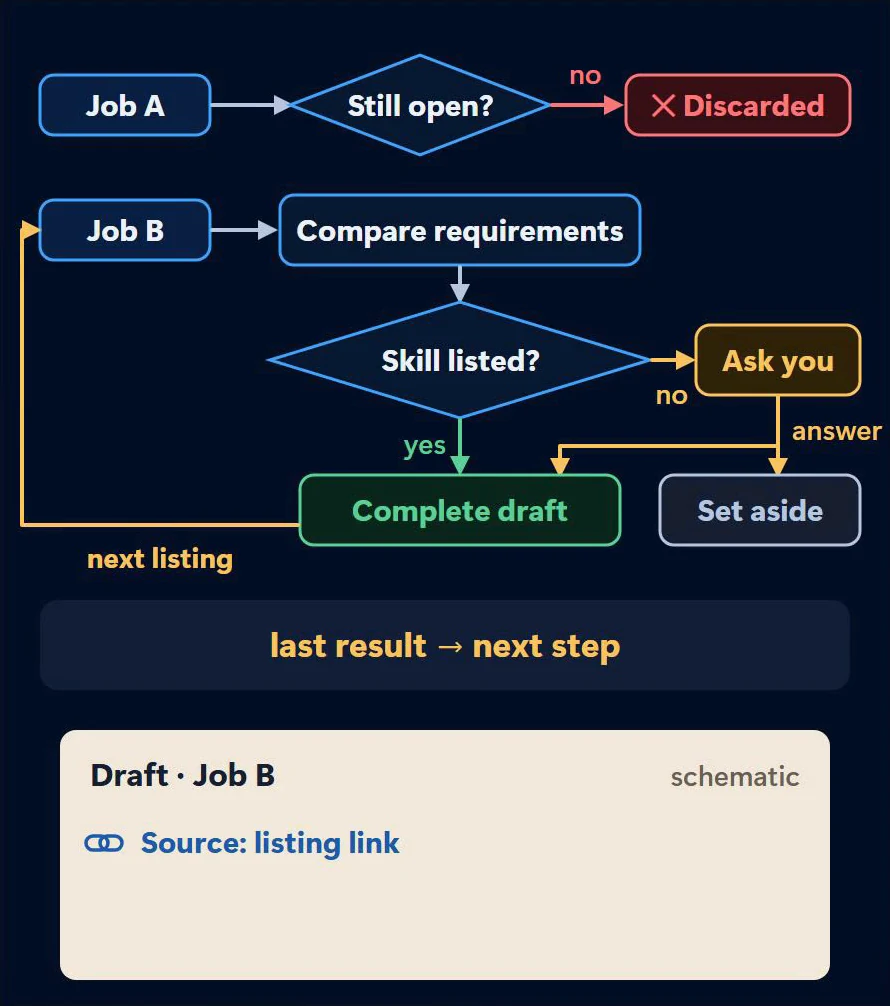
A good setup keeps the source link for every listing it recommends and writes why it recommended it, so you can verify the result.
How is this different from automation?
In a fixed workflow, which step runs under which condition is defined in advance; the path can branch, but you wrote the branches. In an agent, the model chooses some steps from the information available at that moment. If the route is predictable, simpler automation can be a better fit, more predictable and often easier to audit. Not every task needs an agent, and the two can be combined. For the wider terminology, see the AI agent, agentic AI and agent skills comparison.
A concrete check and a stopping point
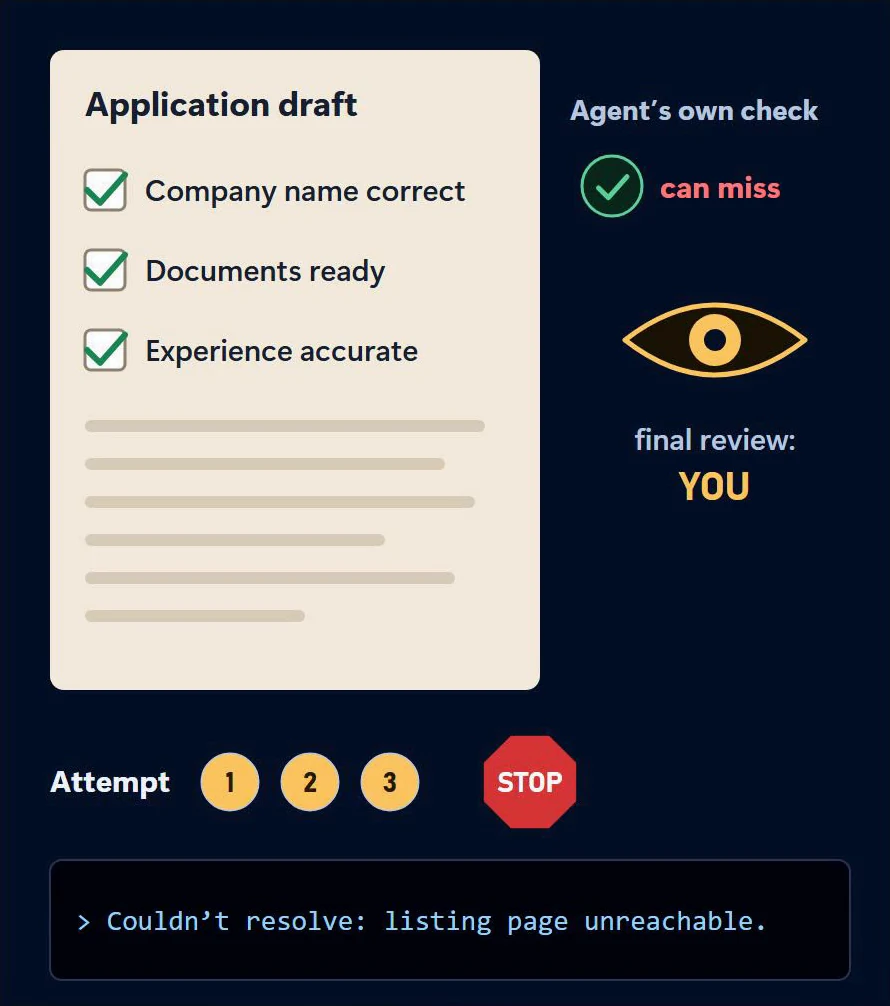
“Check the result” is not enough; list the items. Is the company name correct? Are the required documents ready? Is your experience represented accurately? The agent’s own check can also be wrong, so you read the text before it is sent. The agent also needs a defined point to stop: when it cannot reach information or reaches its attempt limit, it should stop and say plainly what it could not resolve.
How do you try it first?
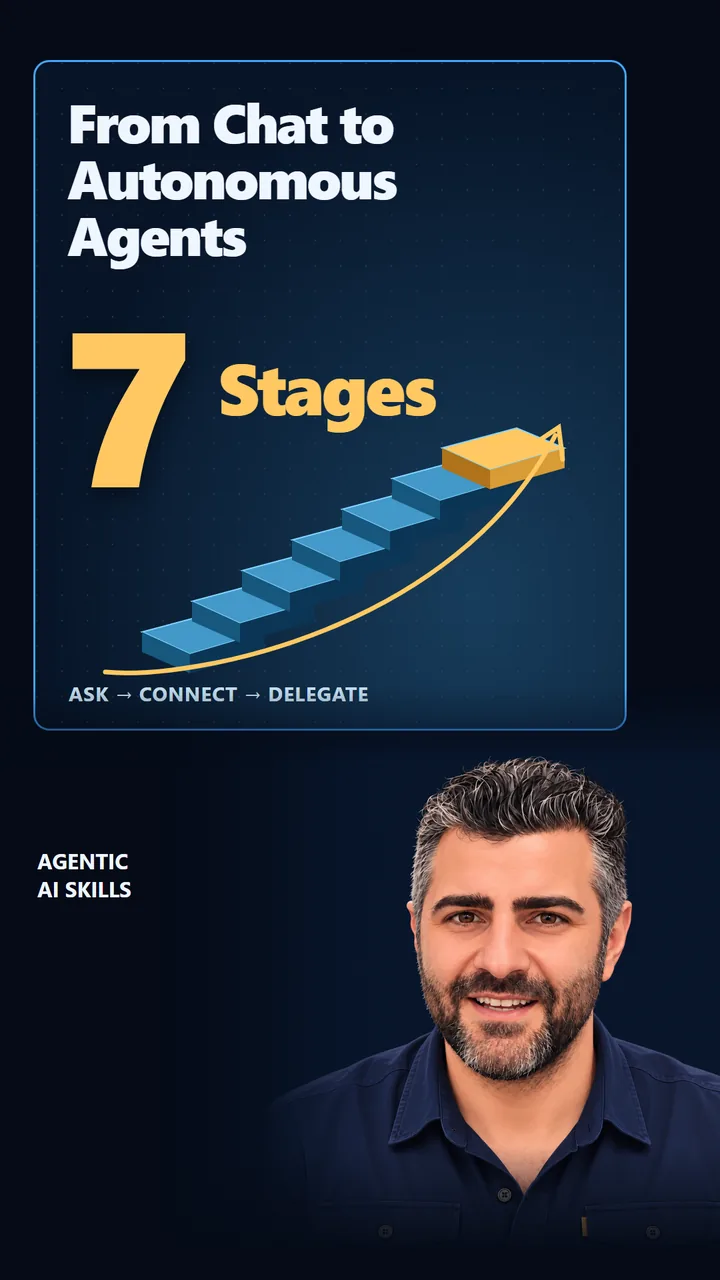
Use listings you have already reviewed yourself. Because you know the outcome, you can compare which opportunities the agent missed and which requirements it misread. The gaps show where it went wrong and where your instructions were incomplete. The wider seven-layer framework is in the video From Chat to Autonomous Agents: 7 Stages.
Frequently Asked Questions
Is an agent just a smarter model?
No. An agent is a system that puts a model’s intelligence to work with tools, permissions and a goal. The same model without tools and a goal only produces responses.
Can an agent submit applications on my behalf?
Only if it has the necessary tools and permissions. Keep permission to draft separate from permission to send, and add a technical approval check before submission; an instruction alone is not enough.
How is it different from regular automation?
In automation, conditions and steps are defined in advance. In an agent, the model chooses some intermediate steps from the information available at that moment. If the route is predictable, simple automation may fit better.
What if the agent reaches the wrong conclusion?
It always can. That is why you need concrete checklist items, source links, a final human read and a stopping limit. The agent’s own check can miss mistakes.
Follow for content about AI
More videos
 From Chat to Autonomous Agents: 7 Stages
 Expense Tracking with AI Automation: Google Sheets or Excel
 Motion Design with Just Claude Opus: 32 Experiments and Prompts
 Can You Run AI Locally on a 16 GB Graphics Card?
 Customer Wrote at Night, Request Ready by Morning
 Give AI the Address, Not the Route: Which Job Goes to Which Model
 Stop Using Excel and Google Sheets as a Database: To a Web App
 ADHD Didn't Change. The Tools Did: A Scattered Brain and Agents
 Can AI Fix Its Own Mistakes? I Checked It Is Not I Fixed It
 OpenRouter and Hugging Face Aren't Models: Three Ways In
 How Do AI Agents Work? Same Model, Different Results
 AI Agents for AEC Firms: How the Five-Layer Setup Works