
What to Look for When Hiring a Claude Expert
What separates a Claude expert from someone who uses Claude in a chat window is that they can describe a system they built in production, its limits, and a mistake they made. A CV line saying “I know Claude, ChatGPT, Gemini” doesn’t show that. Below are four parts: which jobs genuinely need Claude-specific expertise, which questions to ask, how to read the answers, and a small trial you can run before deciding.
First: does your job need Claude-specific expertise?
Not every job does. For a blog post, a social media caption or a translation, which model is used often doesn’t matter; a general AI consultant is enough. Claude-specific knowledge makes a difference in work like this:
- Automation with Claude Code: an agent with file-system and command-line access carrying out a multi-step job under supervision. Which commands are allowed, what happens on error, and at which step a human approves are designed upfront.
- Claude Skills: turning a recurring job (a checklist, a report layout) into packaged instructions. Details in What Is Claude Skills.
- MCP integration: MCP (Model Context Protocol) is an open-source standard for connecting AI applications to external systems; it lets a model reach email, a calendar, a database or an ad account (modelcontextprotocol.io, as of October 2026).
- Projects and context management: setups where a team works from shared context. General background on Claude is in a separate article.
Rough split: if the job is “get me good text”, a general consultant; if it’s “connect a system to Claude and make it run safely”, Claude-specific expertise.
Which questions to ask
A general question (“do you have AI experience?”) gets a general answer. Ask these, with what you want to hear next to each:
| Question | What a good answer looks like | Red flag |
|---|---|---|
| Where have you used Skills? Can you show an example? | Names a specific job, its steps and what the Skill changed; can show it. | “Yes, I use it a lot, it’s a great tool.” |
| Have you built an automation with Claude Code? What limits did you keep commands within, and what happens on error? | Describes an allow-list, approval points and a way to roll back. | Never mentions limits or failure cases. |
| Have you connected an MCP server? To which system, with what permissions? | Names the system, the access granted (read-only or write) and why. | “It connects to anything”; no distinction between permissions. |
| Before installing a third-party Skill or MCP server, what do you do? | Reads the contents, checks which commands and access it asks for. | “If it’s popular, I install it.” |
| What did you decide not to do with Claude, and why? | Can say when a general tool, or no AI at all, was the better choice. | Thinks everything can be done with Claude. |
Questions two, three and four are the security side of the job. Giving an agent account access is a serious decision; don’t start with someone who can’t tell you how they will limit that access. This is covered separately in is it safe to give an AI agent account access.
Real experience usually includes a limitation, a bug or an unexpected behaviour, and how it was worked around. Someone with no concrete story to tell has probably not used the tool in production.
A small trial before you decide
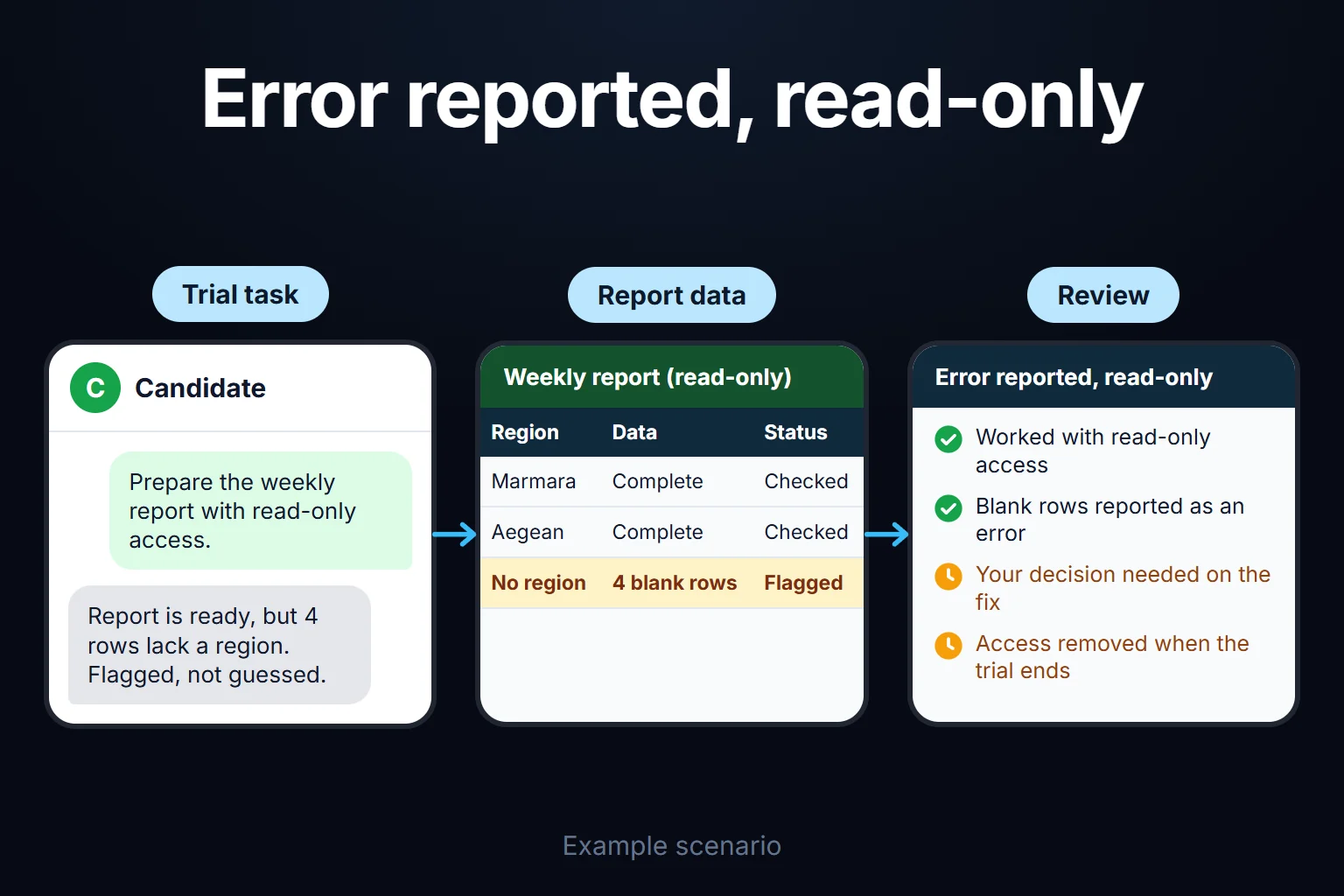
If conversation isn’t enough, give a small, paid, reversible trial job:
- Pick a single recurring task (for example a report prepared in the same format every week).
- Limit access to read-only; don’t grant write access in the first trial.
- Check the output yourself and watch how the candidate handles mistakes.
- Verify which account they accessed with which role, and that access was removed when the job ended.
A candidate who tells you when they made a mistake is a better sign than one who shows complete work and never mentions any uncertainty.
When you receive a proposal
- Scope in writing: which systems will be accessed, which outputs delivered, when it ends.
- Access stays on your account: a role is granted instead of sharing a password, and removed when the job is done.
- Time and price depend on the job. A simple Skill setup and a multi-system MCP setup are not the same job; a proposal promising a fixed duration may not have understood the scope.
- Who maintains it: tools change often, so who updates the setup afterwards should be settled upfront.
You can ask me for this work
If you need Claude Skills setup, automation with Claude Code or MCP integration, see the AI Consulting page for details.
Frequently Asked Questions
Is a “Claude expert” the same as a “prompt engineer”?
No. Prompt engineering is the skill of writing prompts to get good output from a model, and it can work independent of the model. Claude expertise includes that but also covers building automations with Claude Code, packaging Skills, and connecting systems with MCP.
Can someone without Claude Code experience handle a Claude-related task?
For content production or one-off analysis, yes. If the job involves file-system access, running commands or a multi-step automation, an inexperienced person can make mistakes and set access limits wrongly; for those jobs, choose someone who can answer the questions above clearly.
Why should I ask about MCP?
Asking whether someone has connected an MCP server is a fast way to tell “I do integrations” from having actually built one. What you really want to look at is which permissions they granted.
How long does this take, and how is it billed?
It depends on scope. A simple Skill and a multi-system integration don’t take the same time. Ask for a written scope and a list of deliverables; time and price are discussed on that basis.