
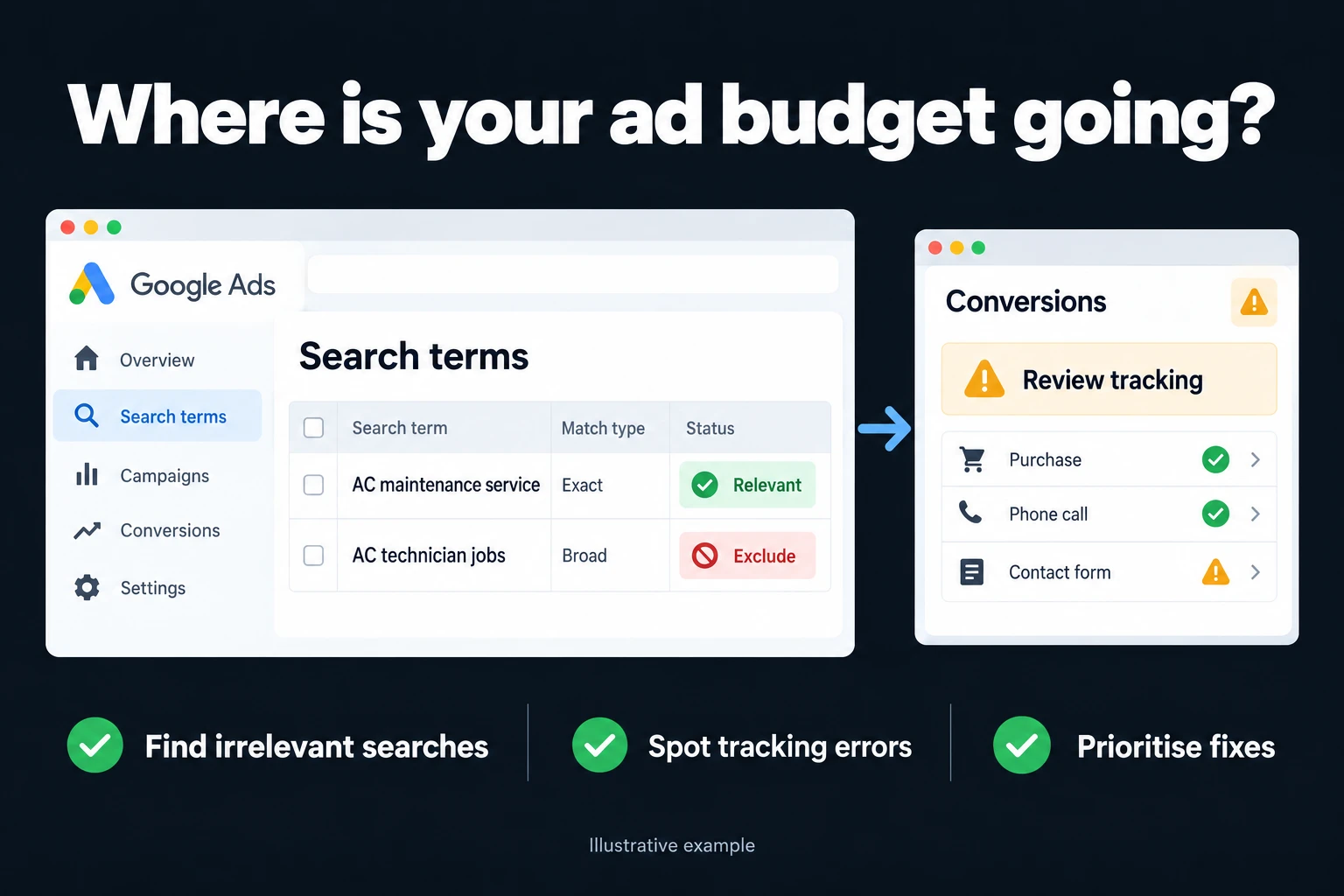
Google Ads Account Audit
For: businesses needing an independent account review. Deliverables: evidenced findings and prioritised implementation recommendations. Scope is agreed in writing and work uses an hours package. Contact.
You’re running ads, money is going out, results are coming in — or not — but you can’t see exactly where the budget is actually going. An account audit shows precisely that: which campaign, which search term, which device, and which time of day is spending your money efficiently, and which isn’t.
The audit is an independent process. If you already have someone managing your account or an agency in place, I don’t interfere with their work — I just look at what the data says. I deliver the results as a written list of findings and priority-ranked action items.
What I Look at in the Audit
Account structure and campaign segmentation; whether conversion tracking is actually working; the search terms report and negative keyword discipline; whether the bidding strategy fits the account’s data volume; audience and remarketing setup; the state of ad copy and assets; landing page fit and speed; geographic and time-based waste.
The most common source of waste I find is search terms. A keyword left on broad match can pull clicks from hundreds of irrelevant terms and quietly eat up a serious chunk of the monthly budget.
What You Get in the Audit Report
I don’t deliver a flashy presentation — I deliver a usable list: for every finding, what it is, why it’s a problem, its estimated impact, and how to fix it. Items are ranked by impact vs. effort, with the highest-leverage items at the top.
You can implement the report yourself, hand it to your existing agency, or we can implement it together. Buying an audit doesn’t require buying management — I keep those two deliberately separate.
After the report: choose the order of fixes
Changing every finding in the same week makes the outcome hard to interpret. I prioritise the report and suggest this sequence:
- Measurement first. Verify the conversion definitions and counting before making bidding decisions from them.
- Then irrelevant spend. Prioritise reversible changes whose effect can be checked.
- Then structure. Reorganising campaigns and ad groups may require the bidding system to adapt. Make the reason and expected observation period explicit.
- Then bidding. Set the strategy and targets using the corrected evidence.
Two settings to choose deliberately: inspect search partners and any Display Network option available to the campaign; understand where spend can appear. Also check whether location targeting covers people present in an area or people showing interest in it. Interest-based reach may be suitable for some businesses and unsuitable for others. Do not assume the same default appears in every setup.
Recommendations need a business test. An optimisation score does not itself establish profitability or lead quality. Applying recommendations in bulk can amplify bad measurement.
Review access. Record users and permission levels, former employees who remain connected and security requirements that can be verified. Do not claim visibility into another user’s private security settings.
When an Audit Actually Makes Sense
A fresh review can also make sense after an agency handover, a site redesign or a new measurement setup.
A new account can be audited for structure and measurement readiness; performance conclusions need sufficient observations. Limited evidence is labelled as such. I do not guarantee that an audit pays for itself.
If you’re considering switching agencies, getting an independent audit before deciding is the smartest first move. It shows you clearly whether the problem is with the agency, or with the product, pricing, or landing page.
How do we start? First, we talk about what you want and what’s realistic. If it makes sense, I’ll send you the scope and price in writing, then we begin. You can reach me through the contact page.
What does the diagnostic and acceptance record contain?
These are method examples, not client results or performance promises.
| Situation | Check | Deliverable / acceptance |
|---|---|---|
| Inflated conversions | Tag and GA4 sources for the same enquiry | Primary-goal mapping and duplicate evidence |
| Wrong enquiries | Search terms and sales-team outcome records | Waste distinguished from insufficient evidence |
Frequently Asked Questions
Do I need to give you full access to my account for the audit?
No. Read-only access is enough. I make no changes to your account during the audit — I only read and report. You can revoke access as soon as the report is delivered, if you’d like.
Will my current agency find out?
Users added to the account are visible in the account settings, so technically they can see it. It’s worth knowing that upfront. Most clients get the audit done transparently, with the agency aware of it, anyway.
How long does the audit take?
It depends on the size of the account — typically a few business days for a standard account. Accounts with many campaigns and a long history can take longer. I’ll pin down the timeframe once I’ve seen the account’s size during the intro call.
Will you also take over management after the audit?
I can, but it’s not a requirement, and I don’t use the audit as a sales tool for it. The audit is sold as a standalone service. Taking the report and implementing it with your own team is a completely normal outcome for me.
Should I apply Google’s recommendations?
Check each recommendation against conversion definitions, lead quality and business goals. Verify measurement before bulk changes, and record changes so their effect can be assessed.
How do I work?
Work-hour packages
Tell me about your business and what you need on WhatsApp or by phone; we agree on a work block of somewhere between 5 and 40 hours and I start doing what is needed. What you get is not a calendar window — it is net working hours spent directly on your business. I can use 40 hours working three days straight, or deliberately spread it out and finish it over a year — whatever the work calls for. I do not spend my time estimating how long something will take, I spend it doing the work; every hour I spend leaves a lasting result in your business. We keep going for as long as you find it useful.
Why not monthly?
Is 40 hours a week?
On a fixed monthly fee both sides are watching the wrong thing: you watch a fixed cost, the other side watches how many more contracts like this they can line up. Working by the hour puts us both in front of the same thing — the real value of the work that got done. I know not having an upfront answer to "how much will this cost in total?" is the natural cost of this model. But instead of paying a fixed fee for months to a setup that is not producing results, you only pay for the qualified time spent on your work — and you see exactly where that time went, start to finish. That is why my clients keep coming back.