Source: https://oguzerol.com/en/periodic-maintenance-tracking-app/ [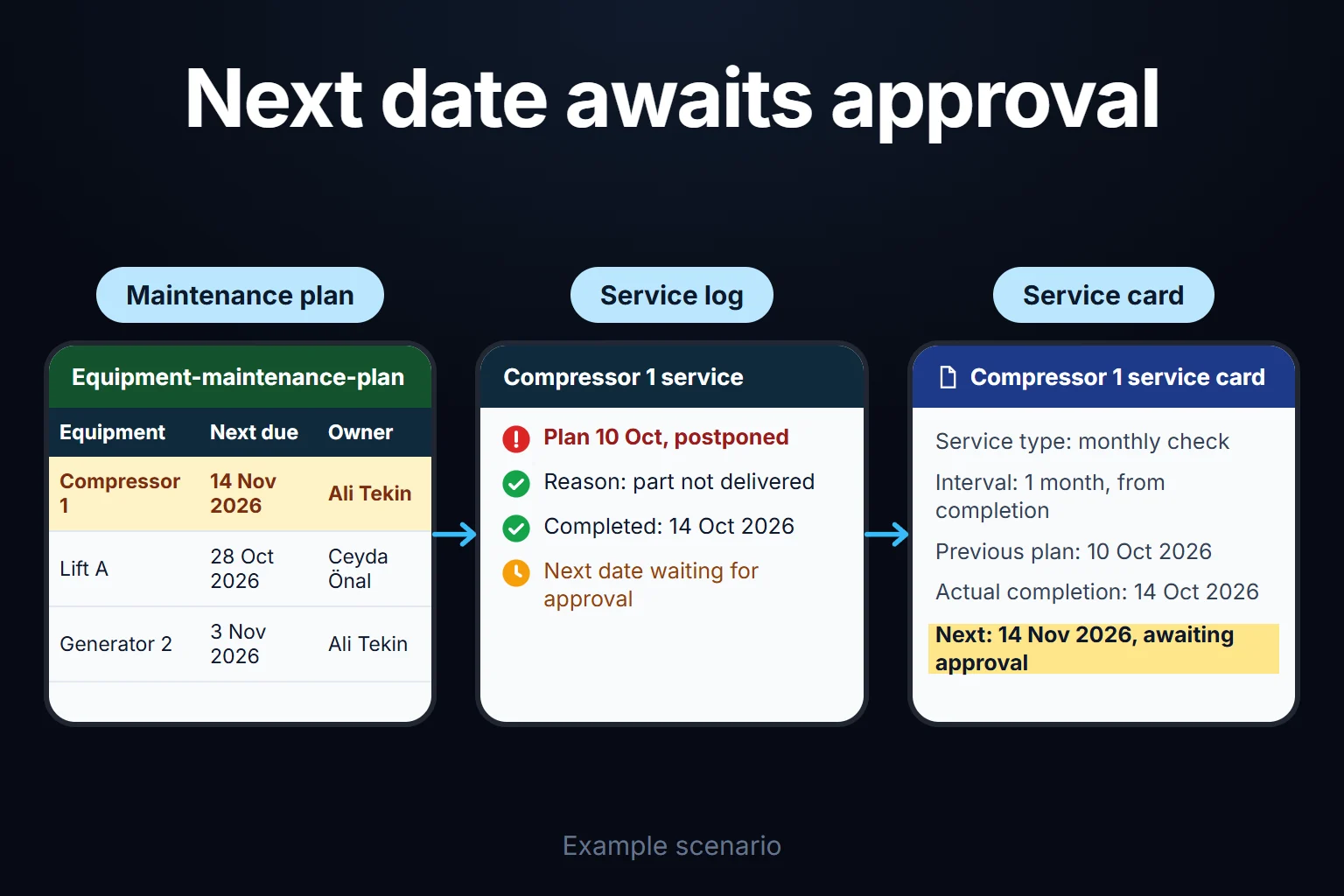 View full size](https://oguzerol.com/gorseller/senaryo/periodic-maintenance-tracking-app-senaryo-en.webp) # Periodic Maintenance Tracking: Calendar and Meter Plans, Deferrals and Inspections [Oğuz Erol](https://oguzerol.com/en/about-me/) | 17 min read Periodic maintenance tracking means tying each machine’s recurring tasks to the calendar or to running hours, turning every due task into a work order, and recording what was done, deferred or skipped, with the reason. A spreadsheet handles the “when” and breaks in three places: a supervisor defers a service twice and the date cell is overwritten; nobody enters running hours and a meter-based service passes its due point unnoticed; a forklift that arrived on rent and was later bought never reaches the inspection list. I build custom web apps that close these gaps with explicit rules, and everyone from planner to operator signs in with their own permissions. Below I follow one month at a fictional manufacturer. ## Planned maintenance, breakdowns and statutory inspections are three separate records Planned maintenance, breakdown repair and statutory inspection happen on the same equipment but are separate records; counting one as another corrupts both the compliance rate and the downtime report. Planned maintenance is known in advance, a breakdown starts when a machine stops, and a statutory inspection is not maintenance but an examination by a qualified person that ends in a signed report. Terms used on this page: - **Plan item:** one recurring task on one machine, with its interval (“CNC-07, quarterly coolant filter service”). - **Due point:** the date or meter reading when it is due. - **Work order:** opened for one due point, closed with work, time, parts and name. - **On-time window:** the range around the original due point in which work still counts as on time; a deferral does not move it. - **Deferral:** a later due point with a reason; the original stays on record. - **Missed:** past the window, neither done nor deferred. ## Sample plant and sample month: one deferral, one stale meter, one forgotten forklift *Sample data, fictional.* A metal parts manufacturer with about 240 staff on two 8-hour shifts: 14 CNC machines, 2 compressors (K1, K2) with 2 air receivers (T1, T2), 6 forklifts (F1 to F6), an overhead crane, a heating boiler, 38 measuring instruments and 132 plan items. The month starts on a Monday and has 22 working days; days below are working days. | first month | count / hours | | --- | --- | | Planned work orders falling due (calibration and inspections included) | 64 | | Completed within the on-time window | 51 | | Completed late | 6 | | Deferred with a reason, still open | 5 | | Missed | 2 | | **Planned maintenance compliance** (on time ÷ falling due) | **51 / 64 = 79.7%** | | Breakdown work orders | 19 (41.5 hours of downtime) | | Planned maintenance downtime | 58 hours | | Overdue statutory inspection found at go-live | 1 (F5) | I give no industry benchmark for 79.7%; compare it with your own past months. **Day 1, the forgotten forklift.** At go-live the inspection list was matched against the equipment register: 5 forklifts listed, 6 registered. F5 had arrived on rent and was later bought; its last inspection report was 13 months old. The health and safety lead marked it out of service; it was inspected on day 3 and cleared with one minor defect, which got a corrective work order. **Days 4 to 16, two deferrals and a breakdown.** CNC-07’s quarterly service was due on day 4, window ±9 calendar days. The previous two months’ notes, imported from the spreadsheet, held two cooling records on that machine: “spindle running hot” and “coolant low”. The production supervisor deferred the service to day 9 to finish an order (7 calendar days, inside the window), then to day 16 for another shipment (18 days, outside it). Nothing showed him the cooling records or sent the second deferral for approval. On day 14 the spindle cooling failed and the machine stood for 9.5 hours. The note: “coolant filter blocked, low flow.” That filter was on the deferred checklist. The service was done with the repair and counted as late. **Days 4 to 19, the stale meter.** Diesel forklift F3 is serviced every 500 running hours (a sample interval): last service 6,120, due point 6,620, window end 6,670. A new operator skipped the start-of-shift meter entry from day 4 to day 18. On day 19 the reading was 6,620: due that day. Regular readings would have opened the work order ten working days earlier (worked out below). The service was done on day 21 at 6,640, 4% over and, by luck, still inside the window. **All month, the compressor waiting for a part.** K1’s filter service opened at its meter threshold, but the shelf was empty while the stock record showed 2. The work order moved to “waiting for parts”, counted apart from deferrals, and the service was done 3 working days after the meter window closed. It is one of the 6 late completions; CNC-07 is another. **Month-end decisions.** The plant manager set three rules. First, the deferral screen shows the last 90 days of notes on the same machine and component, and a second or out-of-window deferral needs the maintenance manager’s approval; that would have sent CNC-07’s second deferral for approval, with both cooling records in view. One breakdown proves nothing, so the rule requires approval rather than banning deferrals. Second, missing meter readings trigger an alert and an estimated meter. Third, no new equipment, rented included, is used until it is registered with its last inspection report. ## Plan rules: when does a work order open, and when is work “late”? All rules are *my starting proposal*; thresholds depend on your manuals, shifts and risk assessment. | rule | starting proposal | what it prevents | | --- | --- | --- | | Plan type | calendar, meter, whichever comes first (e.g. 500 hours or 6 months), or statutory inspection | meter work run on calendar guesses | | Opening the work order | calendar: 14 days ahead; meter: when remaining hours fall to 10 working days of use at the last 20 working days’ average | parts and downtime planned on the last day | | On-time window | 10% of the interval; ±9 days on a 90-day item, +50 hours on a 500-hour item; none for statutory inspections | unlimited deferrals that still look on time | | Deferral | reason required; a first one within the window approved by the planner, a second or out-of-window one by the maintenance manager; inspections are not deferred | maintenance slipping under order pressure | | Closing | each checklist line done / not done / not applicable; “not done” needs a reason and opens a follow-up | a half-done service counting as complete | | Meter readings | a lower reading is rejected; a daily rise above shifts × 8 hours warns; missing readings follow the rule below | a due point missed on a stale meter | | Major repair | closing a breakdown on lifting or pressure equipment asks whether welding, cutting or grinding was done on the structure, or a part other than ropes and chains replaced; “yes” opens an inspection work order | the inspection due after a repair being forgotten | | Deletion | never; cancel or deactivate, reason kept | history cleaned up, compliance inflated | ## How is the next due date calculated? There are four methods, and one machine can use all four: 1. **Wear items, from actual completion.** Oil, filters and belts count from when the work was actually done; otherwise a filter changed late is replaced early next time. The app calculates, the planner approves. 2. **Fixed-calendar items, from the plan.** A boiler service in the same week each year does not shift when one is late. 3. **Statutory inspections, from the report.** The app uses the next date the health and safety lead enters from the report and warns if it exceeds the regulation’s maximum interval from the previous inspection. 4. **Calibration, from the certificate** or your quality system’s interval. ## Meter-based maintenance: what happens when no reading comes in? The weak point is the reading, not the formula. Readings come from the operator, a work order or the machine’s controller; the last depends on what the controller exposes, and I do not promise it before seeing the machine. I put the meter on the first line of the operator’s daily pre-use check, which cannot be closed without it. When readings stop (my starting proposal): after 2 working days the shift supervisor is alerted; after 3 the app adds the last 20 working days’ daily average × days elapsed to the last reading, checks the threshold and labels the value “estimated”. F3’s threshold was 6,520 (6,620 − 10 days × 10 hours); its last reading was 6,460 on day 3, and 6,460 + 6 × 10 = 6,520, so the work order would have opened on day 9. ## Statutory inspections: what does the app track, and what does it not replace? The app tracks the inspection date, booking, report and defect follow-up; it does not replace the qualified inspector or the signed report. It reminds the health and safety lead 30 calendar days ahead (my starting proposal); at go-live T2, due on day 18, was already inside that period, so the reminder went out on day 1. T2 was booked on day 15 and inspected on day 18. A failed report turns the equipment card red and blocks logging usage until the defect is cleared. The out-of-service mark is a record; it does not replace your lockout and tagging procedure during maintenance. **In Turkey**, the rules come from the Regulation on Health and Safety Requirements for the Use of Work Equipment (Official Gazette 25.04.2013, no. 28628; consolidated text including the 23.12.2025 amendment, no. 33116, read on mevzuat.gov.tr on 15 October 2026): - Annex III caps compressor air receivers, heating boilers, cranes, forklifts and machine tools such as lathes, milling machines and machining centres at 1 year unless the relevant standard sets a period; the sample plant’s 14 CNC machines are plan items on that basis. - Results count when wet-signed or kept electronically with a secure electronic signature; a plain scan is neither, so I would keep the signed original (my reading, not legal advice). The inspection contract must be confirmed at least 1 day ahead on İSG-KATİP, the registration and tracking system of the ministry’s Directorate General of Occupational Health and Safety (art. 4/1-r, 7/6). - Where the ministry’s report format grades defects, a minor defect left past the next start date becomes major; all maintenance and repairs are kept for the equipment’s life; renting does not change the employer’s duty (art. 5/3), which is why F5 was the plant’s responsibility. The [Turkish version of this page](https://oguzerol.com/periyodik-bakim-takip-uygulamasi/) covers these article by article. In the UK, regulation 9(3) of [LOLER 1998](https://www.legislation.gov.uk/uksi/1998/2307/regulation/9) requires lifting equipment exposed to deterioration to be thoroughly examined at least every 6 months for equipment lifting people and lifting accessories, at least every 12 months for other lifting equipment, or under an examination scheme (read 15 October 2026). The app stores whatever interval applies; your health and safety lead decides which. I do not give legal advice. ## Spare parts and calibration Parts are the most common hidden wait, so each plan item carries its parts list and the stores lead reserves them when the work order opens. A missing part puts the order in “waiting for parts”, reported apart from deferrals; K1’s record-versus-shelf gap surfaced there. How a below-threshold part becomes a purchase request is on the [minimum stock and purchasing app](https://oguzerol.com/en/minimum-stock-purchasing-tracking-app/) page. Calibration due dates come from your quality system, customer specifications or the manufacturer. In the sample month 3 of 38 instruments fell due: two closed with certificates, a micrometer could not be found (one of the 2 missed work orders). My proposed rule: an instrument past its date is marked out of use and no measurement can cite it. ## How do you separate breakdown downtime from planned downtime? Keep two columns. In one, more planned maintenance looks like more downtime, and maintenance gets cut first. The sample month had 58 planned hours and 41.5 breakdown hours over 19 breakdowns; CNC-07’s service would have taken 4 hours between shifts, the breakdown took 9.5 mid-order. Mean time to repair (MTTR) is breakdown time ÷ breakdowns: 41.5 ÷ 19, about 2.2 hours. Mean time between failures (MTBF) misleads on one or two breakdowns a month; I report it only once a machine or group has 8 to 10 failures. Service requests to your customers’ equipment are a different job: see the [technical service work order tracking app](https://oguzerol.com/en/technical-service-work-order-tracking-app/). ## Roles: who sees, who defers, who closes? My proposal; yours will differ. - **Operator:** own machine and daily checklist; enters meter and check, reports faults. - **Technician:** assigned work orders and history; closes them, proposes plan items, marks a machine out of service on a breakdown and clears it after repair. - **Planner:** all plans and work orders; creates plan items, approves a first in-window deferral, reviews late closures. - **Production or shift supervisor:** own line’s work orders; requests deferrals but cannot approve them, confirms downtime, is alerted on missing readings. - **Stores lead:** reserves parts, flags “waiting for parts”, posts parts used. - **Health and safety lead:** inspections, defects and major repairs; uploads reports, enters next dates, and alone clears an inspection-related out-of-service mark. - **Management:** everything; approves second and out-of-window deferrals and interval changes. Requester and approver are separate on purpose: if one person does both, maintenance slips with every rush order. **Audit trail.** Every change records who, when, old and new value and reason. A “not done” reason can be corrected, but the first version stays and the correction is a new line, so compliance cannot be rewritten afterwards. ## What does AI do here, and what does it not do? Rules calculate due points; people decide. AI suggests three things: 1. **Fault class from the note:** from “coolant filter blocked, low flow”, a class (mechanical, electrical, hydraulic, pneumatic, lubrication and cooling) and component; the technician confirms. 2. **Repeating faults:** “spindle running hot”, “coolant low” and “filter blocked” are one component in three phrasings; grouping them is what lets the deferral screen show same-component records. Counting the day 14 breakdown, CNC-07 had three cooling records in 90 days, which sends it to the planner for review; shortening the filter interval to six weeks is the planner’s proposal and the maintenance manager’s call. 3. **Plan items from the manual:** a draft of tasks and intervals from a PDF manual, with the page number on every line; nothing enters the plan until the planner checks that page, since multi-model manuals can lead it to the wrong table. The model never changes a meter, defers work, sets an inspection date or grades a defect. No row reaches the model without passing the user’s permission filter. I suggest sending roles (“technician 2”), not names; cross-border rules depend on where you operate. In Turkey, personal data sent to a model abroad falls under [Article 9 of Law No. 6698](https://www.mevzuat.gov.tr/mevzuatmetin/1.5.6698.pdf) as amended by [Law No. 7499, Article 34](https://www.resmigazete.gov.tr/eskiler/2024/03/20240312-1.htm) (Official Gazette 12.03.2024, no. 32487, in force 1 June 2024; read 15 October 2026). I provide a written list of the fields sent to the model. ## Where does a maintenance spreadsheet break? A spreadsheet calculates due dates. Columns: `A` equipment, `B` plan item, `C` calendar interval (days), `D` last done, `E` meter interval (hours), `F` meter at last service, `G` current meter, `H` average hours per working day, `I` calendar due, `J` hours remaining, `K` calendar status, `L` meter status, `M` result. Leave unused interval cells blank. - `I2`: `=IF(C2="","",D2+C2)` - `J2`: `=IF(E2="","",F2+E2-G2)` - `K2`: `=IF(C2="","",IF(I2<TODAY(),"Overdue",IF(I2-TODAY()<=14,"Open work order","Planned")))` - `L2`: `=IF(E2="","",IF(J2<0,"Overdue",IF(J2<=H2*10,"Open work order","Planned")))` - `M2`: `=IF(AND(K2="",L2=""),"No interval",IF(OR(K2="Overdue",L2="Overdue"),"Overdue",IF(OR(K2="Open work order",L2="Open work order"),"Open work order","Planned")))` `M` applies “whichever comes first”. Track statutory inspections in a separate column holding the report’s date; a row with no interval shows “No interval”. Do not merge both checks into one `AND` (the `AND` in `M2` is safe because it only tests for blanks and subtracts nothing): it evaluates every condition, and with no calendar interval `I2` is a formula returning empty text (`""`), so `I2-TODAY()` returns #VALUE!. I recalculated the logic in Python on six sample rows; try the formulas once in your own file. It breaks elsewhere: a deferral overwrites `D` or `I`, so the original date and reason vanish and compliance cannot be calculated; `G` makes a 15-day-old reading look like today’s; and completed work lives on another tab or paper, so a “not done” line disappears without a follow-up. ## If a spreadsheet or your current system is enough, you do not need this app Do not commission one if: 1. You have little equipment, one or two maintainers and nothing meter-based. 2. Your ERP’s maintenance module or CMMS already records deferral reasons, meters and inspections, and your team uses them. 3. Over three months these come out low: (a) second or out-of-window deferrals; (b) breakdown hours touching a deferred service; (c) equipment past its inspection date; (d) meters unread for over 3 working days. The sample month: 1 (CNC-07), 9.5 of 41.5 hours, 1 forklift, 1 stale meter. 4. Your health and safety provider keeps inspections complete and their equipment list matches yours. A custom app pays off when those rules cannot be set up in your system, the team has drifted back to spreadsheets and paper, or production, maintenance, stores and safety look at one machine through different lists. ## How do you start, who owns the data and code, and what if the ERP changes? In automation work, the mistake I see most often is picking the most complex process first, so the first version covers one equipment group, say compressors and forklifts, and the inspection list is matched against the register at go-live, where gaps like F5 surface. The app runs on a server (a VPS) that can be opened in your name; the data is yours to export as Excel or CSV at any time, and the full source code sits in a repository you have access to, with written run instructions, a dependency list and known limitations. There is no per-user license; the cost is the monthly server fee plus maintenance, and adding users in a small or mid-sized team does not change it. Everyone signs in through the browser with their own username; because personal data is involved, I assess access, security and hosting separately, and we choose the reminder channel together in the first step. If your ERP changes, history stays in the app and codes are linked through a mapping table; I put the details in writing once I have seen how the new system exports data. Tell me on the [contact page](https://oguzerol.com/en/contact/) how many machines and plan items you have, whether any maintenance is meter-based and who keeps the inspection list today, and we can map your register and deferral rule as the first step. ## Frequently Asked Questions ### Are maintenance records deleted when equipment is retired? No. The equipment is deactivated; past work orders, reports and certificates stay, and a sale or scrapping is recorded with date and reason. ### If an outside service company does the maintenance, how is the work order closed? They need no account. Their report is attached, completed lines and parts are ticked from it, and a technician or the planner closes the order; a line missing from the report stays “not done”. ### Can a technician close a work order where the signal is weak? Offline closing is not something I commit to today; we agree it in writing in the first step. ### Can sensor data be connected for predictive maintenance? If the data is exposed, it can; but deferral and meter rules should settle first. [Back to top ↑](https://oguzerol.com/en/periodic-maintenance-tracking-app/#icerik) ## You may also find these useful [Service Work Order Tracking: SLA Clocks, Warranty vs Billable, Repeat FaultsA role-based web app that tracks each service request from call to invoice: SLA clock, warranty vs billable work and repeat visits. See a 312-request month.](https://oguzerol.com/en/technical-service-work-order-tracking-app/)[Asset Checkout and Custody Tracking AppTrack who holds each asset, its handover condition and return inspection. Turn your equipment list into a custom checkout workflow for your team.](https://oguzerol.com/en/asset-checkout-tracking-app/)[Assigned Records Tracking PortalA tailored tracker where people see assigned customer records while managers retain a complete operational view. Built for Excel and Google Sheets workflows.](https://oguzerol.com/en/assigned-records-tracking-portal/) [Browse all articles →](https://oguzerol.com/en/articles/) WHAT YOU CAN ASK FOR ## How do I work? Work-hour packages Tell me about your business and what you need on WhatsApp or by phone; we agree on **a work block of somewhere between 5 and 40 hours** and I start doing what is needed. What you get is not a calendar window — it is net working hours spent directly on your business. I can use 40 hours working three days straight, or deliberately spread it out and finish it over a year — whatever the work calls for. I do not spend my time estimating how long something will take, I spend it doing the work; every hour I spend leaves a lasting result in your business. We keep going for as long as you find it useful. WORK BLOCKS ## Why not monthly? Is 40 hours a week? On a fixed monthly fee both sides are watching the wrong thing: you watch a fixed cost, the other side watches how many more contracts like this they can line up. Working by the hour puts us both in front of the same thing — the real value of the work that got done. I know not having an upfront answer to "how much will this cost in total?" is the natural cost of this model. But instead of paying a fixed fee for months to a setup that is not producing results, you only pay for the qualified time spent on your work — and you see exactly where that time went, start to finish. That is why my clients keep coming back. 5hours300€ + VAT60€ per hour[Choose this block](https://wa.me/905496546489?text=Hi%2C%20I%27d%20like%20info%20about%20the%205-hour%20work%20block.) 10hours500€ + VAT50€ per hour[Choose this block](https://wa.me/905496546489?text=Hi%2C%20I%27d%20like%20info%20about%20the%2010-hour%20work%20block.) 20hours800€ + VAT40€ per hour[Choose this block](https://wa.me/905496546489?text=Hi%2C%20I%27d%20like%20info%20about%20the%2020-hour%20work%20block.) 40hours1,400€ + VAT35€ per hour[Choose this block](https://wa.me/905496546489?text=Hi%2C%20I%27d%20like%20info%20about%20the%2040-hour%20work%20block.)