Source: https://oguzerol.com/en/what-is-a-token-how-ai-usage-cost-is-calculated/ [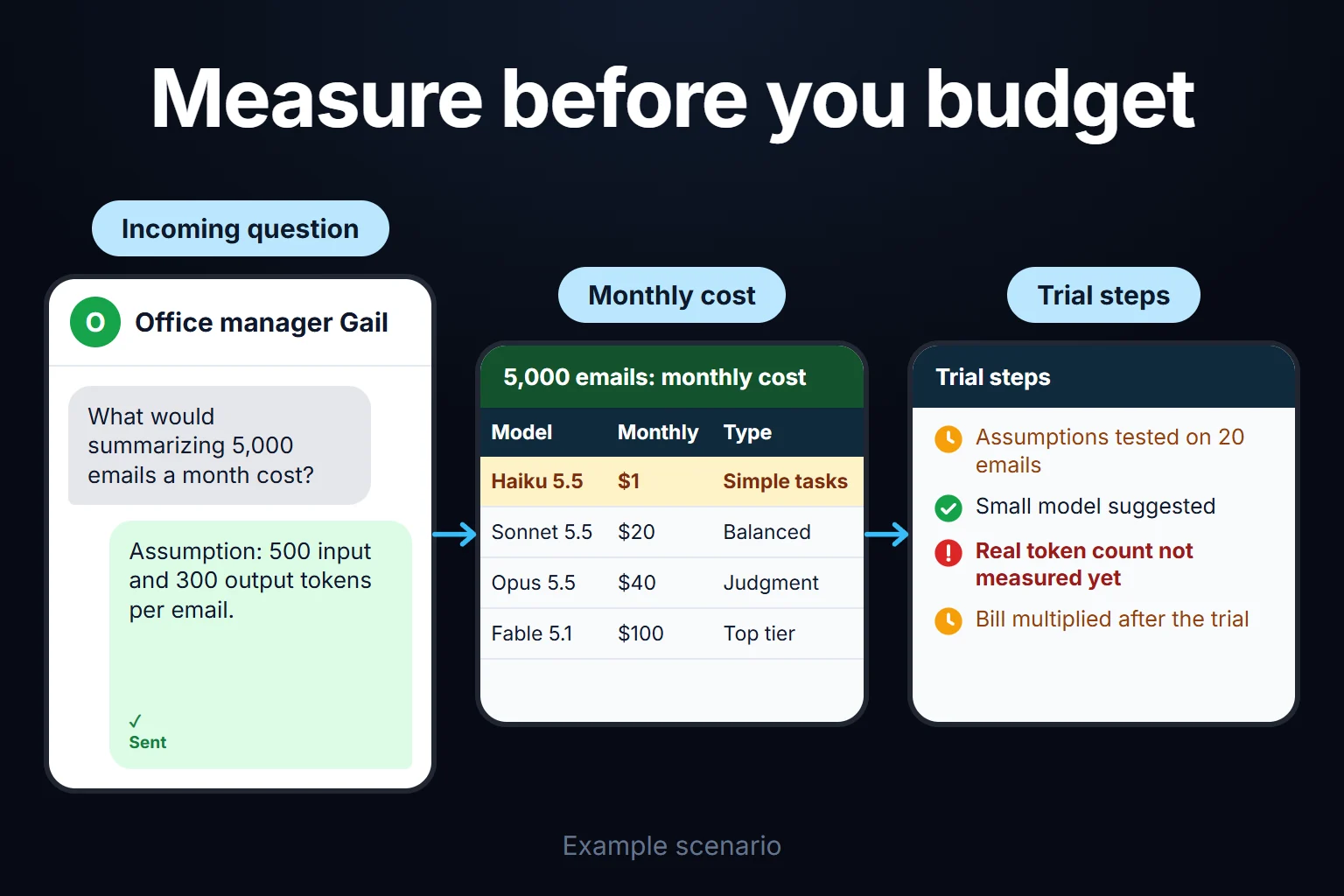 View full size](https://oguzerol.com/gorseller/senaryo/what-is-a-token-how-ai-usage-cost-is-calculated-senaryo-en.webp) # What Is a Token? How AI Usage Cost Is Calculated [Oğuz Erol](https://oguzerol.com/en/about-me/) | 7 min read | Published: 3 August 2026 | Updated: 13 October 2026 ## Quick summary A token is the unit AI splits text into and bills by. How many words are 1 million tokens, why Turkish costs more, and what 5,000 emails cost on each model. A token is the piece of text an AI model reads and writes: a whole word, part of a word, or a punctuation mark. When you use ChatGPT, Claude, or Gemini through an API, the charge isn’t based on words or characters. It’s based on the tokens you send and the tokens you get back. In English, the practical rule is 1 token ≈ 4 characters. In other languages tokens are shorter, so the same text takes more of them. That’s why the same job in Turkish costs more than in English. ## How many words is 1 token, and 1 million tokens? Google’s Gemini documentation says ([as of October 2026](https://ai.google.dev/gemini-api/docs/tokens)) a token is about 4 characters and 100 tokens is about 60–80 English words. So 1 million tokens is roughly 600,000–800,000 English words. That rule fails for Turkish. I measured it myself with OpenAI’s open-source `tiktoken` library, counting the Turkish and English text of this page (about 800–1,000 words each) in two token vocabularies (13 October 2026): | Token vocabulary | Turkish: words per token | English: words per token | Turkish/English tokens for the same paragraph | | --- | --- | --- | --- | | `o200k_base` (GPT-4o and later) | 0.50 | 0.80 | 1.4x | | `cl100k_base` (GPT-4 and GPT-3.5) | 0.38 | 0.79 | 2.0x | The last column comes from one paragraph written in both languages (112 tokens in Turkish, 79 in English). It’s a single sample, and your text will differ. The takeaway: 1 million tokens is about 500,000 Turkish words in the newer vocabulary and about 380,000 in the older one. The reason is that Turkish is agglutinative, so the suffixes after a root often get split into separate pieces, while the vocabularies were built mostly on English text, where words usually stay in one piece. Claude is moving too. Anthropic says ([as of October 2026](https://platform.claude.com/docs/en/about-claude/pricing)) Claude 4.7 and later models use a newer tokenizer that produces roughly 30% more tokens for the same text. Don’t carry a token count measured on one model over to another when you estimate a bill. ### How do I count the tokens in my own text? - **Claude:** Anthropic’s token counting endpoint returns the input token count before you send a message, and it’s free to use ([as of October 2026](https://platform.claude.com/docs/en/build-with-claude/token-counting)). The number is an estimate and can differ slightly from actual usage. - **Gemini:** the `countTokens` method returns the input total, and the real usage appears in the response’s `usage` field ([as of October 2026](https://ai.google.dev/gemini-api/docs/tokens)). - **OpenAI models:** count locally with the `tiktoken` library. ## How is the bill made up? The bill has two separate lines: the text you send (input) and the answer the model produces (output). Output costs more. On every Anthropic model in the table below, output is priced at 5x input. Tokens produced during reasoning (“thinking”) are billed as output too ([as of October 2026](https://platform.claude.com/docs/en/build-with-claude/context-windows)), so a model that thinks for a long time can burn more output tokens than you expect. Model choice is the biggest line on the bill. Four examples from Anthropic’s pricing page ([as of October 2026](https://platform.claude.com/docs/en/about-claude/pricing), US dollars per 1 million tokens): | Model | Input | Output | | --- | --- | --- | | Claude Haiku 5.5 (prompts up to 100,000 tokens) | 0.10 | 0.50 | | Claude Sonnet 5.5 | 2 | 10 | | Claude Opus 5.5 | 4 | 20 | | Claude Fable 5.1 | 10 | 50 | The gap between the smallest and largest model is 100x. The calculation below shows what that means. ### Example: summarizing 5,000 emails a month Assume 500 input tokens and 300 output tokens per email. That’s 2.5 million input and 1.5 million output tokens a month. With the prices above: | Model | Monthly cost | | --- | --- | | Haiku 5.5 | 2.5 × 0.10 + 1.5 × 0.50 = $1 | | Sonnet 5.5 | 2.5 × 2 + 1.5 × 10 = $20 | | Opus 5.5 | 2.5 × 4 + 1.5 × 20 = $40 | | Fable 5.1 | 2.5 × 10 + 1.5 × 50 = $100 | The formula never changes: operations per month × input/output tokens per operation × the model’s price. Run a small trial first and measure your real token counts, then scale. Give simple work (summarizing, classifying) to the small model and judgment-heavy work to the large one; running everything on the large model inflates the bill for no reason. A small model also fails at some tasks, and you won’t know which without testing, so run the same 20–30 examples on two models and compare. ## The context window: why long conversations get expensive The context window is all the text the model can see while it answers: the system instructions, earlier messages, documents you uploaded, and the answer being written. Anthropic says ([as of October 2026](https://platform.claude.com/docs/en/build-with-claude/context-windows)) the window reaches 1 million tokens on most current models. Two consequences: 1. **The history counts as input again on every turn.** At message 20, the previous 19 are sent again and billed as input. 2. **Long context can hurt accuracy.** According to Anthropic’s documentation, accuracy and recall can degrade as the token count grows. Sending only what you need is cheaper and more reliable than filling the window. ### Don’t resend the same document If you paste a product catalog or a 40-page FAQ into every question, you pay for that document’s tokens from scratch each time. There are two fixes: - **Prompt caching (API):** a repeated prompt prefix is written to a cache, and later reads are much cheaper. On Anthropic, a 5-minute cache write costs 1.25x the normal input price and a 1-hour cache write costs 2x. A cache read costs 0.1x on most models, 0.05x on Opus 5.5 and Sonnet 5.5, and 0.025x on Fable 5.1 ([as of October 2026](https://platform.claude.com/docs/en/about-claude/pricing)). So the write cost pays back after a few reuses. - **Claude Projects (interface):** you upload the document to a project once and it’s available in every conversation. I walked through the setup in [Setting Up a Company Assistant with Claude Projects](https://oguzerol.com/en/building-a-company-assistant-with-claude-projects/). Another approach is to send only what changed on each run instead of the whole history. In a recurring automation, that alone cuts input tokens sharply. ## Is a chat subscription the same as the API? No. Chat subscriptions such as ChatGPT Plus or Claude are a flat monthly fee with no per-token bill; instead, plan-specific usage limits apply. Per-token billing starts with the API and with apps that run on it. For what each Claude model costs, see [What Is Claude AI, and What Does It Cost](https://oguzerol.com/en/what-is-claude-ai-what-does-it-cost-how-to-use-it-from-turkey/). ## You can ask me to handle this If you want to see where your AI usage cost is going, choose the right model, or move large documents you resend over and over to a load-once setup, you can ask me to do it. It’s typically a 2-hour to 2-week job, remote, billed hourly. See the [AI consulting](https://oguzerol.com/en/ai-consulting/) page for details. ## Frequently Asked Questions ### Why does Turkish text take more tokens? Turkish is agglutinative: suffixes like “-lerin”, “-inde”, “-arak” often don’t exist as single pieces in a token vocabulary, so they get split. In my measurement above, the same paragraph took 1.4x the tokens in Turkish with the newer OpenAI vocabulary and 2x with the older one. ### Is a smaller model always the better choice? It’s the cheapest by price, but it makes more mistakes on complex tasks. Give simple, repetitive work to the small model and judgment-heavy work to the large one, and decide by comparing both on your own examples. ### Do I pay for tokens on a ChatGPT Plus or Claude subscription? No. You pay a flat monthly fee and plan-specific usage limits apply. Per-token charges appear only with API usage. [Back to top ↑](https://oguzerol.com/en/what-is-a-token-how-ai-usage-cost-is-calculated/#icerik) ## You may also find these useful [The Real Cost Isn't Setup, It's Running ItAn AI system needs upkeep after launch too: APIs change, data sources shift format, model behavior drifts. Who should own it, and how do you decide?](https://oguzerol.com/en/the-real-cost-isnt-setup-its-running-it/)[The Cost of AI Automation for Small BusinessesIn a small business, automation cost is set by number of processes, system fragmentation, and team readiness — a small, measurable start is smartest.](https://oguzerol.com/en/the-cost-of-ai-automation-for-small-businesses/)[How Much Does AI Integration Cost? 2026 Price RangesHow much does AI integration cost? The line items that set the price, hidden costs, and a realistic budget range for a small business. Hidden costs listed.](https://oguzerol.com/en/how-much-does-ai-integration-cost-2026-price-ranges/) [Browse all articles →](https://oguzerol.com/en/articles/)