Source: https://oguzerol.com/en/what-does-an-ai-consultant-actually-do/ [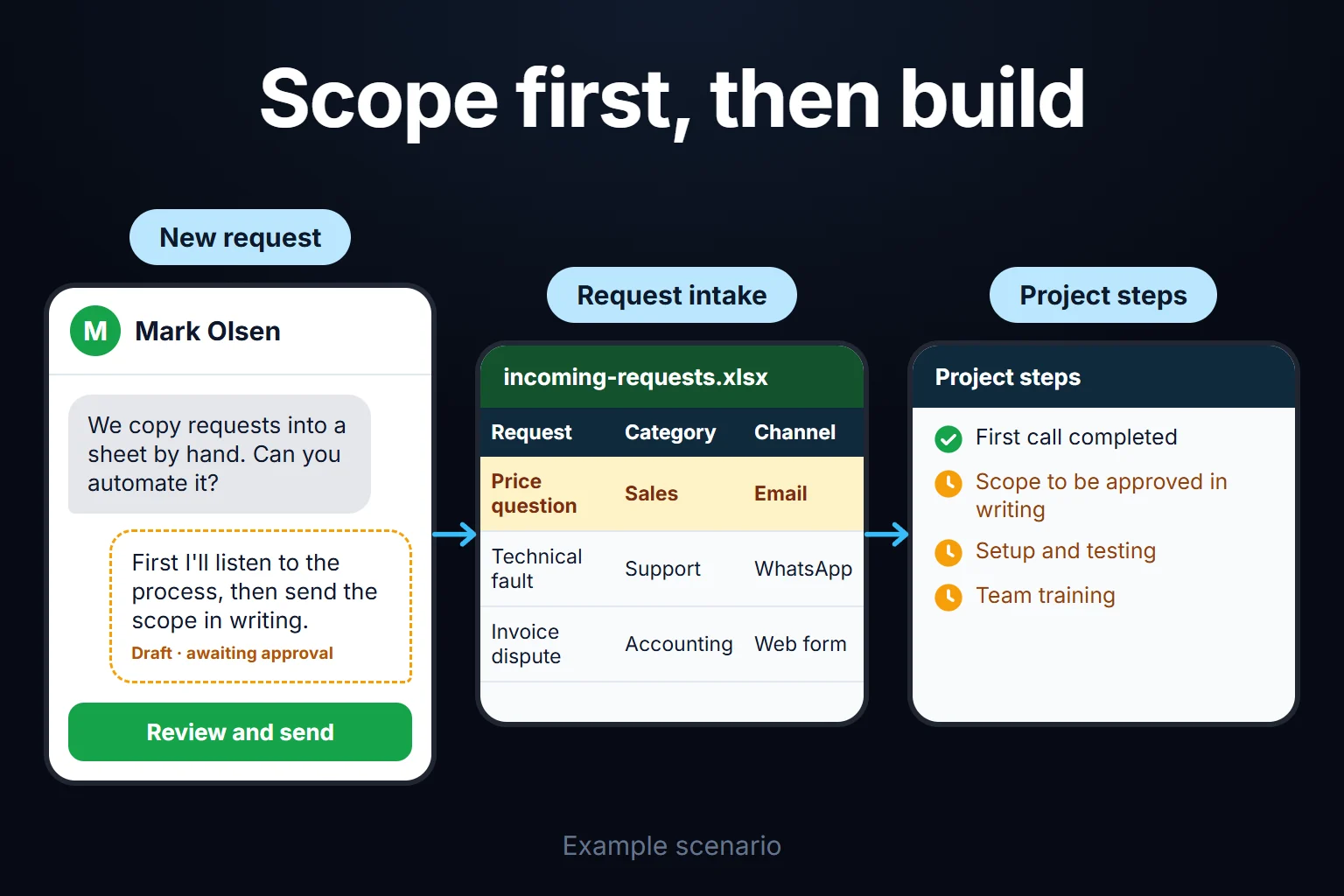 View full size](https://oguzerol.com/gorseller/senaryo/what-does-an-ai-consultant-actually-do-senaryo-en.webp) # What Does an AI Consultant Actually Do? [Oğuz Erol](https://oguzerol.com/en/about-me/) | 6 min read | Published: 4 August 2026 ## Quick summary What an AI consultant actually does: analysis, setup, training, and troubleshooting — the hands-on work, and how it differs from a strategist, with an example. The title “AI consultant” often stays vague: some write a strategy document, some write code and build the system. In reality, this job consists of four things: analyzing an existing process, setting up and testing a system, teaching the team how to use it, and fixing it when something breaks. Below, I lay out these four tasks concretely, how they differ from adjacent titles, and how a real job actually plays out from start to finish. ## What Does the Title “AI Consultant” Actually Cover? The title “AI consultant” doesn’t cover one job — it covers four different task types, and usually all of them show up in sequence within the same project. **Analysis:** First, an existing process gets put on the table — what is a team doing by hand, which step repeats, which decision could actually become a rule. The output of this stage shouldn’t be a slide deck, but a concrete list stating “we can automate this, we can’t automate that.” **Setup:** If the analysis finds something worth automating, setup comes next. That means actually writing code, connecting APIs to each other, integrating an AI model into a workflow, and testing the system before putting it live. This is where the consultant’s “hands get dirty.” **Training:** A system that’s set up is useless if the team using it doesn’t understand it. So the job usually includes a short training session — the team learns how to use the new system, where to step in, and when to ask for help. **Troubleshooting:** No system set up stays trouble-free forever — an API changes, a service goes down, a rule runs into unexpected data. Part of the consultant’s job is sometimes getting called back in to fix that. ## Consultant, Strategist, or Trainer? In the field, “AI consultant,” “AI strategist,” and “AI trainer” get used interchangeably a lot, but there’s a concrete difference between them. A **strategist** usually gives advice: they deliver a report or a presentation covering which processes are fit for automation, which tools to choose, and how to prioritize risk. They typically don’t get involved in the actual setup. A **trainer** teaches an existing system or concept — they give a team a “how to use AI tools” training, but usually didn’t build the system themselves. A **consultant** mostly sits between the two but leans toward “doing the work hands-on”: they both decide what needs to be done and build it themselves. Some consultants stick to setup alone; others add training on top of setup. These three roles sometimes merge into one person, sometimes get carried out by separate people or companies. Before starting a job, clarifying which role the person you’re working with plays — will they just write a report, or will they actually build the system — heads off a mismatch in expectations. ## An Observation From the Field: A Job From Start to Finish A typical job proceeds like this. A business owner starts by describing something their team does by hand every day — for example, reading incoming requests and manually logging them into a categorized spreadsheet. **First call (30–45 minutes):** The process gets walked through step by step, and we identify which parts are genuinely repetitive and rule-based. If a clear scope doesn’t emerge from this call, the project doesn’t start. **Scope clarification:** When it’ll finish, what data access is needed, and which tool will be used get put in writing. This step also settles a time estimate — jobs like this usually take [2 hours to 2 weeks](https://oguzerol.com/en/how-long-does-an-ai-project-take/). **Setup and testing:** The system gets built, tried with real data, and error scenarios — missing data, unexpected formats — get tested separately. **Delivery:** A short training session is given while the team watches the system live — which screen to open, where to look if something goes wrong. **Optional maintenance:** Some jobs end at delivery; some get a short monthly check-in agreement. This isn’t the consultant’s preference — it depends on the nature of the work. ## What an AI Consultant Doesn’t Do What this job doesn’t do is just as defining as what it does. Writing a strategy document, delivering it, and disappearing is not part of this job. Neither is just preparing a PowerPoint deck and saying “here’s your roadmap.” There are plenty of examples of that kind of delivery in the market, and honestly, most of the time it ends up shelved — because no one finds the time to turn that document into code. The approach here is the opposite: a recommendation that doesn’t get your hands into code, integration, and testing doesn’t count as “work” in this framing. If advice is given at all, it’s expected to come with a working prototype or a concrete test result behind it. ## When Do You Actually Need an AI Consultant? If any of the following sounds familiar, you probably need an AI consultant: Your team repeats the same manual work every day, and you think part of it could be automated, but you don’t know where to start. You don’t have an in-house developer to build it, or your existing software team’s priorities lie elsewhere. You already got a strategy report before but nothing got implemented — now you want something concrete and working. If any of that fits, checking [how pricing gets determined](https://oguzerol.com/en/ai-consulting-rates/) and clarifying scope is a good first step. ## You Can Ask Me for This You can ask me for all or part of the analysis, setup, training, and troubleshooting described above. This is usually **2-hour-to-2-week work, remote, billed hourly**. We start once we’ve clarified scope together. Check out my [AI consulting service](https://oguzerol.com/en/ai-consulting/) or write to me directly. ## Frequently Asked Questions ### What’s the difference between an “AI consultant” and an “AI engineer”? An AI engineer usually deals with training a large-scale model from scratch or building a product’s core AI infrastructure. An AI consultant adapts existing off-the-shelf tools (LLM APIs, automation platforms) to a business’s actual process — they write code, but usually don’t train models; they connect existing models correctly. ### What tools does an AI consultant work with? It varies by job: large language model APIs, integration tools for existing software, simple scripts, and sometimes small apps built from scratch. Tool selection follows the scope of the job — there’s no single predetermined stack. ### Why not work directly with a software company instead of an AI consultant? You can, but most software companies are reluctant to allocate an engineering team for small, loosely scoped jobs; they want a minimum project size. AI consulting is usually preferred as a smaller, faster, lower-risk first step — signing a contract with a software company for a 2-hour job isn’t practical. ### Who maintains the system after the consulting job is done? That’s a decision clarified at the start of the job. Some systems get set up and delivered, and the team manages them on their own; others get a short monthly check-in agreement. There’s no default maintenance package imposed — it gets discussed if needed. [Back to top ↑](https://oguzerol.com/en/what-does-an-ai-consultant-actually-do/#icerik) ## You may also find these useful [AI Consultant or Agency?Should you go with an AI consultant or an agency? An honest comparison covering team size, cost, continuity, and decision speed. Sized to your budget.](https://oguzerol.com/en/ai-consultant-or-agency/)[AI Consulting | Start From the Right PlaceEveryone says use AI; nobody shows you where to start. I map your repetitive work, build one pilot, and tell you plainly what AI cannot do for you.](https://oguzerol.com/en/ai-consulting/)[What to Look for When Hiring a Claude ExpertWhat to ask when hiring a Claude expert: questions that separate real Skills, Claude Code and MCP experience, red flags, and a small trial task.](https://oguzerol.com/en/what-to-look-for-when-hiring-a-claude-expert/) [Browse all articles →](https://oguzerol.com/en/articles/)