Source: https://oguzerol.com/en/what-are-agentic-ai-skills-three-meanings-one-page/ [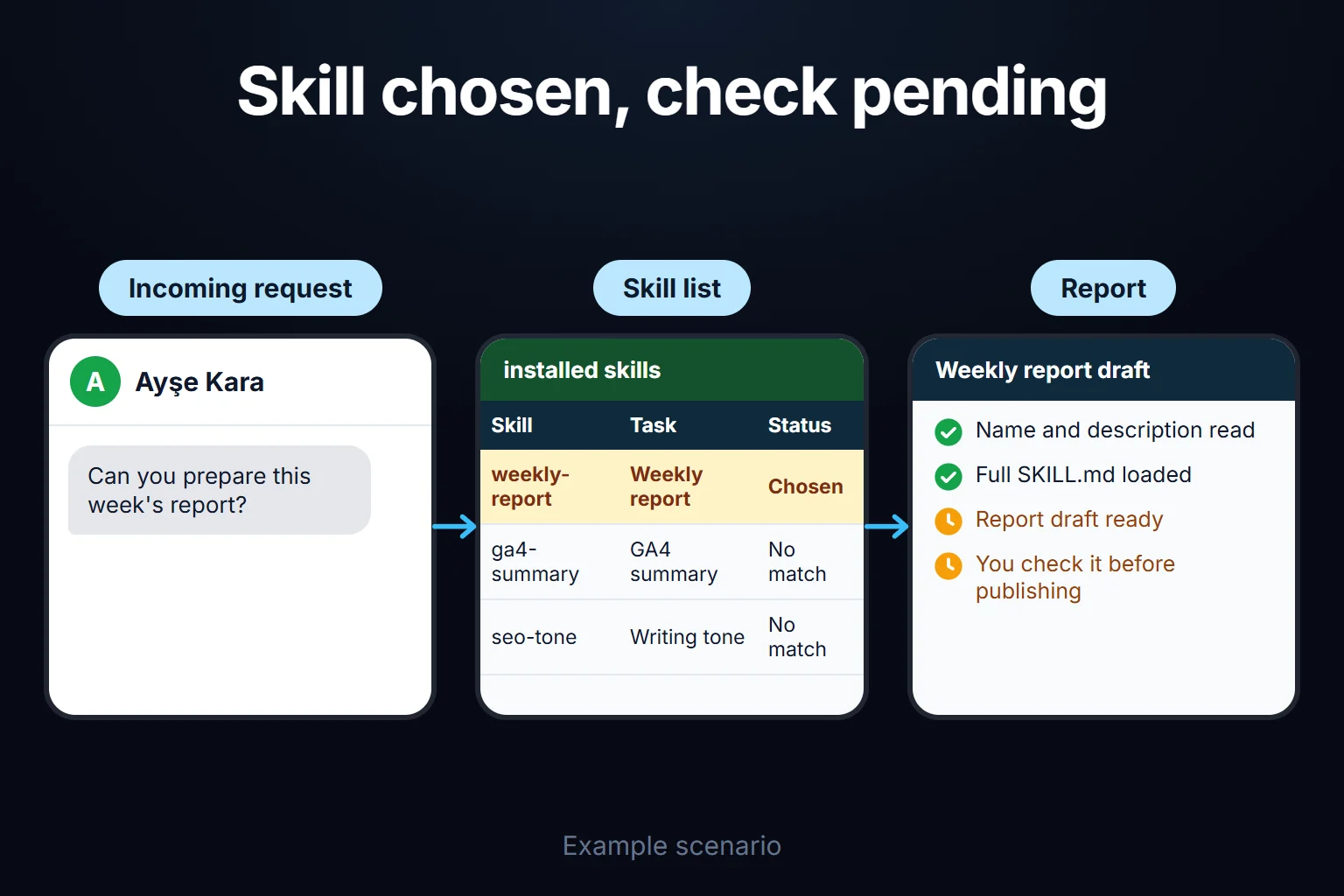 View full size](https://oguzerol.com/gorseller/senaryo/what-are-agentic-ai-skills-three-meanings-one-page-senaryo-en.webp) # What Are Agentic AI Skills? Three Meanings, One Page [Oğuz Erol](https://oguzerol.com/en/about-me/) | 9 min read | Published: 3 August 2026 | Updated: 13 October 2026 ## Quick summary 'Agentic AI skills' means three different things: Claude Skills, an agent's general capabilities, or a resume meta-skill set. I untangle which is which. Search “what are AI skills” or “what are agentic AI skills” and you’ll run into three different things, and they’re quite different from each other. The first is Claude’s ‘Skills’ feature — a concrete Anthropic product defined by SKILL.md files. The second is an abstract concept meaning the general capabilities an [agentic AI](https://oguzerol.com/en/what-is-agentic-ai-a-plain-language-definition/) possesses — planning, tool use, autonomous decision-making. The third is a meta-skill set that shows up on LinkedIn and resumes, something people are expected to learn. This page separates all three. ## The Short Answer: What Are AI Skills? When people say “AI skills” or “agentic skills” today, they usually mean a reusable folder that teaches an AI agent how to do a specific job. It holds at least one `SKILL.md` file (a name, a description and instructions), and can also bundle scripts, reference documents and templates. The agent doesn’t read the whole folder every time: it first looks only at the name and description, and loads the rest of the instructions if the task matches. As of October 2026, this format is documented as the [Agent Skills open format](https://agentskills.io/home): according to its documentation it was originally developed by Anthropic, released as an open standard, and is now supported by many agent products. So the term is no longer Claude-only. But plenty of people search for the human-competency meaning too, so I separate all three below. ## Three Meanings, One Term: Where the Confusion Comes From The same three words point at completely different things depending on context: - **The product meaning** — Claude’s ‘Skills’ feature: reusable instruction packages defined by SKILL.md files. This is a specific, documented Anthropic feature. - **The conceptual meaning** — the general capabilities an agentic AI has: planning, tool use, memory, autonomous decision-making. Not tied to a specific product; a technical topic of discussion. - **The HR meaning** — ‘agentic AI skills’ as it appears in LinkedIn profiles, job postings, and resumes: a meta-skill set people are expected to learn to work with agentic AI tools. This is exactly where the confusion comes from: when a developer says ‘agentic AI skills,’ they may mean SKILL.md files; an academic may mean the general capabilities of agent architecture; a recruiter may mean a line item on a candidate’s resume. All three are legitimate uses — but mixed together in the same sentence, the meaning collapses. ## First Meaning: Claude Skills — Anthropic’s Concrete Feature In this sense, an ‘agentic AI skill’ is a reusable instruction package, defined by a **SKILL.md** file, that teaches Claude how to do a specific job from start to finish. When Claude encounters a task, it looks at its list of available skills and picks and applies the one that fits. I explained what this feature is and how it works in detail in [What Is Claude Skills](https://oguzerol.com/en/what-is-claude-skills-what-is-it-for/); if you want to write your own skill from scratch, [How to Write a SKILL.md](https://oguzerol.com/en/how-to-write-skill-md/) walks through the method step by step. ### What a Skill Looks Like Inside According to the open format, the simplest skill is a folder with a `SKILL.md` inside: ``` my-skill/ ├── SKILL.md # required: name + description + instructions ├── scripts/ # optional: executable code ├── references/ # optional: documentation └── assets/ # optional: templates, resources ``` Agents load skills in three stages ([Agent Skills documentation](https://agentskills.io/home), read 13 October 2026): 1. **Discovery:** at startup, only each skill’s name and description are read. 2. **Activation:** if the task matches a skill’s description, the full `SKILL.md` is read into context. 3. **Execution:** the agent follows the instructions, running bundled scripts or opening reference files if needed. In practice this means you can install dozens of skills and only the relevant one’s text fills the agent’s context. That makes the description line the most important line of a skill: if it’s written poorly, the skill never triggers. ### Skill vs Prompt vs Tool | | Prompt | Skill | Tool / MCP | | --- | --- | --- | --- | | What it does | A one-off request | Packages the method for a repeated job | Gives the agent an ability to act (search, files, APIs) | | Where it lives | In the chat | As a file, versionable | A server or an integration | | When it loads | Typed each time | When the task matches | When the agent calls it | A skill supplies the “how,” a tool supplies the “can.” They can work together. For a fuller comparison see [skills vs tools vs MCP](https://oguzerol.com/en/agentic-ai-skills-vs-tools-vs-mcp/). ### Security: Why You Shouldn’t Install Every Skill Skills can often run scripts, which means they carry the agent’s access. A February 2026 academic survey ([SoK: Agentic Skills, arXiv:2602.20867](https://arxiv.org/abs/2602.20867)) maps the skill lifecycle and its security risks, and discusses a campaign involving nearly 1,200 malicious skills in an agent marketplace. The space is very new and no security standard has settled yet. Before installing one, read the skill’s files and check which marketplace is actually trustworthy — I evaluated that in [my comparison of Claude Skills marketplaces](https://oguzerol.com/en/claude-skills-marketplaces/). ## Second Meaning: Agentic AI’s General Capabilities In this usage, ‘skill’ isn’t a file — it describes a capability. The core capabilities expected of a system for it to count as ‘agentic’ are: - **Planning** — breaking a goal into sub-steps and executing them in sequence. - **Tool use** — picking and calling external tools (search, running code, reading files) based on the task at hand. - **Memory** — using what it learned in an earlier step at a later step. - **Autonomous decision-making** — moving forward at each step within pre-set boundaries, without asking a human. - **Self-correction** — evaluating the result of a step and changing course if there’s an error. These five capabilities aren’t tied to any one product — they belong to a general architecture. Academic literature separates skills from one-off plans and single tool calls: a skill is procedural knowledge packaged with its applicability conditions and reused across tasks ([SoK: Agentic Skills](https://arxiv.org/abs/2602.20867)). So Claude Skills is a concrete implementation that makes an agent’s “how to do a job” persistent; the first sense turns one part of the second into a product. Treating them as synonyms is where I see the most confusion. I’ve covered this distinction more broadly in [Prompt vs Skill vs Agent](https://oguzerol.com/en/prompt-vs-skill-vs-agent/). ## Third Meaning: The Meta-Skill Set on Resumes and LinkedIn ‘Agentic AI skills’ as it shows up in job postings and resumes is something else entirely: not a software feature but a **human competency**. It generally covers: - **Prompt writing and task definition** — being able to clearly state what you want an agent to do, and within what boundaries. - **Agent orchestration** — being able to chain multiple agents or tools together in one workflow. - **Output oversight** — being able to verify what an agent produces before it ships; this means understanding the difference between trusting an agent and supervising one. - **Tool and integration knowledge** — knowing which job can be done with which tool (MCP, API, automation). “AI skills” is sometimes used even more broadly: the technical competencies needed to build or run AI systems (programming, statistics, model development), and the skills a workforce needs to work alongside AI. This page is mostly about the skill of working with agents. **Honesty note:** this list is often used in job postings as a buzzword with no concrete substance behind it. A posting that lists ‘agentic AI skills’ often doesn’t clearly define what it means either. If you’re putting this phrase on your resume, back it up with a concrete example — ‘I set up this agent for this job and got this result.’ An empty title can leave a worse impression than not writing it at all. I cover the resume side in [before you put agentic AI skills on your resume](https://oguzerol.com/en/before-you-put-agentic-ai-skills-on-your-resume/). ## An Observation From the Field When I work with ad accounts, the question I get most often is: ‘Do you have agentic AI skills?’ The question itself usually doesn’t specify which meaning it’s after — sometimes it means ‘are you using Claude’s Skills feature,’ sometimes ‘can you run autonomous work with agents,’ and sometimes it’s a prospective client just repeating a phrase they heard, speaking in resume-language. My answer differs for each: yes, I use SKILL.md files; yes, I trust agents’ planning and tool-use capabilities; but in both cases, I give final approval myself — autonomous decision-making and unsupervised decision-making aren’t the same thing. Before I established this clarity, conversations with clients used to blur together every time; now I ask the first question myself: ‘which sense do you mean?’ ## You Can Ask Me to Do This Once you’ve decided which meaning you’re interested in — Claude Skills setup, agentic agent architecture, or getting your team to use these tools correctly — we can clarify it together. You can ask me to do this: work that typically takes 2 hours to 2 weeks, remote, billed hourly. See the [AI Consulting](https://oguzerol.com/en/ai-consulting/) service page for details. ## Frequently Asked Questions ### Are agentic AI skills a certification or an official qualification? No, there’s currently no official certification or standard qualification. Both Claude Skills (SKILL.md) and agentic AI’s general capabilities are fast-evolving, not-yet-standardized areas; if you see this phrase on a resume, ask for a concrete example, not a certificate. ### Is Claude Skills the same thing as ‘agentic AI skills’? No. Claude Skills is Anthropic’s concrete implementation of the “agentic skills” idea; the same SKILL.md format is now supported as an open format by other agent products too. “Agentic AI skills” as a phrase is broader: it can also cover an agent’s general capabilities and a human competency. ### What does “agentic skills” mean? “Agent skills” is the usual English form. In a technical context it means reusable instruction packages that let an AI agent do a specific job repeatedly and reliably. ### Is a skill the same as a tool? No. A tool gives the agent the ability to do something (search, read a file, call an API); a skill is the instruction package describing how to do the job. They can be used together. ### Should I put ‘agentic AI skills’ on my resume? You can, but don’t leave it empty. Make it concrete in one sentence — which tool, for which job, with what result. ‘Agentic AI skills’ written alone turns into a buzzword that means nothing. ### Which of these three meanings should I start with? Depends on your need. If you want to use Claude in your daily work, start with the first meaning (Claude Skills). If you want to understand agent architecture conceptually, focus on the second. If you want to develop your own competency, focus on the third. The [Agentic AI Guide](https://oguzerol.com/en/agentic-ai-guide/) puts all three into context. [Back to top ↑](https://oguzerol.com/en/what-are-agentic-ai-skills-three-meanings-one-page/#icerik) ## You may also find these useful [AI Agent, Agentic AI and Agent Skills: Not the Same ThingAn AI agent is a system, agentic is an adjective, and a skill is an instruction package the agent loads on demand. The difference, with a table and examples.](https://oguzerol.com/en/ai-agent-vs-agentic-ai-vs-agent-skills/)[What Is Claude Skills, What Is It For?What are Claude Skills, how do they differ from Claude instructions, and how do you add one in claude.ai or Claude Code? A practical guide, October 2026.](https://oguzerol.com/en/what-is-claude-skills-what-is-it-for/)[Agentic AI Skills vs Tools vs MCP: Clearing Up the DifferenceDo Skill, Tool and MCP blur together? One describes the action, one the recipe, one the connection. A table separates them and shows when you need each.](https://oguzerol.com/en/agentic-ai-skills-vs-tools-vs-mcp/) [Browse all articles →](https://oguzerol.com/en/articles/)