Source: https://oguzerol.com/en/preparing-a-proposal-document-with-ai/ [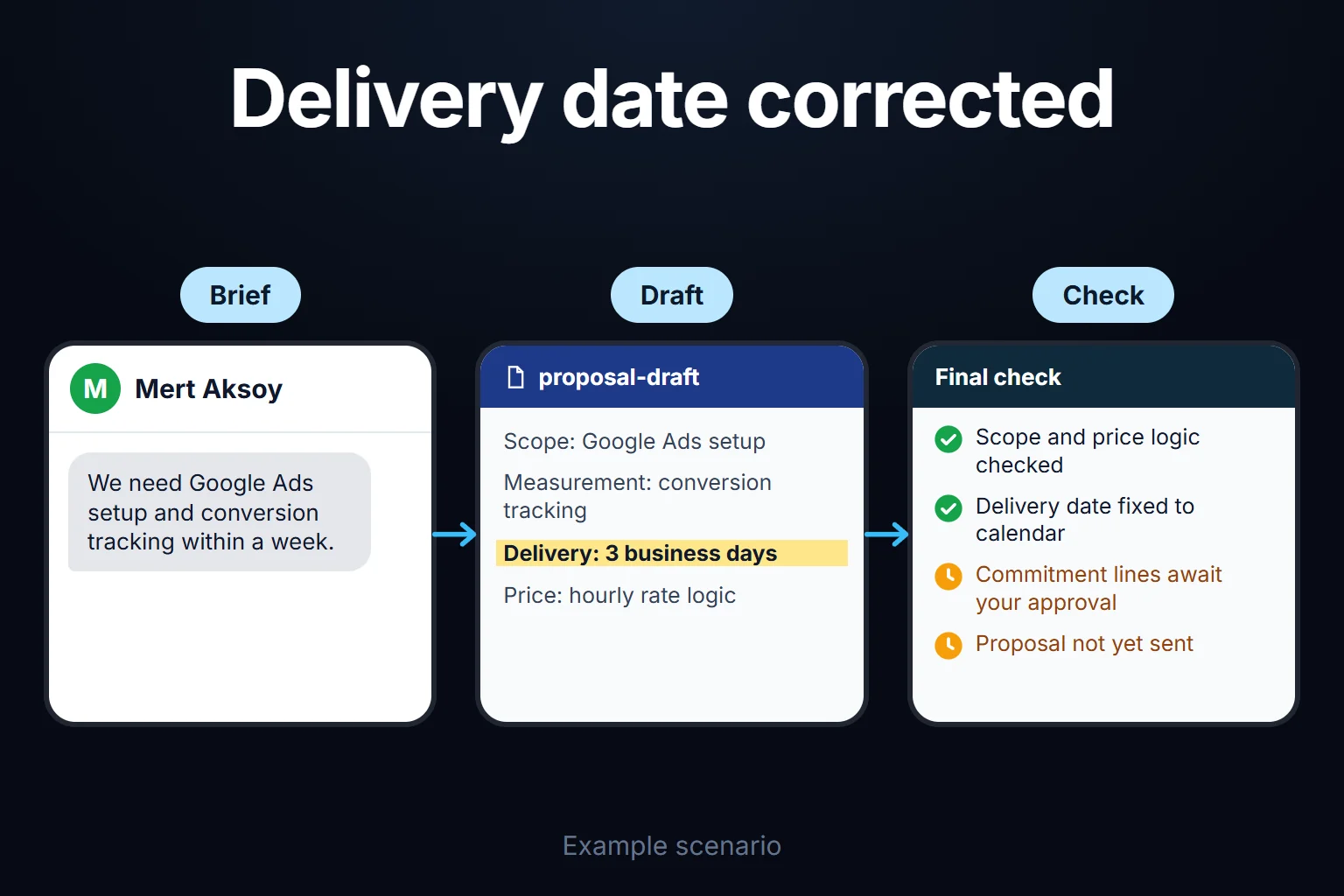 View full size](https://oguzerol.com/gorseller/senaryo/preparing-a-proposal-document-with-ai-senaryo-en.webp) # Preparing a Proposal Document With AI [Oğuz Erol](https://oguzerol.com/en/about-me/) | 5 min read | Published: 3 August 2026 ## Quick summary AI fills in the variable parts of your proposal template (scope, price, timeline) based on client info. Step-by-step process, watch-outs, and a real example. Preparing a proposal with AI means filling in a ready-made template quickly instead of writing a sales or service proposal from scratch. In my own proposal documents, I have AI write the parts that change per client — scope, pricing, timeline — and never touch fixed sections like the company introduction, references, and general terms. The result is clear: a 45-minute proposal-writing job drops to 10 minutes, while any sentence that amounts to a commitment still passes through my final review. ## Fixed vs. Variable Parts of a Proposal Template Every proposal document actually has two layers: a layer that never changes and a layer that changes per client. Trying to use AI without separating these slows the work down instead of speeding it up — because AI ends up trying to regenerate the company introduction every single time, producing inconsistent output and increasing the review burden. **Fixed parts** — written once, used as-is in every proposal: - Company/consultant introduction - Working method and process description - Reference or case study summaries - General terms, payment conditions, confidentiality clauses **Variable parts** — need to be rewritten for every client, this is where AI actually earns its keep: - Scope — the work items the client requested - Pricing — the amount calculated using your own logic - Timeline — delivery dates, phases - A client-specific opening paragraph — referencing the needs and problems mentioned in the brief AI’s most efficient use is right here: filling in only the variable part based on the client brief, without touching the fixed text at all. This distinction is the proposal-document version of the “fixed template + variable data” logic I cover in the [AI Automation Guide](https://oguzerol.com/en/ai-automation-guide/). ## Step by Step: How to Prepare a Proposal With AI The process has four steps, none of which get skipped: 1. **Prepare the fixed template once.** Word, Google Docs, or PDF — doesn’t matter. Company introduction, method, general terms stay fixed in this file. Don’t rewrite it for every proposal. 2. **Collect the client brief.** Need, budget range, time constraint, any special requests — without these, there’s nothing to give AI. 3. **Have AI fill in the scope and pricing draft.** Give it the brief along with the pricing logic you’ve already decided on (hourly rate, package ranges); AI should only apply it, not invent a price on its own. 4. **Do a final manual review and send.** You personally sign off on every sentence that amounts to a commitment — delivery date, guarantee language, scope boundaries. The steps after the proposal is accepted speed up the same way — I handle the presentation with the method in [Preparing a Presentation With ChatGPT](https://oguzerol.com/en/preparing-presentations-with-chatgpt/), and the following months’ reporting with [Monthly Report Automation With AI](https://oguzerol.com/en/monthly-report-automation-with-ai/). ## What to Watch Out For Honestly, two things can break this process. **First, price fabrication risk.** If you give AI an open-ended instruction like “suggest a fair price,” it invents a generic figure from its training data — one that has nothing to do with your actual cost structure. The fix is simple: give it your pricing logic (hourly rate, package prices, floor/ceiling) clearly, in writing, beforehand. Let AI calculate within those bounds, not set the price on its own. **Second, commitment language.** Sentences like “we’ll deliver within 3 business days” or “we guarantee results” carry legal and operational weight. AI doesn’t know your calendar or your current workload; it can generate these sentences on its own. You need to personally verify every such sentence before sending. A third point: before pasting client information into a general-purpose AI tool, check that tool’s data usage policy once — especially if you’re sharing budget figures. ## A Real Example: A Consulting Proposal Let me give an anonymous example from my own operation. A prospective client asked for a proposal for Google Ads setup and conversion tracking, needed within a week. My fixed template was already ready; I gave the brief (industry, budget range, urgency) to AI and asked it to fill in the scope and pricing paragraph based on my own hourly-rate logic. The draft came back in a few minutes, but there was a problem: AI had written the delivery date as “3 business days” — without factoring in what was already on my own calendar. I manually changed that sentence to a realistic date. The rest of the proposal text (scope, pricing logic) went out almost untouched. Total time: 12 minutes from draft to send — writing it by hand would have taken at least 40-45 minutes. ## You Can Ask Me to Do This You can ask me to do this: work I generally run remotely, hourly, taking 2 hours to 2 weeks. If you want to turn your own proposal template into something that works with AI, see the details on the [Automated Proposal System](https://oguzerol.com/en/automated-quote-generation/) page, or write to me directly. ## Frequently Asked Questions ### How long does it take to prepare a proposal with AI? If the fixed template is already ready, giving AI the brief and getting the draft takes 5-10 minutes. Total time including final manual review generally doesn’t exceed 15-20 minutes — 3-4x faster than writing from scratch by hand. ### Is it safe to let AI set the price? Not on its own. If you don’t give it your pricing logic (hourly rate, package ranges) clearly beforehand, AI can invent a number out of thin air. Use AI as a calculator, not a price-setter. ### Should AI write the entire proposal template? No. Fixed parts like the company introduction, method, and general terms should be written once, by you or a copywriter. AI’s job is only to fill in the variable part — scope, price, timeline — based on the client brief. ### Which AI tool should I use? A general-purpose chat tool like ChatGPT or Claude is enough — no special software is needed. What matters isn’t the tool, it’s clarifying the fixed/variable split and giving it the right brief. [Back to top ↑](https://oguzerol.com/en/preparing-a-proposal-document-with-ai/#icerik) ## You may also find these useful [Automated Quote Generation | Quotes in MinutesDon't let preparing a customer quote take hours. I build a system that generates a branded PDF quote from your template and price list in minutes.](https://oguzerol.com/en/automated-quote-generation/)[Track Quote Revisions and Customer Follow-UpsKeep quote versions, customer responses and the next follow-up date together in a custom sales screen using your Excel or Google Sheets list.](https://oguzerol.com/en/quote-revision-followup-tracking-app/)[Company Prompt Library | Same Quality for EveryoneMake your best employee's AI usage the company standard: ready-made prompts by role, examples, and an update routine. Comes with an update routine.](https://oguzerol.com/en/company-prompt-library/) [Browse all articles →](https://oguzerol.com/en/articles/)