Source: https://oguzerol.com/en/conditional-logic-web-forms/ [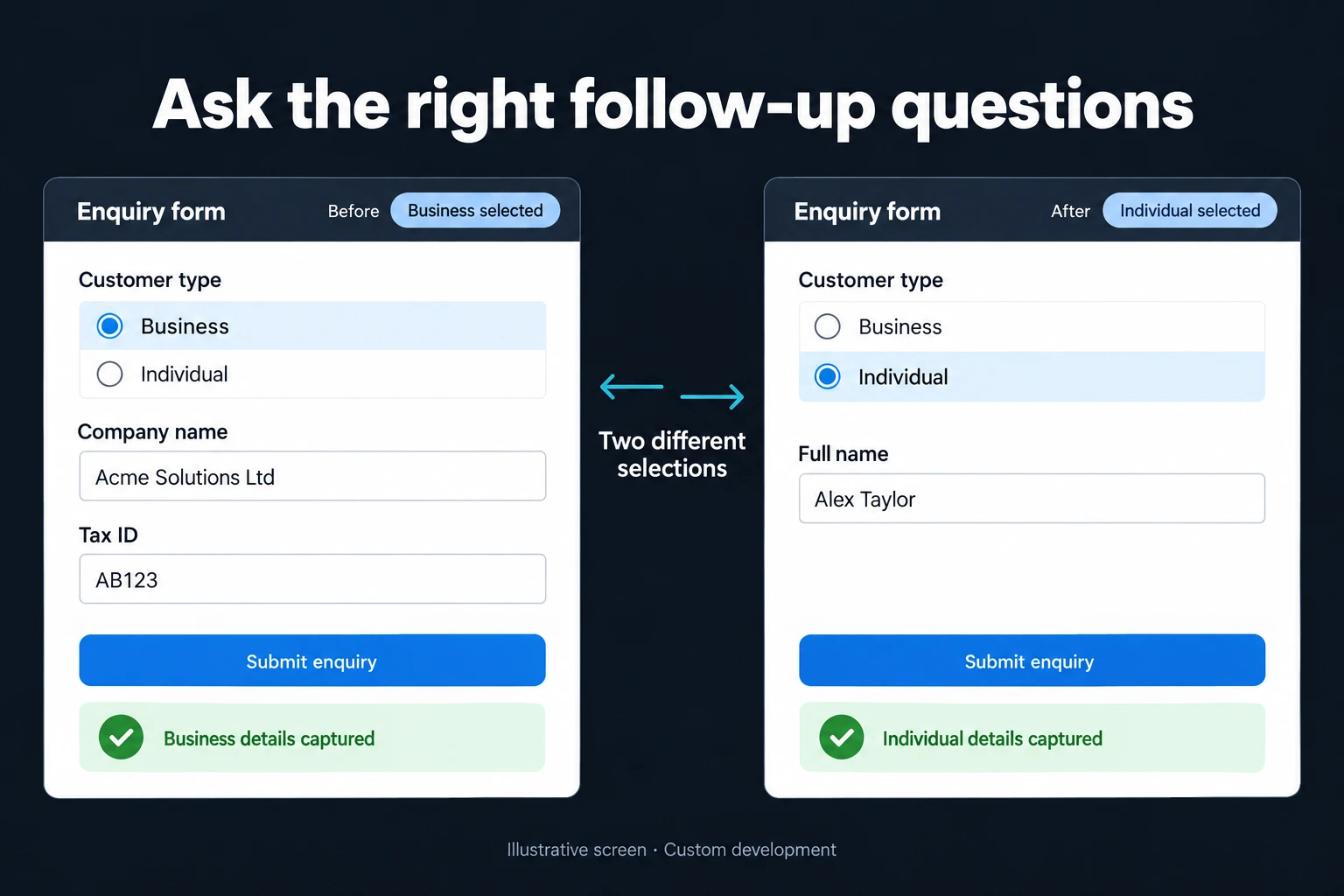 View full size](https://oguzerol.com/gorseller/hizmet-kapaklari/kosullu-sorulu-web-formu-webapp-v1-en.webp) # Conditional Web Forms with Answer-Based Fields [Oğuz Erol](https://oguzerol.com/en/about-me/) | 4 min read A long form often asks everyone the same questions even when only a few apply. I build conditional web forms that change the fields, document requirements and available choices according to the answers already given. The aim is a shorter, relevant path through your actual business process. The rules also need to govern the saved data. Hiding a field is not enough if its old value is still submitted under a different application type. I define how the interface and the stored record respond together, including what happens when someone changes their mind halfway through. ## Example: business and individual enquiries The illustration shows two alternative states of a fictional enquiry form. Selecting **Business** reveals **Company name** and **Tax ID**. Selecting **Individual** reveals **Full name**. These are different selections, not two consecutive stages that everyone must complete. Suppose someone enters company details and then switches to Individual. We decide whether the business values should be removed from the active application or retained only in a temporary draft in case they switch back. They should not accidentally be treated as valid individual application data. The screen explains any information that will be cleared. ## What Google Forms already supports Google Forms offers [section routing based on answers](https://support.google.com/docs/answer/141062?hl=en) for multiple-choice and dropdown questions. That can be sufficient for a few separate paths. A simple branch does not automatically justify a new application. A dedicated interface becomes useful when several answers must be evaluated together, options depend on a customer-specific catalogue or a calculation changes while the form is being completed. [Dependent dropdown forms](https://oguzerol.com/en/dependent-dropdown-custom-forms/) can narrow a product and model selection, while conditional rules determine which supporting fields are needed. ## Turn conditions into an explicit decision table I map when each field is required, optional, hidden or read-only. Conflicting conditions become easier to spot before development. For example, requiring a company document before the customer has selected a company application can create a path that nobody can finish. The browser applies these rules to make the form understandable. The server checks the submitted information against the rules again. Changing a hidden value outside the normal interface should not make an unavailable choice valid. This matters particularly when the form controls eligibility, prices or the documents attached to a request. Drafts also need a policy when rules change. An applicant returning to an older draft should see which answer needs attention, instead of receiving a generic error that gives no way forward. Where necessary, the application records the rule version used for submission. ## Scope, testing and future changes The delivery plan includes the decision table, useful validation messages and tests for changing earlier answers on mobile. I test incomplete and contradictory answers as well as the intended path. If a new product category is added, the team should be able to identify the rules it affects. A small [rules-based entry form](https://oguzerol.com/en/rules-based-data-entry-form/) may be enough for a limited set of conditions. If the submission also needs staff assignment, ongoing review and a customer status screen, it can become part of a [custom application workflow](https://oguzerol.com/en/custom-google-forms-alternative/). ## Frequently Asked Questions ### Can our team change the conditions later? An administration screen can support frequently changing, simple rules. Linked calculations and access rules need additional testing; I would not expose every rule as an unrestricted text field. ### Can a hidden field still prevent submission? That behaviour must be deliberately defined. The applicant should not be blocked by an unexplained requirement they cannot reach. Clearing or preserving an earlier answer belongs in the same decision. ## Discuss your workflow [Share a few examples of your form paths](https://oguzerol.com/en/contact/). I can distinguish the branching your existing form already handles from the rules that would benefit from a dedicated interface. [Back to top ↑](https://oguzerol.com/en/conditional-logic-web-forms/#icerik) ## You may also find these useful [Custom Google Forms Alternative for Your WorkflowTurn form responses into assigned, trackable requests. Explore a custom Google Forms alternative with record permissions, status history and clear next steps.](https://oguzerol.com/en/custom-google-forms-alternative/)[Rules-Based Data Entry FormA bespoke form that flags missing, required or incompatible information before a record is completed. Built for Excel and Google Sheets workflows.](https://oguzerol.com/en/rules-based-data-entry-form/)[Dependent Dropdown Forms for Excel and Google Sheets WorkflowsMove dependent dropdowns into a custom web form that checks product compatibility, stock and user access together. Explore a practical catalogue example.](https://oguzerol.com/en/dependent-dropdown-custom-forms/) [Browse all articles →](https://oguzerol.com/en/articles/) WHAT YOU CAN ASK FOR ## How do I work? Work-hour packages Tell me about your business and what you need on WhatsApp or by phone; we agree on **a work block of somewhere between 5 and 40 hours** and I start doing what is needed. What you get is not a calendar window — it is net working hours spent directly on your business. I can use 40 hours working three days straight, or deliberately spread it out and finish it over a year — whatever the work calls for. I do not spend my time estimating how long something will take, I spend it doing the work; every hour I spend leaves a lasting result in your business. We keep going for as long as you find it useful. WORK BLOCKS ## Why not monthly? Is 40 hours a week? On a fixed monthly fee both sides are watching the wrong thing: you watch a fixed cost, the other side watches how many more contracts like this they can line up. Working by the hour puts us both in front of the same thing — the real value of the work that got done. I know not having an upfront answer to "how much will this cost in total?" is the natural cost of this model. But instead of paying a fixed fee for months to a setup that is not producing results, you only pay for the qualified time spent on your work — and you see exactly where that time went, start to finish. That is why my clients keep coming back. 5hours300€ + VAT60€ per hour[Choose this block](https://wa.me/905496546489?text=Hi%2C%20I%27d%20like%20info%20about%20the%205-hour%20work%20block.) 10hours500€ + VAT50€ per hour[Choose this block](https://wa.me/905496546489?text=Hi%2C%20I%27d%20like%20info%20about%20the%2010-hour%20work%20block.) 20hours800€ + VAT40€ per hour[Choose this block](https://wa.me/905496546489?text=Hi%2C%20I%27d%20like%20info%20about%20the%2020-hour%20work%20block.) 40hours1,400€ + VAT35€ per hour[Choose this block](https://wa.me/905496546489?text=Hi%2C%20I%27d%20like%20info%20about%20the%2040-hour%20work%20block.)