Source: https://oguzerol.com/en/ai-agent-vs-agentic-ai-vs-agent-skills/ [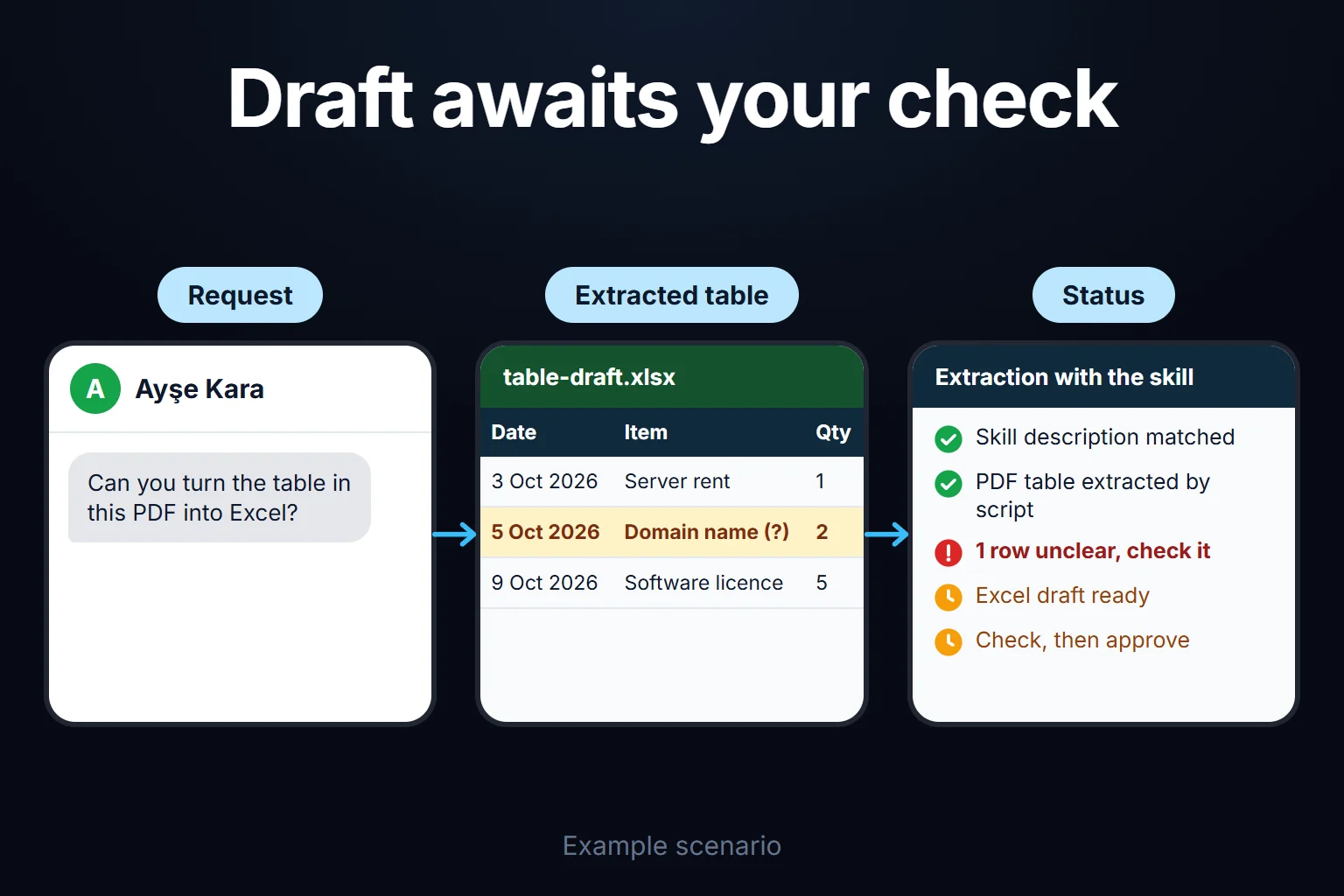 View full size](https://oguzerol.com/gorseller/senaryo/ai-agent-vs-agentic-ai-vs-agent-skills-senaryo-en.webp) # AI Agent, Agentic AI and Agent Skills: Not the Same Thing [Oğuz Erol](https://oguzerol.com/en/about-me/) | 5 min read | Published: 3 August 2026 | Updated: 13 October 2026 ## Quick summary An AI agent is a system, agentic is an adjective, and a skill is an instruction package the agent loads on demand. The difference, with a table and examples. These are not three names for one thing but three different layers. An **AI agent** is a system (a model, tools and a loop), **agentic** is an adjective for how much that system runs its own process, and an **agent skill** is an instruction package the agent loads when it needs it for a particular job. If you are asking “agent or skill?”, the answer is that a skill does not replace an agent; it is a file of knowledge and procedure handed to one. | | What it is | Example | The question it answers | | --- | --- | --- | --- | | **AI agent** | A system that takes a goal and works through it step by step using tools | A coding assistant; a bot that looks up an order and starts a return | “Which system are we talking about?” | | **Agentic** | An adjective: how much the system directs its own flow | “Is this solution agentic, or a fixed workflow?” | “How does it behave?” | | **Agent skill** | A folder of instructions, scripts and references the agent loads on demand | Anthropic’s PDF, Excel, Word and PowerPoint skills | “How is this job done?” | ## AI agent: a system By Anthropic’s definition ([Building effective agents](https://www.anthropic.com/engineering/building-effective-agents), as of October 2026), agents are systems where the model dynamically directs its own processes and tool usage. The contrast is a **workflow**, where models and tools are orchestrated through predefined code paths. The practical difference: in a workflow you write the steps; in an agent the model decides on each turn which step comes next. A customer service agent asks for the order number, connects to the order system, checks the status and, if needed, starts a return. Which step comes next is decided by the model at that moment, not by a pre-written flow. A chatbot that produces one answer and stops is not an agent in this sense. For more, see [what an AI agent is](https://oguzerol.com/en/what-is-an-ai-agent/). ## Agentic: an adjective, not a product Anthropic uses “agentic systems” as an umbrella term for everything from fully independent systems to more prescriptive workflows. So agentic is a spectrum. “This product is agentic” says little on its own; you need to ask how much the model decides, which tools it can reach, and whether it sees results and changes its plan. Stacked phrases like “agentic AI agent” in marketing copy are not technically wrong, but they add no information. For the term itself, see [what agentic AI is](https://oguzerol.com/en/what-is-agentic-ai-a-plain-language-definition/). ## Agent skill: an instruction package the agent receives The official definition is in Anthropic’s documentation ([Agent Skills, as of October 2026](https://platform.claude.com/docs/en/agents-and-tools/agent-skills/overview)): folders that package instructions, metadata and optional resources such as scripts and templates, which Claude uses when relevant. Every skill has a `SKILL.md` file with `name` and `description` fields. At startup the agent loads only that name and description; if a request matches the description, it reads the body of `SKILL.md` and, if needed, the files next to it. Scripts are run and only their output enters the context. Because of this load-on-demand design, installing many skills does not fill the context. Two examples: - **With a skill:** you tell the agent “extract the table from this PDF”. The `pdf-processing` skill’s description matches, the agent reads the instructions and runs the relevant script. - **Without a skill:** the same agent still tries, but has to work out the procedure, the tools to use and the right output format on its own each time. Results can be less consistent. That is also the difference between a skill and a prompt: a prompt is an instruction for one conversation, while a skill is a standing package that steps in when needed, without rewriting it every time. I compare the three in [prompt vs skill vs agent](https://oguzerol.com/en/prompt-vs-skill-vs-agent/), and the difference between skills, tools and MCP in [skills vs tools vs MCP](https://oguzerol.com/en/agentic-ai-skills-vs-tools-vs-mcp/). To write your own, see [how to write SKILL.md](https://oguzerol.com/en/how-to-write-skill-md/). A general introduction to Claude’s version: [what Claude Skills are](https://oguzerol.com/en/what-is-claude-skills-what-is-it-for/). Two caveats. According to Anthropic’s documentation, custom skills on claude.ai, the API and Claude Code do not sync with each other; you upload them to each surface separately. And because a skill carries instructions and code, treat it like installing software: use only skills you wrote yourself or got from a source you trust. ## Which term should you use? Look at what your sentence points to: - A concrete system: **“AI agent”**: “we built an agent that answers customer queries.” - How autonomously a system runs: **“agentic”**: “should we build the flow agentic or fixed?” - A specific, named procedure given to an agent: **“skill”**: “we added a skill for return checks.” ## Applying this to your work To apply the concepts of AI agent, agentic approach and skill to your own work (Google Ads account management, content production, client processes), we can work out together which task needs a real agent setup and which only needs a ready-made skill. Details: [AI Consulting](https://oguzerol.com/en/ai-consulting/). ## Frequently Asked Questions ### Can an AI agent work without agent skills? Yes. A skill is not mandatory: the agent starts the job with its tools and the model’s own knowledge. A skill is added to fix the procedure and output format for a specific task and to avoid rewriting the same instruction in every conversation. ### Is a chatbot an AI agent? Not if it only answers questions and calls no tools. If it calls tools, sees the result and decides the next step itself, that part is agent behaviour. The same product can sit on either side depending on its settings. ### Is a skill the same as a tool? No. A tool is a function or external system the agent calls (a database query, sending an email). A skill is an instruction package that carries “how this job is done” and may include scripts. [Back to top ↑](https://oguzerol.com/en/ai-agent-vs-agentic-ai-vs-agent-skills/#icerik) ## You may also find these useful [Prompt vs Skill vs Agent — In One TableWhat's the difference between a prompt, a skill, and an agent? A comparison table, decision checklist, and real examples to tell them apart.](https://oguzerol.com/en/prompt-vs-skill-vs-agent/)[What Are Agentic AI Skills? Three Meanings, One Page'Agentic AI skills' means three different things: Claude Skills, an agent's general capabilities, or a resume meta-skill set. I untangle which is which.](https://oguzerol.com/en/what-are-agentic-ai-skills-three-meanings-one-page/)[Agentic AI Skills vs Tools vs MCP: Clearing Up the DifferenceDo Skill, Tool and MCP blur together? One describes the action, one the recipe, one the connection. A table separates them and shows when you need each.](https://oguzerol.com/en/agentic-ai-skills-vs-tools-vs-mcp/) [Browse all articles →](https://oguzerol.com/en/articles/)