Source: https://oguzerol.com/en/agentic_ai_skills/can_ai_fix_its_own_mistakes/ # Can AI Fix Its Own Mistakes? I Checked It Is Not I Fixed It [Oğuz Erol](https://oguzerol.com/en/about-me/)6 min readPublished: 20 September 2026Video length 2:51 ## On YouTube I checked it is not I fixed it You ask an AI to check its work. It says "checked it, fixed it" — and the same mistake is still sitting there. The reason is simple: it read its own paper. Full description - A blind spot stays blind on the second pass - What shows the mistake is the answer key: a test, a compiler, a real result - With no key in hand, thinking longer produces a more convincing wrong answer - A key aimed at the wrong thing hands you a clean report while the bug stays put An agent's ceiling is set by the quality of that measurement, not by the intelligence of the model. [Watch on YouTube(opens in a new tab)](https://www.youtube.com/watch?v=O6gsKjbQ_uc)[All channel videos](https://oguzerol.com/en/agentic_ai_skills/) When you ask an AI to check a piece of text or code, you usually get back “checked it, fixed it” — and the same mistake is still sitting there. The reason isn’t carelessness: the model **reads its own paper**. If it misread the question the first time, it misreads it the same way on the second pass, and the blind spot stays exactly where it was. Correction only begins when a **measurement from outside** points at the mistake. That is why an agent’s ceiling is set by the quality of that measurement, not by the intelligence of the model. For the groundwork, see [What Is an AI Agent](https://oguzerol.com/en/what-is-an-ai-agent/) and [AI Agent vs LLM](https://oguzerol.com/en/ai-agent-vs-llm/); the full map is in the [Agentic AI Guide](https://oguzerol.com/en/agentic-ai-guide/). ## Reading your own paper Tell a student leaving an exam to look again. They look, and they say it’s right. They approve question four too, because they understand it on the second reading exactly as they understood it on the first. 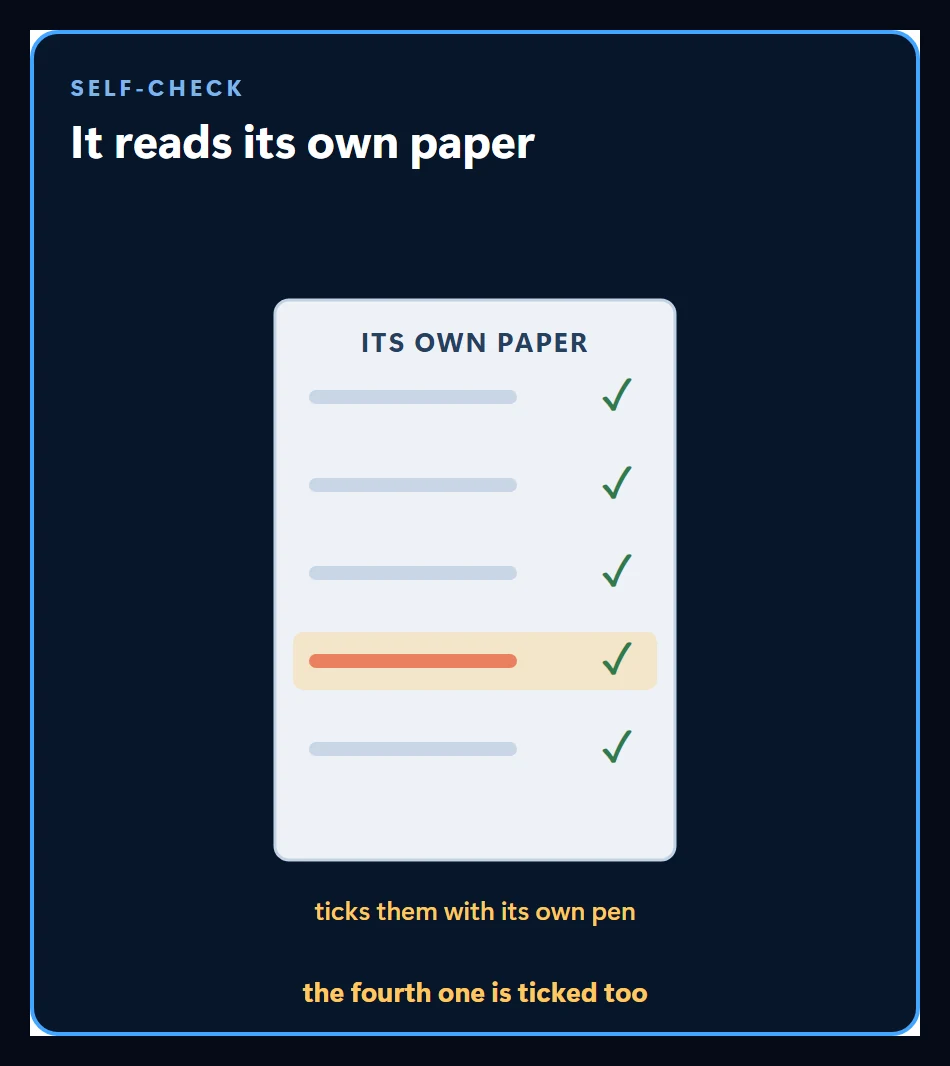 When an AI says “I checked it,” this is what happened. A review took place — but the reviewer and the reviewed are the same mind. ## Why looking harder doesn’t help The obvious fix is to say “look more carefully.” It doesn’t work, because the problem isn’t attention. It’s **comprehension**. 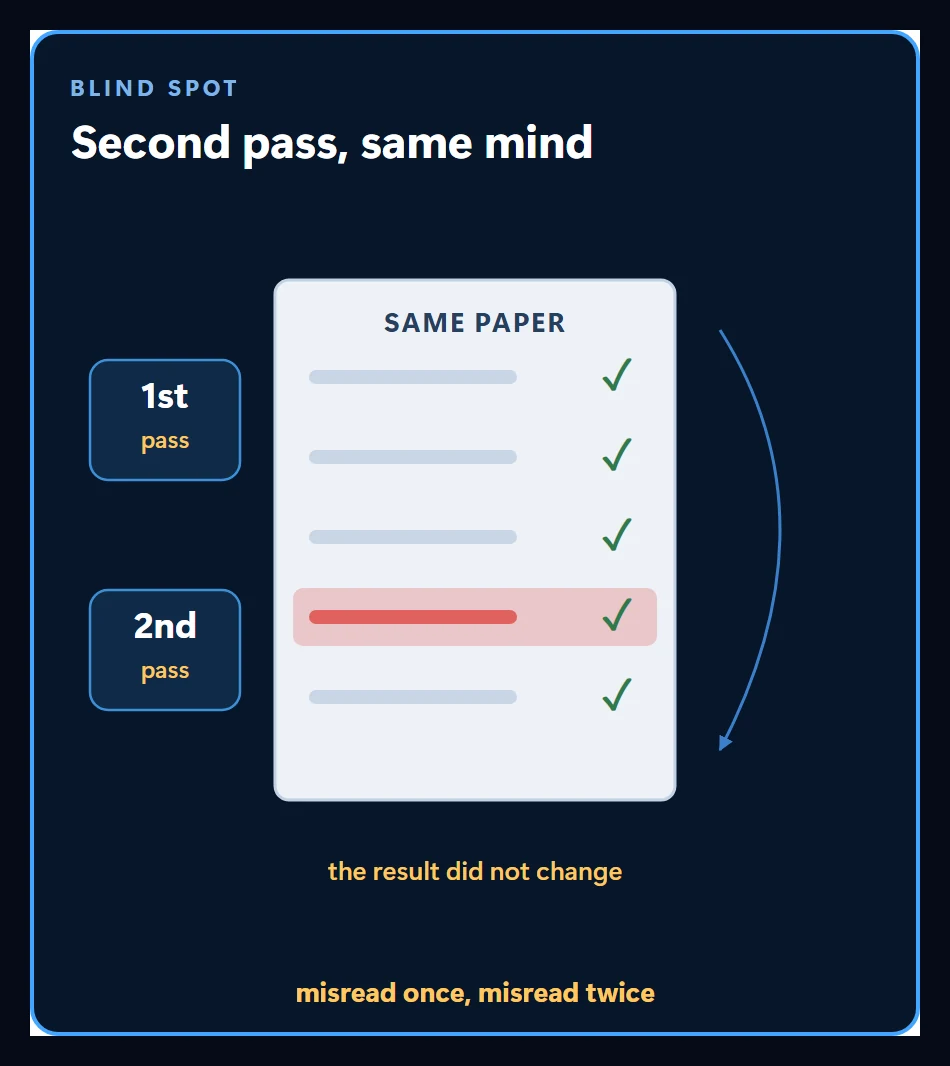 If the question was misread from the start, a second reading doesn’t repair that misreading — it adds a layer of confidence on top of it. A blind spot is by definition the place you cannot see; looking twice with the same eye doesn’t make it visible. ## What the answer key does When does the student actually see the mistake? When they look at the answer key. What the key does is specific: **it doesn’t ask what you thought.** It says question four is wrong, and nothing else.  Correction begins right there. Everything before it isn’t correction — it’s self-approval. ## What the answer key is in an AI system On the AI side the equivalent is a **measurement from outside**: a test turning red, a compiler objecting, a query coming back empty.  What these three have in common: none of them is the model’s opinion. All three are **the world’s answer**. No matter how confident the model is, if the test is red, it’s red. ## How it looks inside a coding agent The clearest example is a coding agent. It writes the code, runs the test, reads the error, fixes it, runs again. It loops until the test turns green.  The value of that loop isn’t its speed — it’s that at no step does it say “that probably worked.” Every turn it gets an answer from outside. ## Why thinking longer isn’t enough “Couldn’t the model just reason about it for longer?” Sometimes it can, but you can’t rely on it.  With no key in hand, thinking longer **doesn’t produce a more correct answer — it produces a more convincing wrong one.** The reasoning gets longer, the language gets better, the confidence rises; the accuracy stays put. This is the most insidious side effect of long-reasoning models. ## Separating opinion from measurement “That part was weak, I fixed it” is an **opinion**. It sounds like a review, but it isn’t evidence.  If you weigh opinion and measurement on the same scale, what you’re left with is a machine that approves itself. The system looks like it’s working, the reports come back clean, and the errors accumulate. ## Having a key doesn’t end the job Don’t relax once you’ve set up a measurement. Because **you only fix what the key measures.**  A key aimed at the wrong thing hands you a spotless report while the bug stays exactly where it was. What matters isn’t that a measurement exists, but **what it measures**. ## A case from this channel This happened in my own production pipeline. I had built a check that transcribed the video’s audio and compared it against the script. The check came back near perfect — yet eight lines had been read **in the wrong voice**. 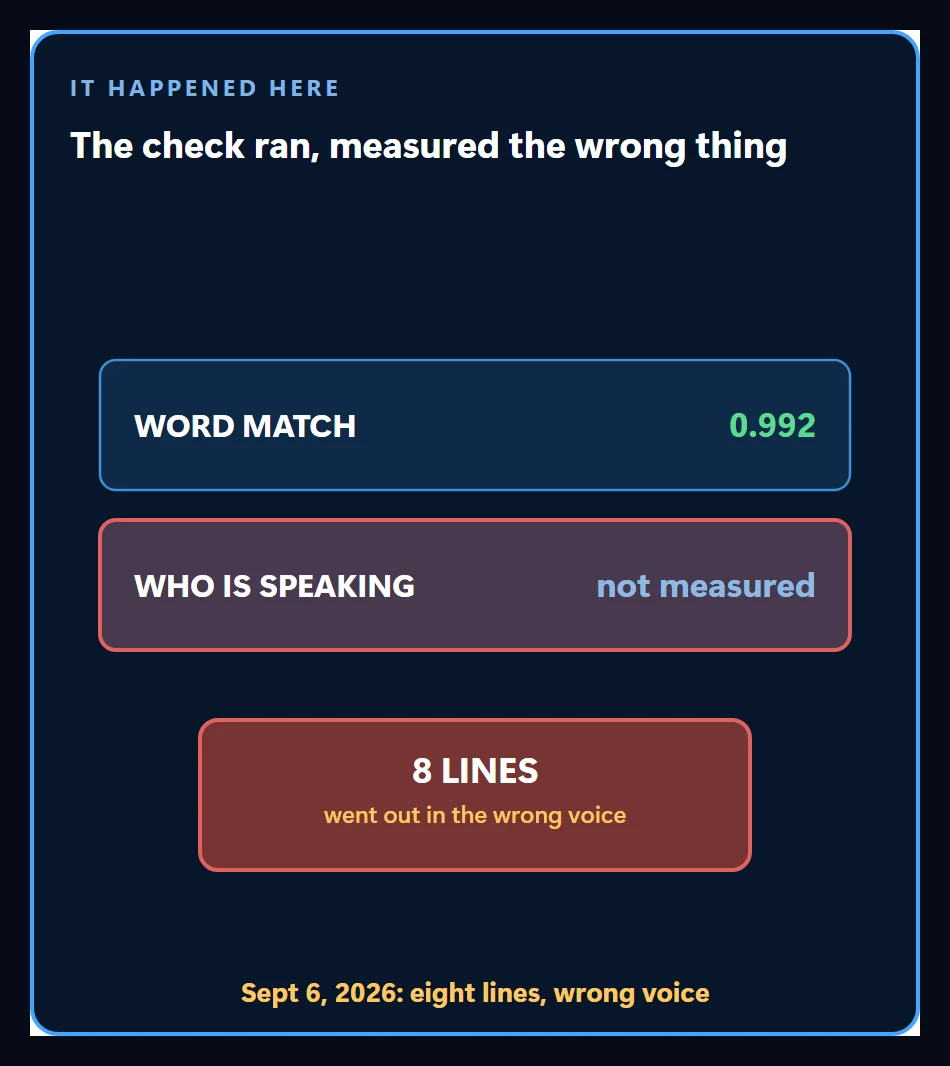 The measurement had worked; it had measured the wrong thing. **It was counting words, not who was speaking.** The text was right, the voice was wrong, and the comparison couldn’t see it. 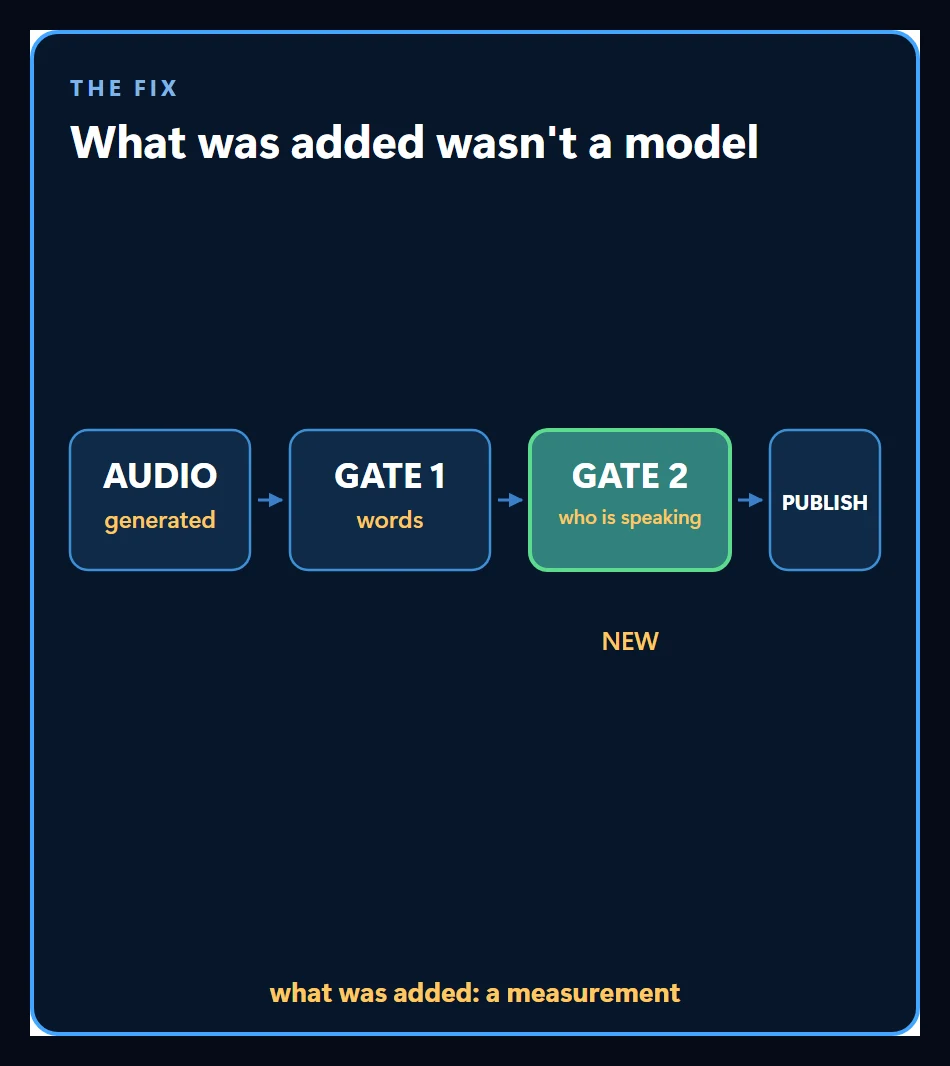 What I added that day wasn’t a new model — it was **a new measurement**: a separate gate that checks whose voice the audio belongs to. The problem was solved by a better measure, not a smarter model. ## Where the analogy breaks The exam analogy carries you only so far. In an exam the **teacher** writes the answer key; here, you write the key yourself. 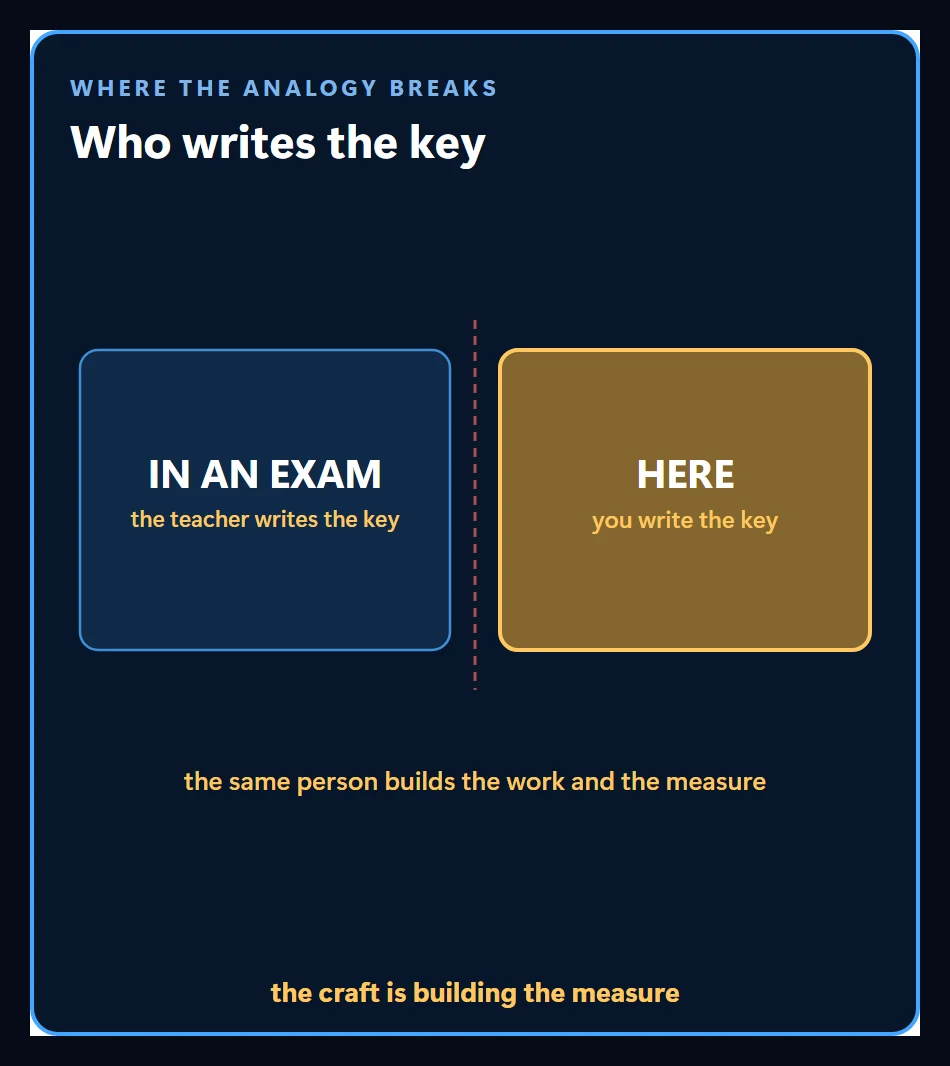 That’s why the real craft isn’t getting the work done — it’s **building the measure for it**. A system’s quality cannot exceed the quality of the measure you set for it. ## The ceiling is set by measurement, not the model 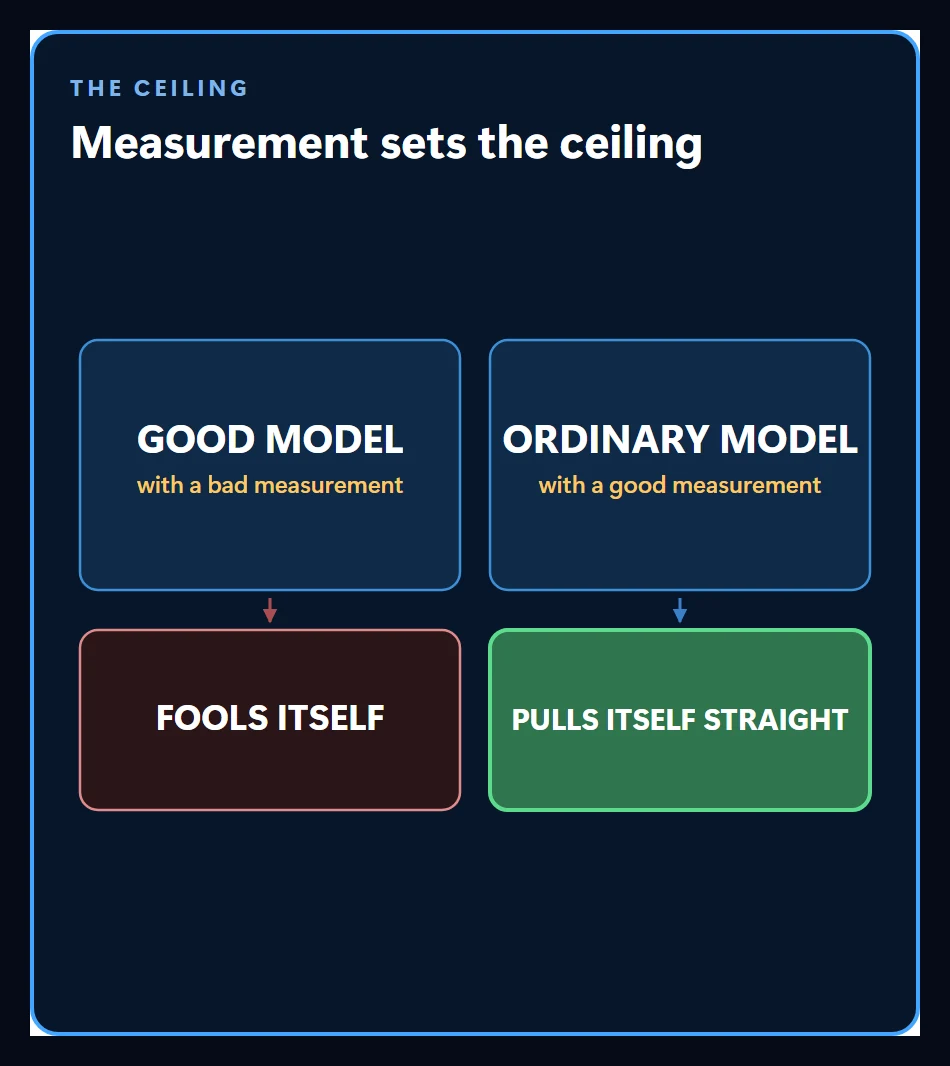 A good model will fool itself with a bad measurement. An ordinary model will pull itself together with a good one. Model choice matters, but **measurement sets the ceiling** — and this is the most commonly skipped point in agent design. ## Not every job has a key Here’s the hard part. Code has tests. Numbers have arithmetic. But “is this writing persuasive” has no answer key. 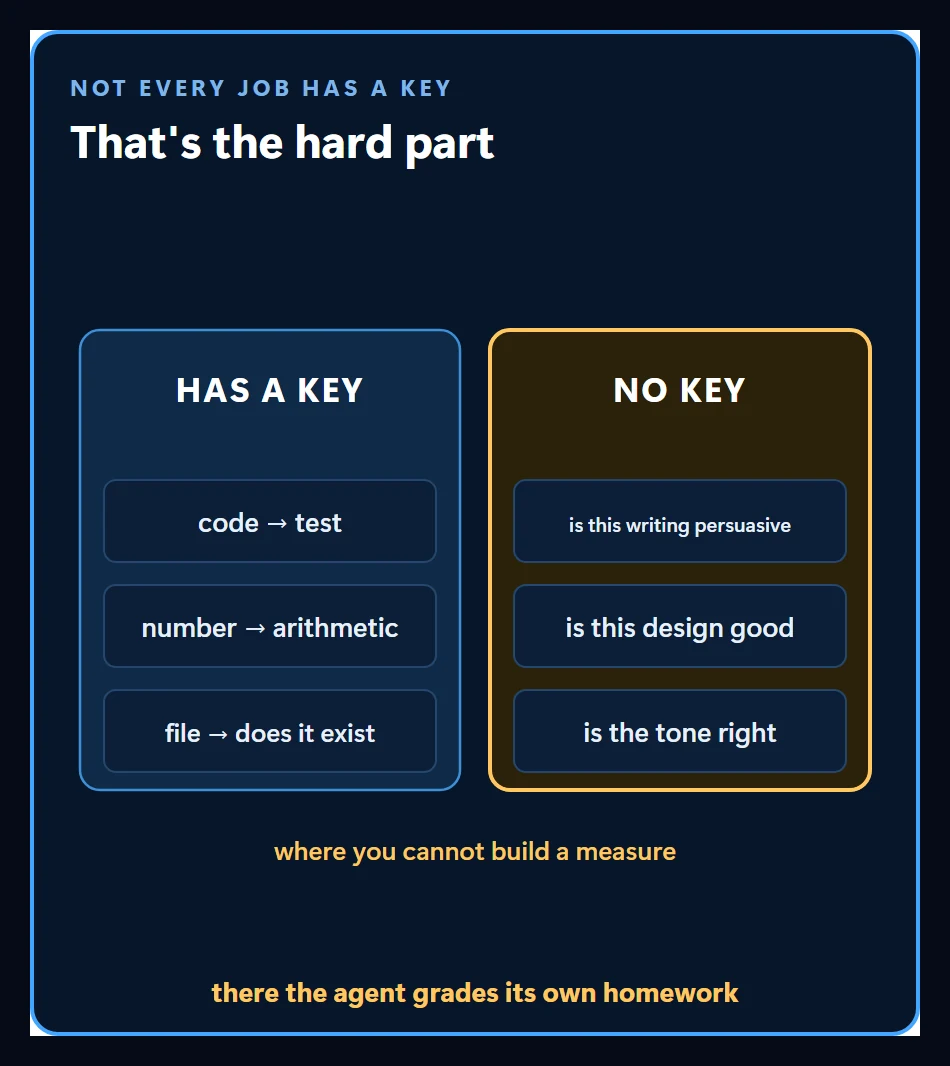 There, the agent grades its own homework — and you’re back at the problem this video opened with. In unmeasurable work, confidence doesn’t substitute for measurement; it only makes the risk invisible. ## The question to ask from now on 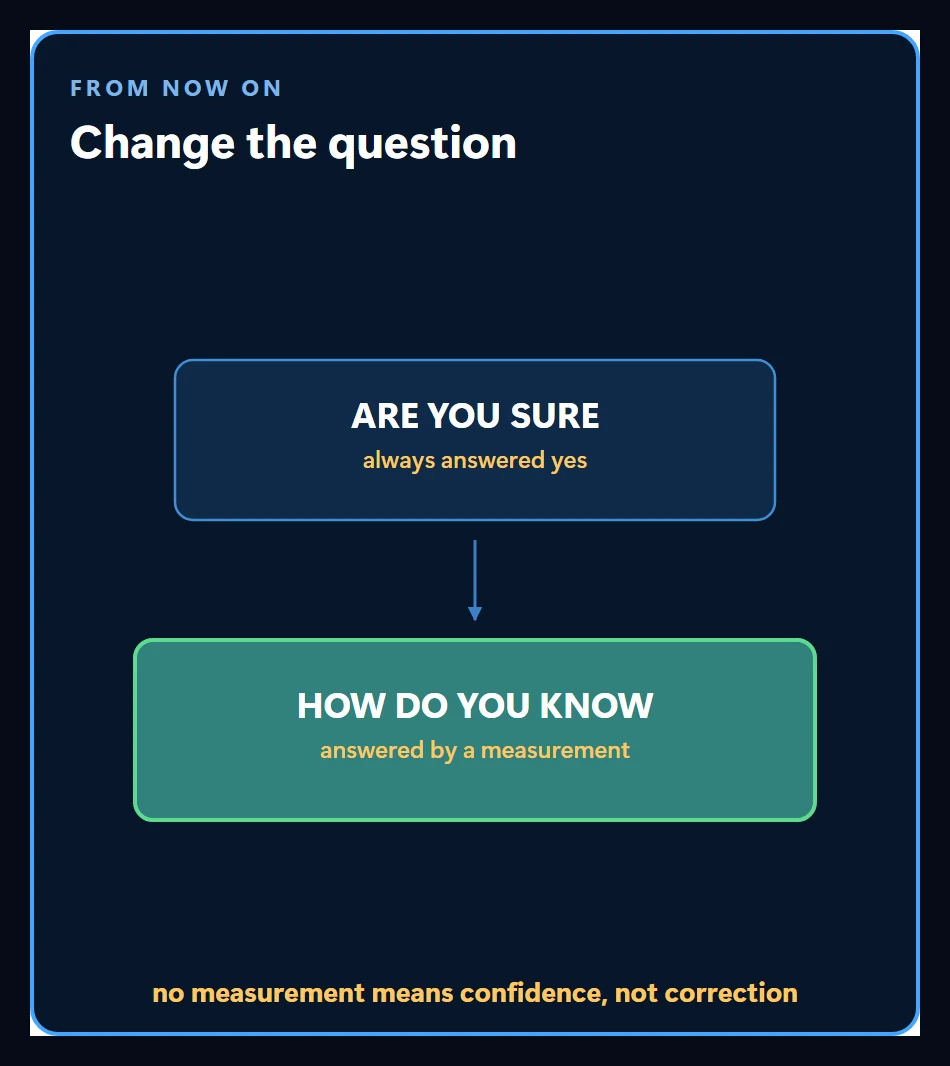 Don’t ask an AI “are you sure.” **Ask “how do you know.”** If the answer doesn’t rest on a measurement, there is no correction — only confidence. That single question separates a system that approves itself from one that is genuinely checked. 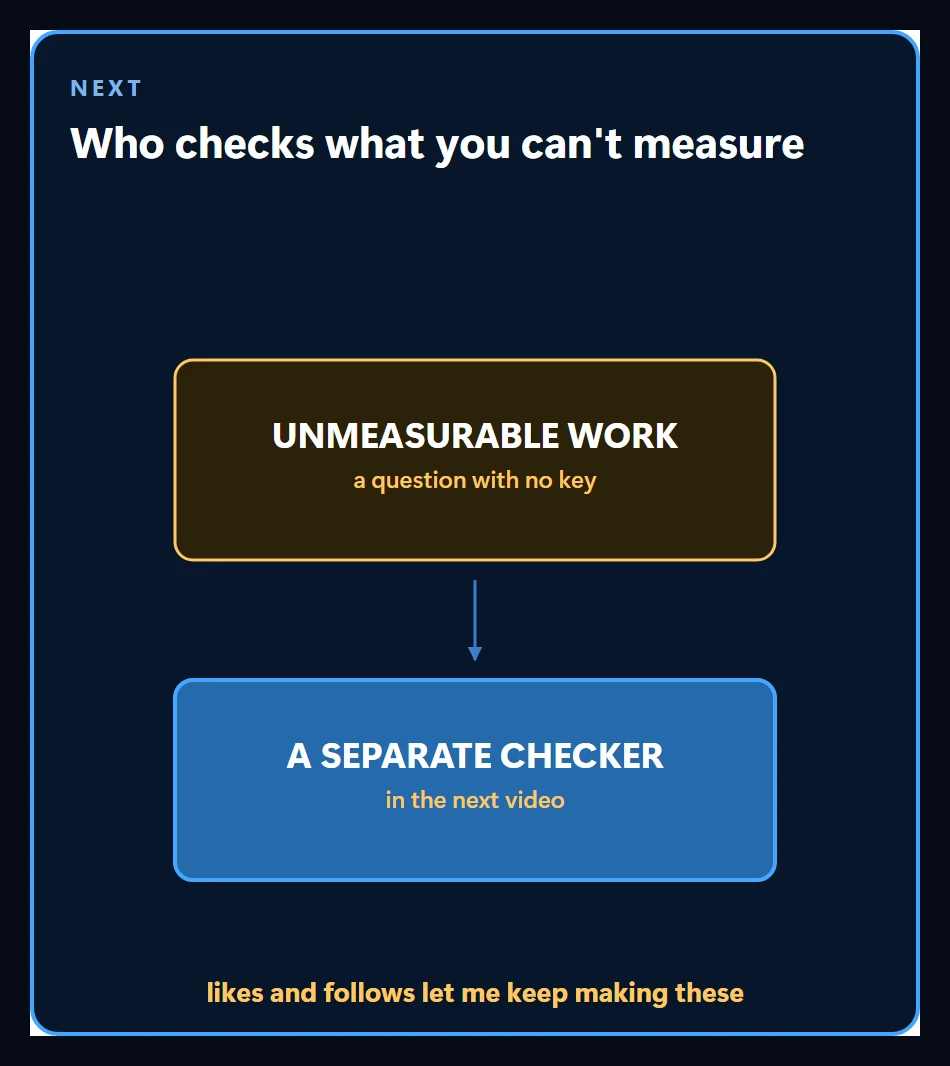 In the next video we’ll look at the harder question: **who checks the work you can’t measure?** ## Frequently Asked Questions ### Why does AI say “checked and fixed” while the mistake is still there? Because it reads its own paper. The problem isn’t carelessness but understanding: if it misread the question at the start, a second read repeats the same misreading and the blind spot stays put. ### If AI thinks longer, will it find the mistake? You can’t rely on it. With no answer key, thinking longer can produce a more convincing wrong answer rather than a more accurate one. ### What is the answer key in an AI system? A measurement from outside: a test turning red, a compiler objecting, a query coming back empty. None of them is the model’s opinion; all three are the world’s answer. ### What should I ask the AI instead? Instead of “are you sure,” ask “how do you know.” If the answer doesn’t rest on a measurement, there is no correction, only confidence. [Back to top ↑](https://oguzerol.com/en/agentic_ai_skills/can_ai_fix_its_own_mistakes/#icerik) ## Follow for content about AI - [YouTube@agentic_ai_skills(opens in a new tab)](https://www.youtube.com/@agentic_ai_skills) - [Instagram@agentic_ai_skills(opens in a new tab)](https://www.instagram.com/agentic_ai_skills/) - [Facebook@agentic.AI.skills(opens in a new tab)](https://www.facebook.com/agentic.AI.skills/) - [X@agenticAIskills(opens in a new tab)](https://x.com/agenticAIskills) - [TikTok@agentic_ai_skills(opens in a new tab)](https://www.tiktok.com/@agentic_ai_skills) - [WhatsApp+90 549 654 64 89(opens in a new tab)](https://wa.me/905496546489) ## More videos - [7 Google Antigravity Expert Rules: Skills, Learn, SSH & Automation19 November 20262:59](https://oguzerol.com/en/agentic_ai_skills/google_antigravity_7_expert_rules_skills_learn_ssh_automation/) - [7 Google Antigravity Orchestration Rules: Neon, Carbon & Swarm19 November 20262:59](https://oguzerol.com/en/agentic_ai_skills/google_antigravity_7_orchestration_rules_neon_carbon_swarm/) - [7 Essentials You Need to Know When Using Google Antigravity19 November 20262:48](https://oguzerol.com/en/agentic_ai_skills/google_antigravity_7_essentials_to_know/) - [Gemini Neon Is Here: Balanced Between Carbon and Hydrogen19 November 20261:54](https://oguzerol.com/en/agentic_ai_skills/gemini_neon_balanced_between_carbon_and_hydrogen/) - [Don't Hunt for Free AI: Pay for It and Use It12 November 20262:52](https://oguzerol.com/en/agentic_ai_skills/dont_hunt_for_free_ai_pay_for_it/) - [From Chat to Autonomous Agents: 7 Stages22 October 20262:48](https://oguzerol.com/en/agentic_ai_skills/from_chat_to_autonomous_agents_7_stages/) - [Expense Tracking with AI Automation: Google Sheets or Excel16 October 20262:23](https://oguzerol.com/en/agentic_ai_skills/ai_automation_expense_tracking_google_sheets_excel/) - [Motion Design with Just Claude Opus: 32 Experiments and Prompts10 October 20262:58](https://oguzerol.com/en/agentic_ai_skills/motion_design_with_just_claude_opus/) - [Can You Run AI Locally on a 16 GB Graphics Card?8 October 20262:39](https://oguzerol.com/en/agentic_ai_skills/can_you_run_ai_locally_on_a_16gb_graphics_card/) - [Customer Wrote at Night, Request Ready by Morning26 September 20262:51](https://oguzerol.com/en/agentic_ai_skills/customer_wrote_at_night_request_ready_by_morning/) - [Give AI the Address, Not the Route: Which Job Goes to Which Model26 September 20262:51](https://oguzerol.com/en/agentic_ai_skills/give_ai_the_address_not_the_route/) - [Stop Using Excel and Google Sheets as a Database: To a Web App22 September 20262:47](https://oguzerol.com/en/agentic_ai_skills/stop_using_excel_and_sheets_as_a_database/) - [ADHD Didn't Change. The Tools Did: A Scattered Brain and Agents22 September 20262:52](https://oguzerol.com/en/agentic_ai_skills/adhd_the_tools_caught_up/) - [OpenRouter and Hugging Face Aren't Models: Three Ways In18 September 20262:53](https://oguzerol.com/en/agentic_ai_skills/openrouter_hugging_face_three_ways/) - [How Do AI Agents Work? Same Model, Different Results13 September 20262:52](https://oguzerol.com/en/agentic_ai_skills/how_ai_agents_work/) - [AI Agents for AEC Firms: How the Five-Layer Setup Works6 September 20262:42](https://oguzerol.com/en/agentic_ai_skills/ai_agents_for_aec_firms/)